Explore a historic cantonment linked to India's freedom movement
Location Circuits
Location Interest
Location How Many Days
Location Content
Text Body
Standing on the muddy eastern bank of the Hooghly River, about 25 kilometres north of the roar and grandeur of Kolkata, the town of Barrackpore carries its history with a quiet, unhurried dignity that is easy to miss, and impossible to forget once encountered. This is a place where the bones of the British Empire lie half-buried in lush greenery, where sepoys once marched and fired the opening shot of India's first great uprising, and where Mahatma Gandhi sat in contemplation by the riverside. It is a town that has shaped nations, yet wears that legacy modestly.
Most visitors to West Bengal speed through Barrackpore on the way to somewhere else, or know it only as the birthplace of the 1857 Mutiny. But those who stop, who walk the shaded cantonment lanes, stand before the ancient banyan tree, and let the Hooghly's breeze cool them at sunset, discover one of the Kolkata region's most rewarding and underrated day-trip destinations.
Barrackpore is not Rajasthan; it will not dazzle you with jewelled palaces or sweeping desert vistas. What it offers instead is a layered, thoughtful experience: colonial-era churches and crumbling bungalows entwined in bougainvillea; riverside ghats where ashes of freedom fighters are enshrined; temples of exquisite beauty inaugurated by Ramakrishna himself; and the everyday Bengali life of chai stalls, phuchka vendors and fish markets going about their timeless rhythm. Come with a sense of history and a comfortable pair of shoes, and Barrackpore will reward you generously.
Ancient Roots & Pre-Colonial Identity
Long before the first British soldier set foot on its riverbanks, Barrackpore, then known by its older names Chanak and Barbakpur, was already a place of consequence. Greek geographers and navigators writing between the 1st century BC and the 3rd century AD placed this stretch of the Hooghly within the territory of the legendary Gangaridai kingdom, a realm so formidable that it allegedly caused Alexander the Great's army to refuse to march further east. By the 15th and 16th centuries, the river towns of this region had become important trading and marketing centres, bustling hubs of commerce and culture.
The British Arrival & the First Cantonment
The arrival of the British East India Company changed the character of Barrackpore irrevocably. In 1772, the Company constructed the first military cantonment in India here, a strategic choice, given the town's commanding position on the Hooghly, the great artery of Bengal's interior. The name “Barrackpore” itself is an Anglicisation of this military origin: from the word 'barracks', the quarters in which soldiers were housed.
The cantonment quickly grew in importance. Governor-Generals found the town a favoured retreat from the heat and press of Calcutta, and a magnificent Government House (later known as Raj Bhavan) was constructed, surrounded by sweeping grounds and gardens. The great names of British India passed through Barrackpore: Lord Hastings, Lord Canning, Lord Auckland, each leaving behind some physical remnant of their tenure. Today, the Jawaharkunja Park (also known as Barrackpore Park), carved from what were once the Government House gardens, preserves some of these relics: an aviary pond, a Minto Fountain and restored World War II Nissen huts that once housed American GIs.
Barrackpore's 1824 Uprising: A Forgotten Forerunner
Barrackpore's history of sepoy resistance predates the famous 1857 Mutiny by more than three decades and following the Vellore Mutiny of 1806, provides one of the most significant early examples of organised military defiance of British authority in Bengal. In 1824, Sepoy Binda Tiwary led a lesser-known but historically significant revolt at the cantonment, protesting the Company's demands that soldiers travel overseas, an act the Hindu sepoys believed would compromise their caste purity. The uprising was suppressed, but the seeds of discontent had been sown.
1857: The Shot That Shook an Empire
The name Mangal Pandey is inseparable from Barrackpore. On 29th March 1857, this 29-year-old sepoy of the 34th Bengal Native Infantry took up a position on the parade ground, opened fire on Lieutenant Baugh, and then attacked the arriving Sergeant-Major with his sword. Outraged by the greased cartridges, rumored to be coated with animal fat offensive to both Hindu and Muslim sepoys, his act of defiance sparked a widespread uprising across the subcontinent. This revolt is historically recognized as the Indian Rebellion of 1857, or the First War of Independence.
Pandey was court-martialled and hanged on 8th April 1857, with the execution carried out at Lal Bagan within the cantonment, near the parade ground. The precise site has become confused over the decades: a large banyan tree within the grounds now occupied by the Swami Vivekananda Police Academy is popularly, though controversially, associated with the hanging, a tradition historians have challenged.
Gandhi’s Barrackpore
Decades later, the town figured in a very different chapter of Indian history. Mahatma Gandhi visited Barrackpore multiple times between 1915 and 1947, using it as a base for meetings with freedom fighters and community leaders. He is said to have found the riverside particularly conducive to reflection. In 1942, the year of the Quit India Movement, Gandhi's presence in Barrackpore gave additional momentum to one of the final, decisive pushes for independence. Following his assassination in 1948, a portion of his ashes was enshrined in the riverside memorial now known as Gandhi Ghat, the town's most serene and contemplative spot.
After Independence
Following Partition and Independence in 1947, Barrackpore transitioned into a mixed industrial and residential suburb of greater Kolkata. The old cantonment remains in use by the Indian Army, lending the town a continued military character. Industry, particularly paper mills and manufacturing, settled along the river, and the population grew with waves of migration. Today, Barrackpore is a bustling municipality that has retained, against the odds, a remarkable quantity of its colonial and pre-colonial heritage.
Title
History and Culture
Is Background Visible
Off
Location Information Items
Location item element
Section Title
Top Sights and Experiences
Text Body
Getting There
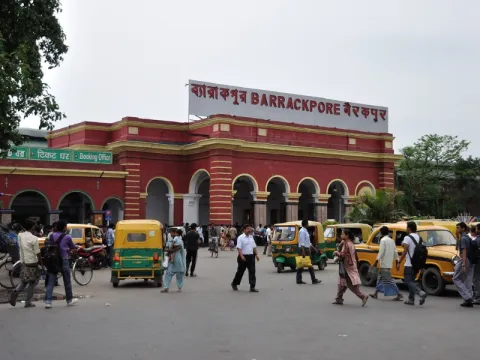
By Train: The easiest, most scenic way to reach Barrackpore from Kolkata is via suburban train from Sealdah Station (Sealdah-Naihati/Ranaghat line). Trains run frequently (every 15-30 minutes peak hours), taking about 45 minutes to an hour. The fare is very cheap. Barrackpore Station is modest; the main commercial area is walkable, or you can take a short auto-rickshaw to the riverside.
By Road: Barrackpore is about 25km north of central Kolkata via Barrackpore Trunk Road (BT Road). Taxi/app-cab (Ola/Uber) takes 45 minutes to 1.5 hours, depending on traffic (rush hour gridlock is common). WBSTC buses also run this route from Esplanade or Ultadanga.
By Air: The nearest airport is Netaji Subhas Chandra Bose International Airport (Kolkata), 17-20km away. A pre-paid taxi or app-cab to Barrackpore takes 30-60 minutes.
Getting Around
Within Barrackpore, the main modes of local transport are autos, cycle-rickshaws (for shorter distances) and on foot. The riverside heritage trail extends from the Annapurna Temple in Titagarh southwards past Gandhi Ghat, the Gandhi Museum and Mangal Pandey Park. In the cooler months, it makes for a pleasant and leisurely walk of around 3–4 kilometres. Wear good shoes, as pavements can be uneven. App-cabs (Ola and Uber) operate in Barrackpore and are the most convenient option for reaching outlying sights or for travel at night.
What to Eat
Barrackpore offers honest, local Bengali food, fish-forward, mustard-rich and seasonal. The dining scene mixes classic restaurants with vibrant street food around Sadar Bazaar and the railway station. Rice is the staple. Meals feature an order of dishes: bitter, dal, vegetables (like posto - poppy seed paste) and the crucial fish course. Hilsa (ilish), an oily monsoon fish, is the “queen” (e.g., bhapa ilish - steamed with mustard). Staples include Katla and Bhetki. Prawn classics are chingri malaikari (coconut milk) and daab chingri (steamed in coconut). For meat, kosha mangsho (slow-cooked mutton) is a favourite.
When to Go
October to February: The weather is cool and dry, with daytime temperatures around 25°C and nights around 10°C, making it excellent for outdoor activities like walking the cantonment, visiting temples and exploring the riverside. This period also features major festivals such as Durga Puja (October), Kali Puja (November) and Christmas (December).
March to May: This period sees a rapid rise in temperatures, ranging from 30°C to 38°C, along with increasing humidity. Early morning exploration is still possible and this time marks the beginning of the local mango season (April-May).
June to September: The monsoon season is characterised by heavy rainfall, especially in July and August, which causes the Hooghly River to swell significantly. However, this season is famous for the highly prized hilsa fish and the misty, lush landscape offers a unique, atmospheric beauty, with the riverside being particularly photogenic in the rain.
Title
Things to Know
Is Background Visible
Off
Location Images
Image
Location Banner Image
Image