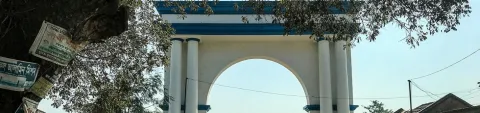
Visit the historic battlefield that changed India's colonial history
Location Category
Location Circuits
Location Interest
Location How Many Days
Location Group
Location Content
Text Body
On the morning of 23 June 1757, beneath a bruised monsoon sky on the east bank of the Bhagirathi River, the world changed. A modest field of mango groves and reed beds near the village of Palashi became the stage for one of history's most consequential and most treacherous battles. Robert Clive's East India Company force of barely 3,000 men faced Nawab Siraj-ud-Daulah's army of 50,000. By dusk, British hegemony over Bengal had been secured and the two-century arc of the British Raj had quietly, catastrophically begun. Today Palashi is an unassuming village of around 20,000 souls on National Highway 34. Its monuments are modest, its streets unremarkable and yet standing in its quiet fields, it is impossible not to feel the terrible weight of what happened here.
History
The battle that took place at Palashi was not, in the strictest sense, a fair fight and that is precisely what makes it so historically instructive. By 1757, Bengal was the wealthiest province of a declining Mughal empire, a powerhouse of textile production whose international commerce drew European trading companies like moths to a lamp. The British East India Company, the Dutch, the French and the Danes all maintained "factories" (trading posts) along the Bhagirathi and Hooghly rivers. The Company had grown ambitious and heavily armed.
The young Nawab Siraj-ud-Daulah, just 23 years old when he inherited the throne of Bengal from his grandfather Alivardi Khan in 1756, saw the threat clearly. He ordered the British to cease their fortification of Fort William in Calcutta. They refused. He marched on the city and seized it, confining 146 British prisoners in a small dungeon in what became notorious as the “Black Hole of Calcutta.” The British, outraged, sent reinforcements from Madras under Lieutenant-Colonel Robert Clive and Admiral Charles Watson.
Clive retook Calcutta in January 1757 and struck a peace treaty, but simultaneously set about engineering the Nawab's downfall. In a plot orchestrated with the immensely wealthy Jagat Seth banking dynasty of Murshidabad, who feared that prolonged conflict would disrupt the lucrative European trade on which they depended, Clive bribed Mir Jafar, the Nawab's own commander-in-chief, with the promise of the Nawab's throne. On the morning of battle, Mir Jafar stood with his third of the Bengali army and did nothing, and Siraj-ud-Daulah was undone.
The actual fighting on 23 June lasted only a matter of hours. Siraj's opening cannonade fell short. A sudden monsoon downpour ruined the Bengali army's gunpowder stores while the British had wisely covered theirs with tarpaulins. When Bakshi Mir Madan, the Nawab's most loyal artillery chief, launched a brave cavalry charge at around 2pm, he was cut down along with his officers Bahadur Ali Khan and Nauwe Singh Hazari. It was the battle's turning point. By evening, the Bengali army had collapsed. Siraj fled north toward Murshidabad and was killed days later, not by a British soldier, but by Miran, Mir Jafar's own son.
Clive reported losing just 18 men, while estimating the Nawab's casualties at around 500. In return for his victory, Clive received over £234,000 in a lump sum and annual payments of £30,000, roughly equivalent to over $50 million in today's terms. Mir Jafar became a puppet nawab. Bengal became the financial engine of British colonial expansion across the subcontinent.
Historical Perspective
Coming to Palashi with some historical awareness is important, because the site itself offers relatively little interpretive infrastructure. There is no museum, no visitor centre, no guided audio tour. When you arrive, you look at stones and fields and you must supply the context yourself, which is why doing your reading before you go is genuinely recommended.
The Battle of Plassey was, militarily, almost a non-event. By the scale of contemporary European battles (the bloodbaths of Blenheim, Minden, or Fontenoy), it was barely a skirmish. What made it world-historical was not the fighting but the conspiracy that preceded it and the political consequences that followed. For Indian visitors, and particularly Bengalis, this site carries a depth of feeling that can be difficult to articulate to outsiders. The defeat of Siraj-ud-Daulah is remembered not simply as a military loss but as a civilisational wound: the moment Bengal, then arguably the most prosperous region on earth, began two centuries of deliberate extraction and underdevelopment. The golden statue of Siraj, erected in 2007, was a small but significant act of cultural reclamation. Many visitors leave flowers.
For British or Commonwealth visitors, the reflections on offer here are more uncomfortable. Clive was celebrated as a national hero for more than a century after Plassey, and his statue was placed on Whitehall in London. He died in 1774, almost certainly by suicide, amid parliamentary investigations into his private plunder of Bengal. The enormous personal fortune he extracted from Bengal sits uneasily on the historical ledger. The province would, within little more than a decade, suffer the catastrophic Bengal Famine of 1770, in which an estimated 10 million people died. Standing at the Palashi obelisk, it is worth knowing all of this.
Recommended Reading Before You Visit
- Plassey: The Battle That Changed the Course of Indian History, Sudeep Chakravarti
- The Anarchy: The East India Company, Corporate Violence, and the Pillage of an Empire, William Dalrymple
- Clive: The Life and Death of a British Emperor, Robert Harvey
- Seir Mutaqharin (A View of Modern Times), Ghulam Husain Khan (contemporary Bengali account, 1781)
The Name: Palashi/Plassey
The village's name derives from the Bengali word palash, the flame-of-the-forest tree (Butea monosperma), whose brilliant scarlet flowers flood the Bengali countryside each spring. The British anglicised this to “Plassey,” the name by which the battle is known in most Western sources. You may still see the trees in surrounding villages, their orange-red blooms vivid against the pre-monsoon sky, a striking reminder of the landscape that greeted the armies in June 1757. The name "Plassey" spread far beyond Bengal: Robert Clive was made Baron Clive of Plassey and an estate in County Clare, Ireland, was renamed in his honour. Even today, the president's office at the University of Limerick is known as Plassey House.
The battlefield today is an open, largely flat landscape of fields, mango orchards and reed beds straddling National Highway 34 on the east bank of the Bhagirathi. Parts of the original site have been swallowed by the modern village and sections of the old battlefield have been washed away or altered as the Bhagirathi River slowly shifted its course over the centuries. What remains, however, is evocative and worth visiting with care.
Title
History and Culture
Is Background Visible
Off
Location Information Items
Section Title
Top Sights and Experiences
Text Body
Getting There
By Train: Plassey Railway Station (code: PLY) sits on the Sealdah-Ranaghat-Lalgola branch line of Eastern Railway. Approximately 26 passenger trains stop daily. From Kolkata's Sealdah station, the journey takes roughly 3-4 hours. The station has three platforms and sits about 7km from the main monument complex. Arrange an auto-rickshaw or toto (electric three-wheeler) from the station forecourt. Check the Indian Railways (IRCTC) website for current timetables.
By Road: National Highway 34 passes directly through Palashi, running from Dum Dum (Kolkata) northward through Barrackpore, Krishnanagar and onward to Dalkhola. The drive from Kolkata takes approximately 3-4 hours depending on traffic. Private taxis or hired cars from Kolkata or Krishnanagar are the most comfortable option. State bus services (SBSTC/WBSTC) operate on NH-34 and stop in Palashi, though they can be slow. From Krishnanagar (well-connected to Kolkata by fast trains), Palashi is a roughly 45-60 minute drive. Shared autos and local buses ply this route, or hire a private auto for the day to visit Palashi and return. This is a cost-effective option for those already planning to visit Krishnanagar.
By Air: Netaji Subhas Chandra Bose International Airport, Kolkata, is the nearest major airport (approximately 160-170km south). From the airport, the most practical approach is to travel into Kolkata, rest overnight, and take an early morning train to Plassey the following day.
Getting Around
Plassey Railway Station is located in the Mirabazar-Kaliaganj area of Nadia district, around 7km from the Palashi Monument near Panighata on the Bhagirathi bank. On exiting the station, you will find auto-rickshaws and toto (electric auto) drivers who know the monument well. Agree on a price before boarding. A round-trip (station → monument → Faridpur tomb → back to station) should be negotiable for a modest fare. There is no metered service here.
What to Eat
Krishnanagar or Baharampur have excellent sweet shops (mishti) selling Bengal's famous sandesh, rasogolla and pantua. Krishnanagar’s sarpuria (a sweet made from cream and sugar) is considered among the district's finest. Pick up provisions before heading to the battlefield.
Best Time to Visit
October to February: This is definitively the best time to visit. These post-monsoon months offer cool temperatures (12°C to 28°C), clear skies and a golden landscape enhanced by migratory birds and the atmospheric rhythms of late-October's Durga Puja.
March to April: These months are visually arresting as the namesake palash trees bloom in fiery red and orange. However, temperatures climb rapidly and by April, the severe heat makes early morning visits essential.
June to September: This is the season of monsoon. Visiting on the battle's June 23rd anniversary is historically poignant (after all, a sudden downpour famously ruined the Nawab's gunpowder, deciding the conflict) but requires braving intense humidity, driving rain and muddy, potentially flooded grounds.
Title
Things to Know
Is Background Visible
Off
Location Images
Image
Location Banner Image
Image