The steel heart of industrial Bengal
Location Circuits
Location Interest
Location How Many Days
Location Group
Location Content
Text Body
Few Indian cities carry the weight of national ambition as visibly as Durgapur. Conceived in the late 1940s by Prime Minister Jawaharlal Nehru and West Bengal Chief Minister Bidhan Chandra Roy as a showcase of post-independence industrial might and meticulously planned by American architects Joseph Allen Stein and Benjamin Polk in 1955, Durgapur rose from forested riverbanks and coalfield fringes to become what Nehru proudly called a ‘temple of modern India’. Today it stands as the ‘Steel Backbone of Industrial Bengal’, the third-largest city in West Bengal by area, yet beneath its industrial carapace beats a surprisingly gentle heart shaped by the Damodar River and the extraordinary barrage that tamed it.
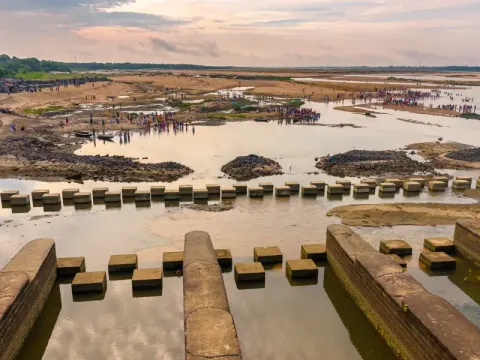
The Durgapur Barrage, that 692-metre ribbon of concrete and steel arching across the Damodar, is both the city's founding act and its greatest natural attraction. Built in 1955 by the Damodar Valley Corporation (DVC), India's first multipurpose river valley project, modelled on the Tennessee Valley Authority, controls floodwaters that once devastated Bengal's plains and has a gross command area of 569,000 hectares across Burdwan, Bankura and Hooghly districts, with an irrigation potential of 364,000 hectares actually created. Come here at the height of monsoon when the 34 lock-gates are thrown open and a wall of water thunders through and you will understand why Durgapur calls itself a city that tamed a river.
Yet Durgapur is far more than an engineering monument. Its wide, tree-lined boulevards betray its planned origins; its red-brick DSP Township echoes British-era garden-city ideals; and its parks, temples, riverside ghats and raucous street-food lanes reveal a city that has grown comfortably into itself. It sits at a fascinating cultural crossroad where Bengali tradition mingles with waves of migrants from Bihar, Jharkhand, Odisha and Rajasthan who arrived to build and run the steel plant, creating a cosmopolitan texture rare in a city of this size. For the traveller willing to look beneath the smokestacks, Durgapur offers history, nature, flavour and the rare pleasure of watching an Indian city be quietly, stubbornly itself.
History
Stone hunting implements excavated in the area attest to human habitation around 5,000 BCE. The Damodar–Ajay river valley fostered settled life during the Harappa-Mohenjo Daro era and the region later passed through the hands of the Maurya, Gupta and other later medieval dynasties. By the 18th century, the forested ravines flanking the Damodar had become the territory of legendary dacoit Bhabani Pathak, whose exploits Bankim Chandra Chattopadhyay fictionalised in his novel Devi Chaudhurani.
Modern Durgapur is fundamentally a creature of India’s Second Five-Year Plan (1956–1961). In the wake of independence and partition, India's planners urgently needed to expand steel output and Durgapur, already earmarked as the DVC's barrage site, close to the Raniganj coalfields and on the main Kolkata–Delhi railway, was chosen for a massive integrated steel plant built with British technical collaboration. The Durgapur Steel Plant (DSP) began crude steel production in 1959 at one million tonnes per annum and is today operated by the Steel Authority of India Limited (SAIL). Alongside it grew a township of extraordinary ambition: wide arterial roads up to 50 metres across, grid-planned residential sectors, company clubs with swimming pools, a cineplex, parks with musical fountains and technical colleges including the prestigious National Institute of Technology (NIT) Durgapur. The British- and Soviet-era design signatures are visible in different quarters of the city to this day.
In the decades since, Durgapur has diversified beyond steel into IT, education and services, and its population now exceeds 600,000.
The Barrage Area
The area around the Durgapur Barrage is the city's spiritual and scenic heart and the single most rewarding destination for any visitor. Set aside at least a half-day; ideally arrive in the early morning and stay for the evening arati.
Title
History and Culture
Is Background Visible
Off
Location Information Items
Section Title
Top Sights and Experiences
Text Body
Getting There
By Air: The closest airport is Kazi Nazrul Islam Airport (RDP) in Andal, 25km away, with limited domestic flights (Kolkata, Delhi, etc.). Check the current schedule. The main international hub is Netaji Subhash Chandra Bose International Airport (CCU) in Kolkata, 165–175km away (3–4 hours by road). The Durgapur Expressway (NH 19) by taxi or pre-booked car is the most comfortable option from Kolkata airport.
By Train: Durgapur Railway Station is on the heavily trafficked Howrah–Delhi Grand Chord Line, served by many express and superfast trains daily. Journey times: Howrah (Kolkata) 2–3 hours, Asansol 30 minutes, Bardhaman 45 minutes. Book in advance for peak season (Oct–Mar) and weekends.
By Road: Durgapur is 165km from Kolkata via NH 19 (Durgapur Expressway), a comfortable toll road (2.5–3 hours by private car/taxi). Regular AC coach services (SBSTC, WBTC, private) depart Kolkata (Esplanade/Karunamoyee) for City Centre, Durgapur (approx. 3–3.5 hours). Buses also connect to Bardhaman, Bankura, Asansol, Purulia, Jharkhand and Bihar.
Getting Around
Auto-Rickshaws & Toto (E-Rickshaws): Auto-rickshaws are Durgapur's primary local transport; agree on fares as meters are rarely used. Cheap, slow and charming electric Toto rickshaws are also widespread. Both are readily available near the station, markets and City Centre.
Minibuses: SBSTC and private minibuses run between the railway station and Prantika in Benachity. While cheap, they are crowded and follow indirect routes; autos/taxis are better for visitors.
Taxis & App-Based Cabs: Ola and Rapido offer the most convenient point-to-point travel, especially for long distances or airport trips. Local taxis can be hired near major hotels.
Walking: Walking is pleasant in the wide, tree-lined planned zone (City Centre, Bidhannagar and the barrage area, 8km from the station). Take an auto/toto to the barrage and explore the bank on foot.
What to Eat
Durgapur's food reflects its cosmopolitan nature: primarily Bengali, blended with North Indian, Mughlai, South Indian and local “Chinese”. It offers genuinely good, inexpensive dining if you know where to look.
Bengali Classics: Shorshe ilish (mustard Hilsa, seasonal), macher jhol (light fish curry), shorshe chingri (mustard prawns), mishti doi (sweet yoghurt), roshogolla and sondesh.
Dry Curries: Chicken/Mutton kasha (slow-cooked, spiced, excellent with rice/luchi).
Street Food: Phuchka (spiced water balls), kathi roll (paratha wrap, Kolkata original), jhalmuri (spiced puffed rice), ghugni (spiced white-pea curry).
Other: Biryani (Amin is top choice), Indian-Chinese fusion (chilli chicken, etc., fiercely local).
Best Time to Visit
October to March: This is the sweet spot, most recommended time to visit. November and December offer the most pleasant temperatures (25°C days, 12–15°C nights) and the best air quality.
June to September: The monsoon offers a strikingly beautiful experience at the barrage, which is worthwhile if you can tolerate the heat and humidity, though it may cause travel disruptions.
April to May: Summers are genuinely brutal and best avoided unless you have a specific reason to visit.
Title
Things to Know
Is Background Visible
Off
Location Images
Image
Location Banner Image
Image