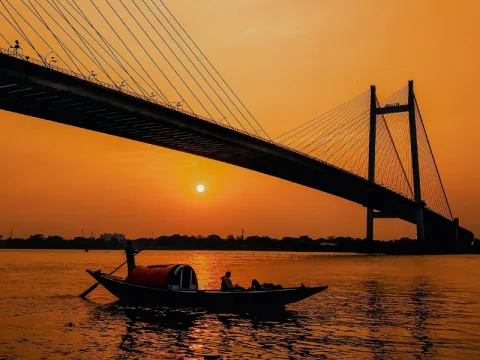
Every great river city has a complicated relationship with its water. London turned its back on the Thames for a century before rediscovering it; Paris kept the Seine at a cultivated aesthetic distance. Kolkata does neither. The Hooghly, the westernmost distributary of the Ganges, is not an amenity the city has chosen to incorporate: it is the condition of Kolkata’s existence.
The city was founded on the Hooghly's eastern bank because the river was the route: for trade, for conquest, for the movement of goods between the Bengal interior and the open sea. Everything Kolkata became (colonial capital, industrial powerhouse, cultural metropolis) followed from that position on the water. The river’s logic is still legible in the city’s infrastructure: the bridges knitting the two banks together, the ghats where a river-worshipping culture performs its daily rituals, the ferries that have moved people and goods to Howrah since before the first bridge existed.
This guide treats the Hooghly as a subject in its own right: a linear landscape stretching roughly fifteen kilometres from Bagbazar Ghat in the north to Prinsep Ghat and beyond in the south. On the Kolkata bank: the ghats, the flower market, Howrah Bridge, the colonial-era strand once the promenade of empire. On the Howrah bank: the Botanic Garden and its Great Banyan, and the railway station that has processed more human movement than almost any structure on earth.
The Two Routes
The riverfront cannot be walked as one route. This guide splits it into a Northern Route and a Southern Route, each a self-contained half- or full-day. Read both before choosing.
The Northern Route
Centred on: Howrah Bridge, Mullick Ghat Flower Market, Howrah Station, Ahiritola Ghat, Nimtala Ghat, Bagbazar Ghat, Kumartuli
Best pacing: Pre-dawn (4:30am) through mid-morning, or a separate evening visit for the bridge illumination
Transport: Walk the bridge from the Kolkata side; return by ferry from Howrah Station to Chandpal Ghat (from c. 7:45am) or Metro from Howrah to Esplanade (~10 min, from c. 7am; not until 2:15pm on Sundays). Before 7am neither runs: walk back.
Total time: 5-6 hours
Within roughly three kilometres, the northern riverfront concentrates the flower market, the bridge, the railway station and some of the river’s most historically significant ghats, and correspondingly the most intense human movement in the cluster.
Arrive at Ahiritola or Nimtala Ghat by 4:30am: quieter, less photographed, more representative of the river’s working-class devotional life. The Nimtala cremation ghat sits immediately adjacent, and the proximity of funeral fires to dawn bathing produces one of the Hooghly’s most concentrated atmospheric effects: birth, death and daily renewal side by side, exactly as Hindu understanding of the sacred river intends.
Walk south along Strand Bank Road as the city wakes, through Kumartuli, the idol-makers’ quarter, where the goddesses due for immersion in October stand unpainted in their workshops. By 5:30-6am you’ll reach Mullick Ghat Flower Market, already in full swing since 2am.
At Howrah Bridge, walk the full crossing (pedestrian lanes on both outer edges), about 20-25 minutes, with the midpoint view of both banks receding into morning haze the best reason to cross on foot. Descend to Howrah Station from the western end, then take the ferry from the station ghat to Chandpal, giving you the bridge from both banks and from the water, three distinct relationships with the same structure.
The Southern Route
Centred on: Prinsep Ghat, Babu Ghat, Outram Ghat, Armenian Ghat, Vidyasagar Setu viewpoint, Acharya Jagadish Chandra Bose Indian Botanic Garden
Best pacing: Dawn at the central ghats; mid-morning ferry to the Botanic Garden; afternoon there
Transport: Walk the central ghats south from Armenian to Prinsep Ghat at dawn; back-track to Chandpal or Babughat for the Botanic Garden ferry; return by ferry in late afternoon
Total time: 7-8 hours
The southern half is more contemplative (wider river views, less industrial intensity) with the Botanic Garden waiting across the water. The central ghats (Babu, Outram, Armenian) are the best-maintained on the Kolkata bank. Prinsep Ghat, at the southern end, is the most beautiful in formal design and most atmospheric at dusk, though also the most popular with evening visitors.
Begin at Armenian Ghat at dawn. Walk south past Fairlie Place and Chandpal Ghats to Babu Ghat, then Outram to Prinsep, roughly 2.5km of the stretch landscaped and reopened in May 2012, the easiest continuous walking on the bank, taking 45 minutes to an hour at a slow pace (longer if you stop at each ghat, which you should).
From Prinsep, head back to Chandpal or Babughat for the ferry across to the Botanical Garden jetty (services also reach neighbouring Shibpur and Ramkrishnapur ghats). The crossing is wider and slower than at Howrah Bridge and the approach (the garden’s great trees visible from the water) is the most dramatic arrival the garden offers. It’s closed Mondays; the ticket counter shuts around 4pm. Return by ferry in late afternoon for the best Prinsep Ghat light at dusk; the enclosure closes around 8pm.