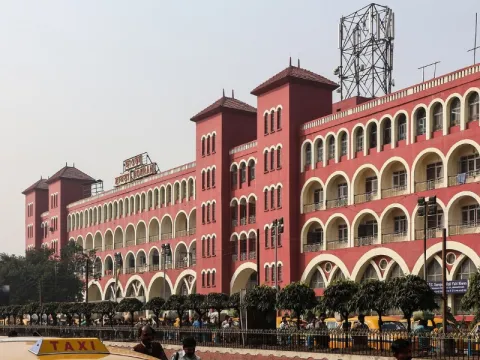
Among the busiest railway stations in the world by footfall: roughly one million people daily through a single structure. Built in stages from 1854; the current terminal block dates from 1901-06, designed by British architect Halsey Ricardo in an Indo-Saracenic style adapting Mughal and Rajput forms to a Victorian railway programme: arched galleries, turreted pavilions, a central clock tower, red brick with white stone dressing.
The main hall is always full with every cross-section of Indian life: families, porters, soldiers, students, pilgrims and those who have simply come because the station is where you go when there’s nowhere else. Howrah has 23 platforms, the most in India; the view from the station’s elevated footbridge across the full spread is one of the most impressive operational railway vistas anywhere (ask at ticket inquiry for access). The red-jacketed licensed porters negotiate posted per-piece rates: agree the rate before accepting help and count your bags.
Since 2024 the station has a second mouth: the Green Line Metro terminus beneath Howrah Maidan, at 33 metres India’s deepest station, passing under the same river it took the 1943 bridge builders four years of caisson-sinking to cross: two engineering answers to the same problem, four hundred metres apart.
Article Content
Text Body
Is Background Visible
Off
Published on
Article Image
Image
Updated On
Read Time
1
Article Type
Location
Article Videos
Is Background Visible
Off
Upload Video
Content Family
General Purpose
Image Gallery
Upload Images
Is Background Visible
Off
Images View Mode
Simple
Video Gallery
Is Background Visible
Off
Upload Video
gallery view mode
horizontal
action if location
default
Comments