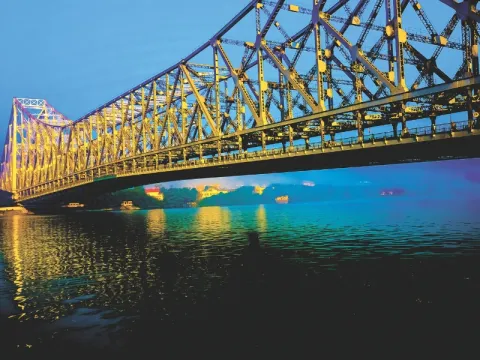
Officially named for Tagore in 1965 but universally known by function. Completed in 1942 and opened 3 February 1943, replacing a pontoon bridge from 1874, it was at completion the third-largest cantilever bridge in the world (now sixth-longest of its type): a suspension-type balanced cantilever with a 457.2-metre main span and 705-metre total length, carrying a 21.6-metre carriageway and two 4.6-metre footpaths on two 82-metre towers, entirely riveted with no bolts or nuts. Designed by Rendel, Palmer and Tritton, built by Braithwaite, Burn & Jessop. Of its 26,500 tonnes of steel, only around 3,000 came from England: the rest was Tata’s Tiscrom, making the most recognisable object in colonial Calcutta, by weight, overwhelmingly Indian.
Trams ran across it for fifty years until 1993, when combined traffic and pedestrian load became too much. Today it carries an estimated 100,000 vehicles and 150,000 pedestrians daily; walking the footpath at rush hour is intensely physical but entirely safe, its density managed by decades of habitual use. The best structural view is from a ferry at river level: position yourself at the bow on the Chandpal-Howrah crossing, which passes directly beneath. At night the steel cycles are amber, white and blue, best seen from Millennium Park or the Howrah Station waterfront.
Photography from the bridge is technically restricted as a “defence structure,” a WWII-era classification; enforcement in practice is intermittent and focused on professional shoots rather than casual visitors. Use judgment and never photograph security personnel or installations.
Comments