A tranquil Himalayan sanctuary known for salamanders and birdlife
Location Circuits
Location Interest
Location How Many Days
Location Group
Location Content
Text Body
Jore Pokhri Wildlife Sanctuary, a small 4-hectare area of mist-covered highlands nestled in the Darjeeling hills of West Bengal, holds a unique distinction. It is one of the very few locations on Earth where a creature, once thought to be completely extinct, still thrives. Its rediscovery of the living Himalayan Salamander in 1964 put this quiet hilltop hamlet on the scientific map. Yet despite its ecological fame, the sanctuary remains resolutely off the beaten track, overshadowed by the tea gardens and mountain vistas that attract thousands to Darjeeling each year. That obscurity is precisely its charm. Here, visitors can wander along forested trails in near-solitude, watch mist curl off the surface of twin lakes and if they're patient and lucky, catch a glimpse of the rough-skinned, prehistoric-looking Himalayan Newt creeping along the water's edge. Surrounding the sanctuary, rhododendrons bloom in spring, pine and oak canopies shelter warblers and bulbuls and on clear days the white ridgeline of Kangchenjunga floats above the horizon like a mirage.
Jore Pokhri is a sanctuary in both senses of the word: a legally protected ecological refuge and a place of profound quiet where the chaos of the plains feels very, very far away.
The Salamander That Came Back from the Dead
The story of Jore Pokhri Wildlife Sanctuary is, at its heart, the story of one remarkable amphibian. The Himalayan newt (Tylototriton himalayanus), known locally as ‘Gora’ in Nepali and sometimes called the crocodile newt for its knobbly, prehistoric appearance, is an ancient-lineage amphibian found only in the eastern Himalayan region. For decades in the 20th century the species was believed to have vanished entirely from the Indian Himalaya, yet in 1964, herpetologists confirmed a thriving population at the high-altitude lakes of Jore Pokhri. This was the first confirmed record of the amphibian in the Darjeeling hills in the modern scientific era.
The government of West Bengal responded by formally designating the area a Wildlife Sanctuary in 1985, making the protection of this tiny high-altitude wetland and its rare inhabitants a matter of law. The sanctuary is managed by the West Bengal Forest Department and is located within the Eastern Himalayan biodiversity hotspot. This region is internationally recognized as a highly diverse but significantly threatened ecological zone globally.
Cultural Roots
Long before scientists arrived, Jore Pokhri was revered by local Lepcha and Nepali communities as a sacred site. Local pilgrims consider the ‘Jore Pokhri,’ the twin lakes that give the sanctuary its name (Jore means two and Pokhri means lake in Nepali), to be holy. The site features a prominent Shiva temple and several smaller shrines. This convergence of ecological importance and cultural reverence has created an unusual dynamic: the sanctuary is simultaneously a place of scientific study, a wildlife refuge and a pilgrimage destination.
Geography & Landscape
Jore Pokhri sits at about 7,400 feet (roughly 2,250 metres) above sea level in the Dalkajhar Forest area, positioned in the upper Darjeeling hills near the India-Nepal border. The sanctuary is centred around its twin lakes, which form the ecological heart of the site. These bodies of water are fed by Himalayan streams and snowmelt, maintaining a cool, moist microhabitat year-round. The terrain is characterised by rolling forested slopes, steep enough to create the impression of enclosure, yet open enough to permit sweeping views of the surrounding hills and, on clear days, the distant Kangchenjunga massif.
Despite its tiny protected area of just 4 hectares, the sanctuary functions ecologically as part of a much wider landscape that includes the Singalila National Park to the west, which runs along the ridge separating West Bengal from Nepal, and the tea estates and forest blocks that cascade down the Darjeeling hillsides. This connectivity is crucial: the Himalayan Newt's populations at Jore Pokhri are understood to be part of a regional network that also congregates around Sukhia Pokhri and other high-altitude lakes within 20km of the sanctuary boundary.
The forest cover within and immediately around the sanctuary is a mixture of naturally occurring oak, rhododendron and silver fir, supplemented by artificial afforestation with conifers such as pine. This planted element gives the landscape a slightly arranged quality in places, contrasting with the wilder, more chaotic beauty of the surrounding Himalayan hillsides.
Wildlife
The Star: Himalayan Newt (Tylototriton verrucosus)
The reason most naturalists make the journey. The Himalayan newt (Tylototriton himalayanus) is immediately identifiable by its rough, warty, blackish-brown skin and the vivid orange-yellow colouring that marks its parotoid glands, dorsal rib nodules and the underside of its tail. Adults reach up to approximately 16-18cm in total length.
Other Amphibians & Reptiles
The lakes and moist surroundings of Jore Pokhri support a broader amphibian community, including various frog species adapted to the high-altitude conditions. The sanctuary's role as a breeding ground for multiple amphibian species is increasingly recognised by conservation biologists studying the Eastern Himalayan biogeographic zone.
Mammals
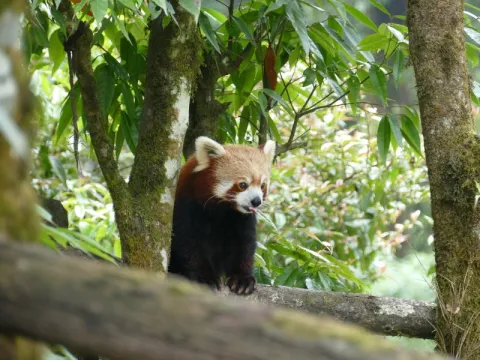
The forested slopes surrounding the sanctuary are home to a range of high-altitude mammals, though most are secretive and rarely seen by casual visitors. Rhesus macaques are the most commonly encountered species, often visible near the lakes and around the temple area. The wider Darjeeling and Senchal forest complexes provide habitat for barking deer, wild boar and Himalayan black bear, though sightings within the small sanctuary perimeter itself are uncommon. The proximity to Singalila National Park means that, in principle, red panda and leopard territories extend close to the area, though the chances of encountering them at Jore Pokhri specifically are slim.
Birds
For birdwatchers, Jore Pokhri and its environs punch well above their weight. The combination of high-altitude wetland, mixed conifer-broadleaf forest and proximity to the Singalila ridge creates ideal habitat for an impressive array of Himalayan species. The following species have been recorded in and around the sanctuary:
- Himalayan Bulbul: frequently heard singing from scrub edges
- Red-vented Bulbul: common year-round resident
- Various Sylvid Warblers: particularly active in the pine and oak understorey
- Kalij Pheasant: occasionally seen on forested slopes
- Rufous-vented Tit: a sought-after high-altitude species
- Blood Pheasant: possible at higher elevations nearby
- White-capped Water Redstart: near streams
- Flycatchers, laughingthrushes and sunbirds: during spring migration
The migratory season (October to December) brings additional species down from higher altitudes, swelling the possible bird list considerably. Dedicated birders will want to explore not just the lake margins but the forested trails leading away from the sanctuary toward Ghoom and Sukhia Pokhri.
Flora
The vegetation of Jore Pokhri is a rich tapestry of Himalayan plant communities. The lakeside margins support aquatic plants and mosses that form critical habitat for salamanders and other amphibians. Moving into the surrounding forest, visitors encounter a classic Eastern Himalayan mid-altitude forest assemblage:
- Rhododendrons: spectacular in flower from February to April, painting the hillsides crimson and pink
- Himalayan Oak: forming the backbone of the canopy
- Silver Fir: present at higher elevations within the forest complex
- Pine: much of the afforested cover
- Tree ferns and a rich understorey of Himalayan ferns: particularly lush after monsoon
- Orchids: several epiphytic species cling to moss-covered trunks
- Himalayan Magnolia: occasional specimens with remarkable large flowers in spring
Title
History and Culture
Is Background Visible
Off
Location Information Items
Location item element
Section Title
Top Sights and Experiences
Text Body
Getting There
By Air: Bagdogra Airport (IXB), approximately 68-70km/2.5-3.5 hours from Darjeeling by road, connects to Kolkata, Delhi, Guwahati and other major cities. Hire a prepaid or private taxi; the drive up is scenic.
By Rail: New Jalpaiguri (NJP) Station, 8 km/3 hours from Darjeeling, is the main rail hub with major express services. Shared/private jeeps and taxis run regularly. The Darjeeling Himalayan Railway links New Jalpaiguri with Darjeeling, but Jore Pokhri still requires an onward road journey from Darjeeling or Ghoom.
Darjeeling to Jore Pokhri: Jore Pokhri is 20 km/45 minutes-1 hour from Darjeeling, winding through tea gardens and forest.
Shared Jeep: Cheapest (Rs 30-60) from Darjeeling towards Ghoom/Sukhia Pokhri.
Private Taxi: Most convenient (negotiate Rs 1,200-1,800 return with waiting).
On Foot/Trek: A short walk from Sukhia Pokhri (2km/30-40 minutes) on the forest road is highly rewarding for birdwatching.
Entry, Fees & Permits: Entry requires a fee of Rs 50 for Indian nationals. Camera and vehicle fees are not typically charged. No special viewing permit is needed, but check in with the Forest Department watchpost upon arrival.
Opening Hours: The sanctuary is open year-round, officially 9am to 5pm. Early visitors are common and gates are not always strictly monitored. The temple lake area is open longer for pilgrims.
Guides: No official guides are stationed here. Local naturalist guides can be arranged via Darjeeling/Mirik tour operators. Hiring a knowledgeable guide is highly recommended for serious wildlife watchers, especially for finding the Himalayan Salamander, as they know seasonal congregation spots.
What to Eat
The Darjeeling hills offer a distinctive culinary landscape shaped by Nepali, Tibetan and Bengali traditions. Do not leave without eating:
- Momos: steamed or fried dumplings stuffed with vegetables or meat, served with chilli dipping sauce. The Darjeeling momo tradition is among India's finest.
- Thukpa: hearty Tibetan-style noodle soup, ideal for cold mornings before a wildlife walk.
- Sel Roti: a traditional Nepali ring-shaped fried bread, often eaten at breakfast.
- Gundruk: fermented leafy greens, an acquired but rewarding local flavour.
- Darjeeling Tea: Drink it here, from a proper local teashop, made with the correct ratio of leaf and hot water. The 'second flush' (June harvest) teas are the most prized.
- Bengali Fish Curry (Macher Jhol): Widely available in Darjeeling's Bengali restaurants; comfort food of the highest order.
When to Go
October to December: The finest season to visit. Fresh post-monsoon air brings crystal-clear mountain views, pleasant daytime temperatures and excellent conditions for birdwatching. The sanctuary is particularly scenic, and the Himalayan salamanders are often active around the lakes.
January to March: Winter brings cold, crisp weather, with frosty mornings and occasional sub-zero temperatures at night. Visitor numbers are lower, offering a quieter experience and superb long-distance views on clear days. By late February and March, the first rhododendrons begin to bloom, adding colour to the surrounding hillsides.
April to May: Spring transforms the landscape as rhododendrons reach their peak bloom and the Himalayan salamander breeding season begins. Days are pleasantly warm, though mountain views can occasionally be hazy. This is also a popular period for visitors, particularly during weekends and holidays.
June to September: The monsoon blankets the forest in mist and vibrant greenery. While the sanctuary has a distinctive atmosphere and salamanders remain active, persistent rain, leeches and slippery trails can make exploration more challenging. Heavy rainfall may also occasionally disrupt travel in the Darjeeling hills.
Travel Tip: Winter nights, particularly from December to January, can fall below freezing. Pack warm clothing, especially if visiting early in the morning or staying after sunset.
Title
Things to Know
Is Background Visible
Off
Location Images
Image
Location Banner Image
Image