The lost capital beneath the forest
Location Category
Location Circuits
Location Interest
Location How Many Days
Location Group
Location Content
Text Body
A hauntingly beautiful ruined fort-city at the foot of a jungle-clad hill, where the whispers of a thousand-year Rajput dynasty mingle with birdsong and the distant shimmer of the Damodar River. Garh Panchkot is one of eastern India’s most atmospheric and least-visited historical sites, a place where history, nature and solitude converge in equal measure.
History & Background
Garh Panchkot, literally “fort of the five divisions” (garh = fort; panchkot = five regions or fortified wards), is one of the most evocative historical ruins in eastern India. The name derives from the five concentric fortification walls that once encircled the royal capital of the Panchkot Raj, a kingdom ruled by the Singh Deo dynasty for over eight centuries. Some scholars believe “Panch Khunt” refers to the five tribal clans indigenous to the area, a name later simplified by the British to “Panchet.”
According to legend, in the late first century CE (around 80 CE), Raja Jagat Deo of Dhar (in modern Madhya Pradesh) was journeying to Puri on pilgrimage when his queen gave birth to a son at Jhalda, in present-day Purulia. Left behind and believed dead, the child was rescued and eventually founded a line of rulers in this remote, hilly landscape. While the founding myth is debated, historical records confirm that the Singh Deo dynasty shifted its capital to Garh Panchkot around 940 CE and ruled from this fortified hill-base uninterrupted for approximately 810 years.
The kingdom flourished in relative isolation, its rulers originally followers of Shaktism who later came under the spiritual influence of Chaitanya Mahaprabhu in the 16th century, embracing Vaishnavism and commissioning the distinctive terracotta temples that survive today. Around 1600 CE, the Singh Deos briefly lost control to Bir Hambir of the powerful Bishnupur Malla dynasty, though they eventually recovered their seat.
The end came dramatically in the mid-18th century. Maratha cavalry, known locally as “Bargis” (a Bengali corruption of bargir, denoting Maratha cavalry whose horses and arms were furnished by the state, as opposed to shiledar soldiers who supplied their own mounts and weapons.), swept into Bengal as a consequence of the power struggle triggered when Nawab Alivardi Khan seized Bengal in 1740 by killing the incumbent Nawab Sarfaraz Khan. Sarfaraz's brother-in-law Rustam Jung, the governor of Orissa, refused to accept Alivardi's authority; defeated militarily, he enlisted the Maratha king Raghoji Bhonsle of Nagpur to help unseat the new Nawab. One of their invasion routes passed directly through Panchet Hill. The small kingdom, valuing pride above pragmatism, chose to resist the vastly superior Maratha forces. The result was devastating: the fort was sacked, the palace demolished and according to local folklore, all seventeen queens of the king took their own lives during the assault. The defeated royal family retreated to Kashipur in Purulia district, approximately 30 km to the south, near Adra, where their descendants remain to this day.
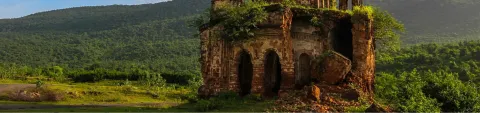
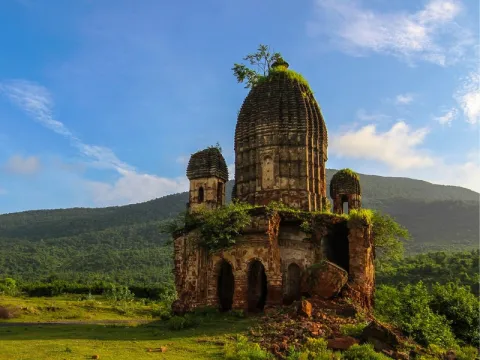
Garh Panchkot has lain in romantic ruin ever since, its crumbling watchtowers and terracotta temples slowly being reclaimed by the dense sal and tamal forests of the Chhotanagpur Plateau. The region, historically known as “Maan-Bhum” (Land of Pride), carries this history in its very name.
Title
History and Culture
Is Background Visible
Off
Location Information Items
Location item element
Section Title
Top Sights and Experiences
Text Body
Getting There
By Train
The most practical option. Asansol Junction, on the main Howrah–Delhi line, is served by numerous express and Rajdhani trains from Kolkata (3–4 hours from Howrah), Delhi and other cities. From Asansol, Garh Panchkot is about 30 km by road (45 min–1 hour by car). The smaller station at Kumardubi on the Adra–Asansol line is slightly closer. Muradi station is nearest to Baranti (6 km by auto-rickshaw).
By Road
From Kolkata, approximately 250–260 km via the Durgapur Expressway to Asansol, then via Sitarampur and Disergarh Bridge across the Damodar to Satbari and along village roads to the resort area. Total driving time: roughly 5–6 hours. An alternative route via Raniganj–Mejia–Shaltora–Santuri is about 35 km shorter. State buses connect Purulia town and Asansol to the area, though frequency is limited.
By Air
Kazi Nazrul Islam Airport at Durgapur (approximately 70 km) has limited commercial flights. Netaji Subhas Chandra Bose International Airport in Kolkata (approximately 250 km) is the main gateway for long-distance travellers, with onward connections by train or hired car.
Getting Around
Most sightseeing at Garh Panchkot itself is on foot (ruins, Dhara spring and lower hill trails are all walkable). For day trips to Panchet Dam, Baranti, Joychandi Pahar, or Maithon, you’ll need hired transport – a car arranged through your resort, a shared auto-rickshaw from Muradi, or a cycle-rickshaw for short local distances. No organised public transport connects the sights. Village roads can be narrow and poorly maintained.
When to Go
October to March (peak season) is ideal. Daytime temperatures sit around 15–25°C with crisp, cool nights. December and January can see temperatures drop to 3°C at night – bring warm layers. Clear skies make for excellent photography.
February to March brings the spectacular flowering of the palash trees (Butea monosperma), when the dry, red-earth landscape erupts in flaming orange-red blossoms, one of the great natural spectacles of rural Bengal.
April to June (summer) is intensely hot, regularly exceeding 40°C. Not recommended unless you are very heat-tolerant.
July to September (monsoon) transforms the landscape into lush green. The hill looks spectacular and the air is fresh, but roads can be muddy, leeches are active on trails and some paths become impassable. Beautiful if you don’t mind getting wet.
Title
Things to Know
Is Background Visible
Off
Text Body
Baranti (Muradi Lake)
Located about 15 km away, Baranti is a serene irrigation dam nestled between two small hillocks: Muradi Hill and Baranti Hill. The 1-km-long lake is one of the most photogenic spots in Purulia, especially at sunset when the water turns gold. The village on the Muradi side offers basic accommodation and is closer to the railway station. Fish from Baranti Lake features on local restaurant menus and is well worth trying.
Joychandi Pahar
About 30 km from Garh Panchkot, this rocky hill requires a climb of roughly 300–400 stone steps to reach the summit, where you’ll find the Joychandi Temple and a Hanuman shrine. The panoramic views of rolling red earth, palash forests ablaze in spring, and distant hillocks more than justify the effort. Film enthusiasts will recognise the landscape from Satyajit Ray’s beloved 1980 film Hirak Rajar Deshe.
Maithon Dam & Kalyaneshwari Temple
Maithon Dam, the largest in the DVC system, is built across the Barakar River and offers boating rides. About 2.5 km from the dam, the Kalyaneshwari Temple is an important regional pilgrimage site. The original deity is said to have been relocated here from Garh Panchkot after the Maratha destruction. Both can be combined into a half-day excursion.
Charida (Mask Village)
The village of Charida (locally called Mukhosh Para, or Mask Village) is the epicentre of Purulia's celebrated Chhau mask tradition. Around 150 families of artisans create the vivid, oversized clay-and-paper-pulp masks used in Chhau dance, a UNESCO-recognised intangible cultural heritage. You can watch craftspeople at work and purchase masks directly.
Ajodhya Hills (Extended Trip)
For those with more time, the Ajodhya Hill Range lies about 120 km south-west. Part of the Eastern Ghats extension and Dalma Hills, this range contains Chamtuburu (approximately 720 m), Purulia's highest peak, along with Gorgaburu (677 m) and other forested summits. It offers serious trekking, waterfalls (Bamni Falls, Upper Dam, Lower Dam), and wildlife including elephants and leopards. Best as a separate overnight trip.
Is Background Visible
Off
Location Images
Image
Location Banner Image
Image