A sacred pilgrimage island where the Ganga meets the Bay of Bengal
Location Category
Location Circuits
Location Interest
Location How Many Days
Location Group
Location Content
Text Body
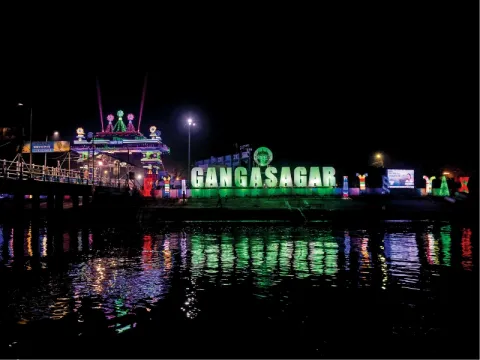
At the southernmost tip of West Bengal, where the Ganga finally meets the Bay of Bengal after its long journey from the Himalayas, lies a beach of silver sand and an ancient shrine. This is Gangasagar: the meeting of the river and the sea, of the sacred and the elemental, of myth and geography in a single wide horizon. Every year in January, on the auspicious morning of Makar Sankranti, several million (in recent years attendance has ranged from roughly 6.5 million to more than 12 million) pilgrims converge on this remote island (monks, farmers, retired schoolteachers, young families, the very old and the very devout) to wade into the confluence and take a holy dip that, according to scripture, washes away the accumulated sins of a lifetime. The mela is often described as second only to the Kumbh Mela.
History & Mythology
Gangasagar's spiritual significance is inseparable from one of Hinduism's most resonant creation myths that spans three generations of a royal dynasty and culminates on this very shore.
Long ago, King Sagara of the Ikshvaku dynasty, an ancestor of Lord Rama, decided to perform the great Ashwamedha Yajna (horse sacrifice) to assert his sovereignty. The sacred horse, which must roam free for a year before the ritual, was stolen by Indra, King of the Gods, who hid it near the ashram of the sage Kapil Muni on this island at the mouth of the sea.
Sagara sent his sixty thousand sons to find the horse. They discovered it near Kapil Muni's ashram and, believing the meditating sage to be the thief, hurled abuses at him, disrupting his meditation. The sage, roused from his deep trance and in his righteous fury, reduced all sixty thousand sons to ash on the spot. Their souls descended into hell, condemned without the ritual funeral rites that would have granted them liberation.
Generations passed. The grief of the Sagara dynasty endured. Finally, King Bhagiratha undertook an extraordinary penance (years of tapasya) to bring the goddess Ganga down from the heavens to Earth, so that her sacred waters might touch the ashes of his ancestors and grant their souls moksha (liberation). After immense devotion, Lord Shiva agreed to break the force of Ganga's descent in his matted hair and the great river flowed to Earth. Bhagiratha led her, through the Himalayas and across the plains, all the way to this island, where the Ganga's waters touched the ashes of the sixty thousand sons and set their souls free. In honour of King Bhagiratha's devotion, one branch of the Ganga is named the Bhagirathi. The place where the river met the sea and performed this liberation was named Gangasagar, after King Sagar and the Ganga.
The day of this liberation is said to be Makar Sankranti, when the sun enters the constellation of Capricorn. And so each year, on that day, millions come to bathe in the same waters and seek the same liberation for themselves.
The mythological layers of Gangasagar reach into some of Hinduism's most ancient texts. The Mahabharata's Vana Parva mentions the Pandavas' pilgrimage to the Gangasagara sangam (confluence), placing the site's sanctity in at least 1,500-2,000 BC. The pilgrimage is referenced in Kalidasa's fifth-century Raghuvaṃsha. A 16th-century Bengali text notes the temple of Kapil Muni had already been “known to people for 1,400 years.” King Devapala of the Pala dynasty performed rituals here and left inscriptions.
In medieval times, the journey to Gangasagar was genuinely perilous. Pilgrims travelling the Adi Ganga route passed through the hamlet of Mograhat, named for the slave market operated there by the Mog people of Arakan, who preyed upon pilgrims. They faced Bengal tigers in the mangrove forests, gharials in the waterways, Portuguese pirates on the river and endemic cholera (the 1891 mela became a centre of the fifth global cholera pandemic). The Bengali proverb “Sab tirth bar bar, Gangasagar ekbar” was not merely pious hyperbole. It was practical advice. You might not survive a second trip.
The island itself was heavily forested until the early 19th century. Under British rule, jungle clearance and resettlement by families from Arakan began in the early 19th century. Around the same time, the Kapil Muni shrine came under the stewardship of Ramanandi sadhus from Ayodhya, with whom the original zamindars, the Gayen family, had donated land for the purpose. The current temple is a rebuilt modern structure; the original, along with four other temples, was destroyed in a violent storm in the 1960s.
Title
History and Culture
Is Background Visible
Off
Location Information Items
Section Title
Top Sights and Experiences
Text Body
Getting There
Reaching Gangasagar is a journey in three stages. You travel through the southern delta districts of West Bengal, cross the Muriganga River by ferry to Sagar Island and then continue by road to the pilgrimage site. As there is no bridge to the island, the ferry crossing is mandatory. Allow at least 4–5 hours from central Kolkata under normal conditions. Ferry services are tide-dependent, so build extra time into your itinerary and avoid tight schedules.
Stage 1: Kolkata to Kakdwip | Distance: ~90 km | Travel time: 2.5–3 hours
By Road: Drive south via Diamond Harbour Road (NH-12/NH-117) through Behala and Joka to Kakdwip. Traffic is often heavy between Behala and Joka, especially during peak hours.Park at Kakdwip Jetty (Harwood Point/Lot No. 8). Vehicle transport across the river is limited and depends on tidal conditions.
By Bus: Regular WBSTC and private buses operate from Esplanade to Kakdwip throughout the day. The journey usually takes 3–4 hours.
By Train: Frequent local trains on the Sealdah South–Lakshmikantapur line stop at Kakdwip and Namkhana, both convenient ferry points. Early morning departures (between 5am and 7:15am) are recommended.
Stage 2: Kakdwip to Kachuberia (Sagar Island) | Distance: ~3.5 km | Travel time: 30–40 minutes by ferry
From Kakdwip, take an auto-rickshaw to Harwood Point (Lot No. 8), the main ferry terminal. Government ferries cross the Muriganga River to Kachuberia Ghat on the northern tip of Sagar Island. Ferries generally operate between 8am and 8pm, although timings vary with the tides. The crossing takes around 30–40 minutes and tickets cost approximately Rs 9 per person. Alternative Route: If ferry services from Kakdwip are disrupted, travel via Namkhana, where ferries connect to Venuban Ghat. This crossing takes 1.5–2 hours and costs around Rs 40 per person.
The Muriganga ferry crossing is entirely tide-dependent.
- Ferry timings cannot be guaranteed and may change without notice.
- During unusually low tides, services may be suspended for several hours.
- Arrive at the jetty before 10am, when conditions are generally more favourable.
- Confirm ferry operations locally before beginning the crossing.
- If Kakdwip services are suspended, enquire about the Namkhana–Venuban route.
- During the Gangasagar Mela (around 14–15 January), ferries operate around the clock, but waiting times can be very long.
Stage 3: Kachuberia to Gangasagar | Distance: 30–35 km | Travel time: 40–50 minutes
From Kachuberia Ghat, shared vehicles, private cars, electric totos and government buses operate to Gangasagar.
Approximate fares:
- Shared electric toto: up to Rs 1,200 per vehicle (less when shared)
- Private car: Rs 1,600–2,300 (one way)
- Government buses: economical and frequent
The road is fully paved and the journey usually takes 40 minutes to one hour.
From the main parking area, it is a short walk to both major landmarks:
- Kapil Muni Temple: approximately 200 metres
- Gangasagar Sangam: approximately 700 metres
Electric totos are available for the final stretch (around Rs 40 per person).
During Gangasagar Mela
- Special trains and additional bus services operate from Kolkata, Howrah and other major cities.
- Begin your journey as early as possible to avoid severe congestion.
- The administration issues numbered entry passes for pilgrims at designated transit points.
- Mobile connectivity may be unreliable on the island, so download offline maps before leaving Kolkata.
What to Eat
Gangasagar's food culture caters to pilgrims, emphasizing simple, inexpensive vegetarian fare. Khichuri (rice and lentil porridge) and luchi with alur dom (fried bread with spiced potato) are staples. Ashrams and dhabas offer cheap thali meals (rice, dal, two vegetables, pickle). Labra (mixed vegetable curry) is a classic temple dish. Street food includes tea, jhalmuri (spiced puffed rice), fried snacks and Bengali sweets (sandesh, mishti doi, rosogulla). Fresh fish and prawns are available in the market and at some non-ashram restaurants, representing a rare departure from the pilgrimage-dominated economy. Ask specifically at non-ashram dhabas for seafood.
Best Time to Visit
January (Mela): The Gangasagar Mela (around Jan 14-15, Makar Sankranti) is an extraordinary sight. Expect enormous crowds, long queues and complex logistics. Advance planning is essential.
October to December/February: The best time for a peaceful visit. Pleasant temperatures, clear skies and comfortable travel conditions make this the ideal season for pilgrims, photographers and travellers seeking a quieter spiritual experience. Accommodation and transport are also easier to arrange.
March to May: Temperatures and humidity rise steadily through the summer. Early mornings and evenings remain comfortable, but midday can be intensely hot. Occasional pre-monsoon thunderstorms may occur in the late afternoon.
June to September: The southwest monsoon brings heavy rain, rough seas and frequent ferry disruptions. Cyclonic weather systems can affect the region during this period, making travel unpredictable. Unless necessary, this is the least suitable season to visit.
Title
Things to Know
Is Background Visible
Off
Location Images
Image
Location Banner Image
Image