Spot deer, birds and native wildlife in a protected forest sanctuary
Location Category
Location Circuits
Location Interest
Location How Many Days
Location Group
Location Content
Text Body
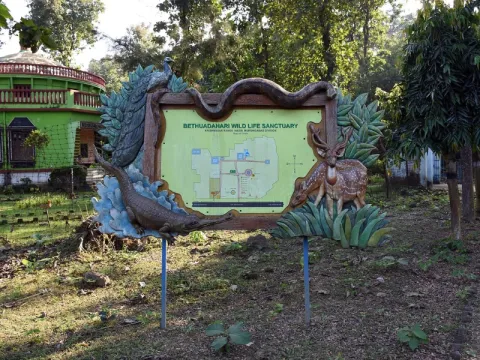
Bethuadahari Wildlife Sanctuary, situated in the center of Nadia district, is one of West Bengal's most delightful, yet frequently neglected, natural havens. It is located right off the bustling National Highway 12 (previously NH-34). It is not the Sundarbans. It is not Gorumara. But that is precisely its appeal. At just 67 hectares, this compact pocket of tropical moist deciduous forest punches well above its weight in biodiversity, atmosphere and accessibility. Chital (spotted deer) graze in dappled clearings, common langurs swing overhead and more than 50 bird species fill the air with sound. A resident population of gharials suns itself on muddy banks.While modest by the scale of India's renowned wildlife reserves, Bethuadahari offers a rewarding intimacy to the patient visitor, a quality often missing in larger parks.
For visitors combining nature with culture, the location could not be better. The sanctuary sits roughly halfway between Kolkata and Murshidabad, within easy range of the pilgrimage city of Nabadwip, the ISKCON mega-complex at Mayapur and the world-famous clay-doll artisans of Krishnanagar's Ghurni neighbourhood. The characteristic pace of rural Bengal is experienced here on a weekend, where morning forest strolls transition into the evening sound of temple bells.
Origins
The land that is now Bethuadahari Wildlife Sanctuary has been nurtured far longer than its official founding date suggests. Formally gazetted as a Wildlife Sanctuary in 1980 under the Wildlife Protection Act, the area originated as a managed deer park in 1969. It was notable as one of the few such facilities located in the lower Gangetic plains. Its mandate was clear: to preserve a representative fragment of the central Gangetic alluvial ecozone, a habitat type that had been almost entirely consumed by agriculture and human settlement across the Nadia plains.
The sanctuary bears its name from the town of Bethuadahari, which grew up around the same stretch of highway. Carefully planted, fenced and managed, the forest is a man-made woodland in the best sense. Despite its cultivated origins, it has matured over decades to achieve a feeling of genuine wildness.
Ecological Context
Nadia district sits in the heart of the Bengal delta, where the Ganga splits into its distributaries and the soil is among the most fertile on earth. Natural forests here were cleared centuries ago for rice paddy and jute cultivation. Bethuadahari is therefore a precious island of green in an agricultural sea, serving as a refuge not just for its resident species but as a waypoint for migratory birds moving along the Gangetic corridor.
The surrounding area is one of the most prominent jute-producing regions of West Bengal, and the contrast between the emerald interior of the sanctuary and the flat crop-scape outside is striking. BirdLife International has recognised Bethuadahari as an Important Bird Area (IBA), a designation that reflects its significance well beyond its small size.
Flora & Fauna
Trees & Vegetation
The forest canopy is dominated by sal (Shorea robusta), the quintessential tree of the northern Indian plains, whose straight trunks rise like columns through the understorey. Interspersed are teak (Tectona grandis), arjun (Terminalia arjuna), Indian rosewood (Dalbergia latifolia), bamboo thickets and shisham. Numerous medicinal plants are woven through the undergrowth and the forest floor in the wet season is carpeted with ferns and wildflowers.
Two large, still water bodies punctuate the forest interior, fringed by reeds and aquatic vegetation that provide critical habitat for wading birds and reptiles. Open grassland patches break up the woodland, creating ideal feeding grounds for deer and ideal viewing spots for visitors.
Mammals
- Chital/Spotted Deer: The sanctuary's flagship species. A 1998 census counted 295 individuals; herds are commonly seen grazing in the open grasslands, especially in the early morning and late afternoon.
- Common Langur: Grey, long-tailed primates that move in boisterous troops through the upper canopy.
- Bengal Fox: More often heard than seen, these slender foxes are active at dusk.
- Jackal: Common and vocal at dawn and dusk. Their chorus echoes across the sanctuary before sunrise.
- Indian Porcupine: Nocturnal; those staying overnight in the forest guesthouse may hear them shuffling under the trees.
- Jungle Cat & Civet Cat: Elusive but present; patient dawn walkers sometimes catch a glimpse.
- Mongoose & Black-naped Hare: Often spotted darting across the trails.
- Monitor Lizard: Large and surprisingly bold; look for them basking near the water bodies.
Reptiles
Bethuadahari hosts a small, yet significant, population of rehabilitated gharials. This species is critically endangered throughout its entire range. The sanctuary maintains a dedicated enclosure where several individuals can be observed basking. The presence of numerous snakes, including reticulated pythons in the dense forest areas, along with spectacled cobras, Russell's vipers, kraits and monocled cobras, serves as a crucial reminder to remain strictly on the designated trails. Freshwater turtles shelter in the shallow lake and can often be seen from the bank.
Birds (50+ species)
- Bethuadahari's IBA status reflects a genuinely rich bird list that rewards birdwatchers at every level of expertise. Key species include:
- Parakeets (Rose-ringed & Alexandrine): Abundant, noisy flocks wheel above the canopy at dawn.
- Indian Cuckoo & Hawk-Cuckoo (Brain-fever Bird): The insistent call of the hawk-cuckoo is the soundtrack of the sanctuary in summer.
- Barbets (Coppersmith & Brown-headed): Resident and vocal; the coppersmith's metronomic call is inescapable.
- Owls (Spotted Owlet, Brown Fish Owl): The overnight guest has a good chance of hearing or seeing these.
- Migratory Waterfowl: Winter brings a variety of ducks, waders and herons to the water bodies.
- Kingfishers, Bee-eaters, Rollers & Drongos: All present and generally approachable.
- Peacock (Indian Peafowl): A small enclosure holds peacocks; free-ranging birds also occur near the edges of the sanctuary.
Title
History and Culture
Is Background Visible
Off
Location Information Items
Section Title
Top Sights and Experiences
Text Body
Getting There
By Train (Recommended): Bethuadahari station is on the Sealdah-Lalgola line. Direct trains from Kolkata (Sealdah) include the Lalgola Passenger (2.5-3 hrs). Alternatively, take a suburban train to Krishnanagar City Junction (2 hrs), then a bus/auto on NH-12 (45 min, 24km). The sanctuary is 8km from the station; take an auto or cycle-rickshaw.
By Road: Bethuadahari is on NH-12 (old NH-34).
From Kolkata (120-140km, 3-4 hrs): Take NH-12 north; AC buses and private cars run from Esplanade.
From Krishnanagar: 24km north on NH-12 (frequent shared autos/buses).
From Berhampore/Murshidabad: 80km south on NH-12.
From Shantiniketan/Bolpur: Approx. 90km via state roads (best by private car).
By Air: The nearest airport is Kolkata (CCU), approx. 155 km away. From CCU, take a taxi to Sealdah for the train or book a direct car.
Operating Hours: Typically open from around 9am or 10am until afternoon or dusk, varying by visitor type and day. Verify seasonal timings with the forest office.
Admission Cost:
Indian nationals: Approximately Rs 120 per person.
Foreign nationals: Subject to higher fees.
Payment is made at the entrance gate via ticketing.
Guide Requirement: A forest guide is mandatory and is either included in the entry fee or can be arranged at the main entrance.
Photography Equipment: Permitted; no separate fee for professional equipment mentioned. Check requirements upon entry.
What to Eat
Krishnanagar is famous throughout Bengal for two things: its clay dolls and its sweets. No visit is complete without sampling:
- Sarpuria: A delicate, lightly sweetened milk-based sweet unique to Krishnanagar. Melt-in-the-mouth in the best possible way.
- Sarbhaja: A fried, layered sweet made from chhana (fresh cheese curd), one of Bengal's great confectionery achievements.
Mihidana & Sitabhog: Fine-grained sweetmeats from the Bengali tradition, also sold widely in Krishnanagar.
Several long-established sweet shops line the main market area of Krishnanagar. Seek recommendations from local residents, but be aware that their preferences are often deeply held and strongly debated.
Best time to visit
October to March: Peak season. Cool, dry weather, excellent wildlife sightings and outstanding birdwatching make this the most rewarding time to visit. Sparse vegetation improves visibility and the forest is at its most accessible for trekking and photography.
Late September & Early April: A pleasant shoulder season. September sees the forest freshly revived after the monsoon, with lush greenery and the first migratory birds beginning to arrive. Early April remains suitable for visits, although daytime temperatures begin to rise.
April to June: Summer brings intense heat, with daytime temperatures often reaching 38–42°C. Wildlife is most active during the cooler hours around dawn and dusk, while midday conditions can be uncomfortable for walking or extended outdoor activities.
July to September: The monsoon transforms the forest into a rich, emerald landscape. Heavy rainfall replenishes streams and wetlands, creating dramatic scenery and a distinctive atmosphere. However, muddy or flooded trails, reduced wildlife visibility and occasional access restrictions can make travel more challenging.
Title
Things to Know
Is Background Visible
Off
Location Images
Image
Location Banner Image
Image