A riverside getaway offering scenic views and colonial heritage
Location Circuits
Location Interest
Location How Many Days
Location Group
Location Content
Text Body
Stand on the waterfront at Diamond Harbour as dusk gathers and watch a freighter the size of a city block glide silently upriver, lit amber in the last light, and you understand immediately why this place has been pulling people to its banks for five centuries. This modest town on the east bank of the Hooghly sits at one of the great geographical hinge-points of the Bengal delta: the broad bend where the river widens dramatically, pivots south and begins its final run to the Bay of Bengal. Portuguese pirates fortified it in the sixteenth century. British East India Company officers sheltered their ocean-going ships here in the seventeenth. Today, the fishing trawlers, river launches and the occasional bulk carrier have replaced the men-o'-war, but the water is still commanding and the sky is still vast. For Kolkatans, Diamond Harbour is a beloved weekend escape: the river promenade, the sea breeze, the hilsa fish, the sunset. For the more curious visitor, it is also a town of ghost-forts and colonial ruins, Ramakrishna ashrams and ferry rides out toward Sagar Island and the sacred confluence of the Ganges with the open sea.
History
The town that the British named Diamond Harbour was once known simply as Hajipur, a name derived from the Hajipur creek that once flanked its eastern edge. That older name hints at its character: a waystation, a resting place, a node in a network of movement. Long before the British re-christened it, the strategic value of this particular bend in the Hooghly was apparent to every maritime power that worked the Bay of Bengal trade routes.
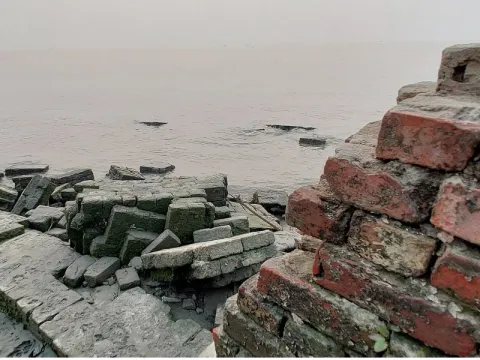
The Portuguese arrived in Indian waters in the early sixteenth century and quickly established a chain of river settlements along the Hooghly. They came, officially, as traders in silk, spices, salt and gold, but many operated as little more than pirates (harmads, as they were known in Bengali). Diamond Harbour, with its commanding position at the river's great southward bend, became one of their strongholds. The fort they built here, the Chingrikhali Kella, reputedly included underground chambers, cannon emplacements and river-facing ramparts that made it a formidable position for monitoring all shipping entering the Hooghly from the south.
The Portuguese hold on the Hooghly was eventually broken. In 1632, the Mughal governor of Bengal, Qasim Khan, mounted a massive assault on the Portuguese settlement at Hooghly, some 75km upriver, driving them out and freeing thousands of enslaved captives.The Chingrikhali Fort's precise fate during this period is unclear (some scholars believe the British East India Company later occupied and modified it) but by the eighteenth century the British had decisively taken over this stretch of the river, and the name “Diamond Harbour” had settled into use.
The harbour became vital to the Company's navigation of the lower Hooghly. Ocean-going ships of the era could not travel all the way upriver to Calcutta without risk; Diamond Harbour, with its deep-water anchorage, served as a holding and lightening point where cargoes were transferred between sea vessels and river craft. The strategic lighthouse was essential for guiding ships around the treacherous bend and the shifting sandbars of the estuary. For over two centuries, Diamond Harbour was the maritime gateway to one of the world's most lucrative trading routes.
With Indian independence and the gradual decline of Calcutta port’s dominance after Partition, Diamond Harbour's commercial maritime role faded. The deep-water anchorage gave way to the larger, more modern port of Haldia, visible across the water on a clear day. But Diamond Harbour endured as a town of meaning: a fishing port, a pilgrimage transit point for those heading to Sagar Island, and, above all, a beloved place of Sunday leisure for generations of Kolkatans.
Diamond Harbour is not a place of grand monuments or exhausting itineraries. Its pleasures are quieter: the light on the water, the promenade at dusk, the ruins of an old fort glimpsed through riverside scrub. The town rewards those who slow down, wander without agenda and let the river set the pace.
Title
History and Culture
Is Background Visible
Off
Location Information Items
Section Title
Top Sights and Experiences
Text Body
Getting There
By Train: Diamond Harbour is accessible via the electrified Sealdah South-Diamond Harbour line of the Kolkata Suburban Railway. The approximately 1.5-hour journey from Sealdah South passes through stations including Ballygunge, Sonarpur, Baruipur and Magrahat before reaching Diamond Harbour. The well-sheltered Diamond Harbour station has basic facilities, with the waterfront a short toto or rickshaw ride away. Frequent EMU trains run daily; check the current schedule online.
By Road: National Highway 12 (NH-12, commonly known as Diamond Harbour Road) connects south Kolkata (Behala, Joka) to Diamond Harbour, a distance of approximately 55km. The 2-2.5 hour journey by private car/taxi is often slowed by heavy traffic, particularly between Behala and Joka. Both WBSTC and private buses run services between Esplanade/Dharmatala (central Kolkata) and Diamond Harbour (routes SD-18, SD-19, STA). The WBSTC bus terminus is opposite the Sagarika Tourist Lodge.
By Air: Diamond Harbour is 75-80km south of Kolkata's Netaji Subhas Chandra Bose International Airport. Fly-in visitors should take the metro or a taxi to central Kolkata, possibly stay overnight and then take a train south to Diamond Harbour the next morning.
By Ferry: A functional ferry connects Diamond Harbour and Haldia, offering a dramatic crossing with views of the Hooghly estuary's full width. Seasonal ferries also run from Diamond Harbour to Sagar Island, though most Sagar traffic goes via Namkhana and Kakdwip.
Getting Around
The town is small and most key sites (promenade, fort ruins, lighthouse) are walkable from the station or lodge. Toto (electric three-wheelers) and cycle-rickshaws are the main local transport; always negotiate before boarding. For Sarisha Ramakrishna Mission Ashram, hire a toto or auto: it is 5km out and not on a convenient bus route. For Raichak, the easiest option is a hired car or taxi from Diamond Harbour town.
What to Eat
Diamond Harbour, an active fishing port on the lower Hooghly, offers an exceptional, deeply satisfying seafood experience rooted in Bengali culinary tradition.
The Hilsa Question: Hilsa (ilish) is a seasonal, highly prized fish. From July to October, Diamond Harbour is a prime spot near Kolkata for genuinely fresh Hooghly hilsa, prepared classically as shorshe ilish, bhapa ilish, or ilish bhaja. This, with rice and dal, is a quintessential Bengali food experience. Note: Outside this season (November-June), the fish is typically frozen or sourced elsewhere (like the prized Padma variety), so manage expectations.
Other Local Seafood: The river and estuary location provides excellent bhetki (barramundi), chingri (prawns), parshe (mullet) and estuary crabs. Chingri malai curry (prawns in coconut milk) is a celebrated, reliably fresh dish here.
Seasonal Sweet: From November to February, the essential food purchase is moya from Joynagar. This seasonal sweet is made from puffed rice and nolen gur (winter date-palm jaggery). Its simple ingredients, extraordinary flavor and dependence on season and craft make authentic Joynagar moya a must-buy in winter.
Best Time to Visit
October to February: The ideal time to visit. Expect clear skies, pleasant temperatures (14–28°C), comfortable evenings and excellent conditions for walking along the river. Migratory birds are present, the river is at its most picturesque and seafood remains excellent following the peak hilsa season. Major festivals during this period include Durga Puja, Diwali and the Gangasagar Mela.
March to April: Temperatures rise quickly, but the riverfront remains beautiful and visitor numbers are lower. Plan outdoor activities for the early morning, as afternoons become increasingly hot and humid. This season is also known for its striking pre-monsoon light and dramatic cloud formations.
May to June: Intense heat (often exceeding 38°C) and high humidity make sightseeing uncomfortable. Powerful pre-monsoon thunderstorms (kalbaisakhi or nor'westers) can arrive suddenly. This is generally not the best season for casual visitors.
July to September: The monsoon transforms the landscape. The Hooghly runs high and fast, carrying brown, silt-laden water, while the riverbanks become lush and green. This also marks the beginning of peak hilsa season (July to October), when the fish are at their richest and most prized. Expect slippery promenades, frequent rain and relatively few visitors. For dedicated food enthusiasts and photographers, however, the season offers a uniquely atmospheric experience — just be sure to bring reliable waterproof gear.
Title
Things to Know
Is Background Visible
Off
Location Images
Image
Location Banner Image
Image