A literary pilgrimage on the banks of the Rupnarayan River
Location Category
Location Circuits
Location Interest
Location How Many Days
Location Group
Location Content
Text Body
The rural cluster of Deulti-Samta in Howrah district, near the Rupnarayan River and accessible by a short drive from Deulti railway station, is a significant literary destination and an undervisited rural spot in West Bengal.
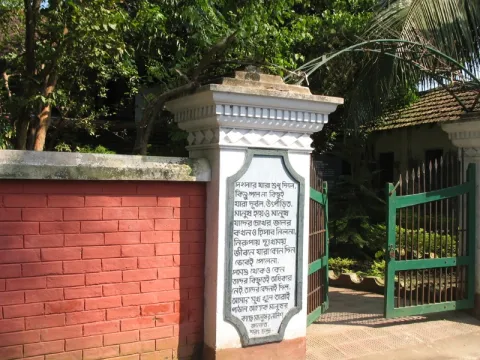
Its importance stems from Sarat Chandra Chattopadhyay (1876-1938), one of the most widely read Indian authors of the 20th century, who lived and wrote at the modest Sarat Chandra Kuthi (Samtaber) in Samta. Chattopadhyay’s novels, known for their radical empathy, created enduring characters like Devdas and Lalita, and have been adapted into over forty films across twelve languages. The house itself, of Burmese-influenced design, reflects the author's connection to the common people and offers a powerful, emotional experience despite its simplicity and the river's changed course.
Samta’s literary identity is further framed by the adjacent Mellock's Madangopal Jiu Mandir, a large, terracotta Atchala temple built in 1651 CE, and the Rupnarayan River, which inspired Rabindranath Tagore's late poem ‘Rupnarayoner Kule’.
Deulti-Samta is not a stimulating tourist spot, but a place for travellers who appreciate the powerful connection between literature and its specific geographic roots, offering a changed perspective on the author's work.
History
Samta and the Roy Zamindars
Samta’s history under the zamindari system runs back several centuries. The Roy family, originally Brahmin Banerjees, governed the village. They had been granted the zamindar title of Roy by their superiors, the powerful Bardhaman Raj Estate, which itself was subservient to the British colonial administration. The Goddess Shitala (the village deity associated with epidemic illness and smallpox protection, one of the most widely worshipped goddesses of the Bengal countryside) is the family deity of the Roys, and her temple stands on a small hill in the village where a cluster of the Roy family still lives. In the village, a memorial once honoured Ishan Chandra Roy, a notable family member. Now, in a quiet irony reflecting a landscape repeatedly remoulded by the river over centuries, this memorial lies partially submerged in a pond.
The Roychowdhury zamindars, a related family, ruled the adjacent hamlet of Mellock (or Mellak), near Samta. Their most celebrated act of patronage was funding the construction of the Madangopal Jiu Mandir in 1651 CE. The cluster of villages in this area, Samta, Mellock, Panitras and Deulti formed an interconnected estate economy tied to the Rupnarayan’s agricultural productivity: rice, jute, mustard and the seasonal hilsa fish trade that made the river’s flood season both feared and economically essential.
The Rupnarayan’s Shifting Course
The Rupnarayan River has not always flowed where it flows today. Over the past three or four centuries it has progressively changed its course, moving away from both the village of Samta and the Madangopal temple at Mellock. The temple was originally built on the Rupnarayan’s bank; Sarat Chandra could see the river from his ground-floor study when he moved in. Now the Rupnarayan has receded further, and visitors must walk some distance from both sites to reach its present bank. This quality of impermanence, of a landscape that shifts and erodes and resurfaces, is part of the fundamental character of this Bengal delta world. The 1978 West Bengal floods damaged the Sarat Chandra Kuthi significantly, requiring government repair. The same floods that threatened the temple at Mellock are part of the longer history of the Rupnarayan asserting its authority over all human structures built on its banks.
Tagore and the Rupnarayan
In 1941, the year of his death, Rabindranath Tagore wrote the poem ‘Rupnarayoner Kule’ (‘On the Bank of the Rupnarayan’), one of the finest poems of his last collection, Shesh Lekha. The poem begins with an awakening on this river’s bank and the realisation that the world is not a dream; it is read as a late meditation on mortality, on the reality of existence and on the clarity that the river’s edge somehow makes available. The fact that Tagore chose the Rupnarayan as the setting for one of his most transcendent poems places Deulti-Samta within a dual literary constellation: Sarat Chandra’s fiction below, Tagore’s poetry above.
Sarat Chandra Chattopadhyay: A Life
Sarat Chandra Chattopadhyay was born on 15 September 1876 in Devanandapur, located in the Hooghly district. Although many visitors mistakenly assume his birthplace was Deulti due to a strong association, the residents of Devanandapur are careful to clarify that their village, not Deulti, is his true birthplace. He spent most of his childhood at his maternal uncle’s home in Bhagalpur, Bihar, absorbing the rural cultures of both Bengal and Bihar that would animate his fiction. His family was poor; formal education was repeatedly interrupted by financial constraint. He later wrote: ‘From my father I inherited nothing except, as I believe, his restless spirit and his keen interest in literature. The first made me a tramp and the second made me a dreamer all my life.’
In January 1903, at 27, Chattopadhyay left for Burma (Myanmar). Before departing, he submitted a story to the Kuntaleen Story Competition under a pseudonym; it won first prize from 150 entries. In Rangoon (now Yangon) and Pegu (Bago), he held sundry jobs before finding work in the Burma Public Works Accounts Office. He lived for thirteen years in Burma in the Botahtaung Pazundaung neighbourhood where manual workers and craftspeople lived, freely mixing with them, giving free homeopathic treatment to the poor, writing job applications and mediating disputes. Most of his major literary drafts were written or revised during these Burma years. His 1913 publication in the Jamuna magazine catapulted him to fame in Bengal.
Returning to India in 1916, Chattopadhyay lived in Howrah for a time. This period was marked by notable literary output and increasing political involvement. He served as president of the Howrah district branch of the Indian National Congress from 1921 to 1936. He bought a plot of land in Samta village in 1919 for Rs. 1,100. This location was near his sister’s residence at Panitras. In 1923, construction of the Kuthi was completed by local builder Gopal Das at a total cost of Rs. 17,000. In February 1923, Chattopadhyay moved in, beginning the twelve most productive years of his writing life.
He married his second wife, Hironmoyee Debi and the house became the creative nucleus of a life simultaneously literary, political and deeply rooted in the village community. Chattopadhyay treated villagers with homeopathic medicine without charge; he supported a local primary school; he sheltered underground freedom fighters through a backdoor in the house specifically designed for the purpose. Subhas Chandra Bose and Chittaranjan Das (‘Deshbandhu’) were among the nationalists who visited the living room of the Kuthi for political meetings. In 1926, Pather Dabi, his novel about a revolutionary movement in Burma, was banned by the British government. It remained one of the most sought-after banned books in colonial India. He left Samtaber for Kolkata in 1938 and died there on 16 January 1938 from liver cancer, aged 61.
Title
History and Culture
Is Background Visible
Off
Location Information Items
Location item element
Section Title
Top Sights and Experiences
Text Body
Getting There
By Train: Take a local train from Howrah Junction to Deulti (Howrah-Kharagpur section, SER). Journey time is ~1.5 hours (50km). From Deulti station, Sarat Chandra Kuthi is 3km: take an auto-rickshaw, a rickshaw-van, or walk.
By Road: From Kolkata, take Vidyasagar Setu and follow NH16 (via Kona Highway). Pass Bagnan and turn left at the Deulti crossing. Total drive is ~50-60km, taking 1.5-2 hours. Nirala Resort, Mellock is a useful landmark.
By Bus: Buses from College Square (Esplanade) or Howrah bus stand go to Deulti crossing via NH16, taking ~2 hours. Ask for a Deulti or Bagnan bus. Early departure is recommended for day trips.
Getting Around
Deulti-Samta is fundamentally a walking and cycling destination. The village paths between Deulti station, Mellock, Samta and the Rupnarayan bank are all within a 3-5km radius and are best appreciated on foot or bicycle. The narrow clay paths through paddy fields and bamboo groves are the real substance of the experience here. Auto-rickshaws are available at Deulti station and can be hired by the hour or half-day for visits to the Kuthi, the Madangopal temple, the riverbank and the Kolaghat area. Rickshaw-vans provide the traditional village transport. Bicycles can be hired through Nirala Resort or Prantik Retreat.
What to Eat
The cuisine of Deulti-Samta is authentic village Bengali: fresh, fish-centered and flavored by mustard oil, turmeric and green chilli. Dining options are limited to local eateries, resort restaurants (Nirala, Prantik) and guesthouses.
The Hilsa of the Rupnarayan
From June to October, the fresh hilsa (ilish) from the Rupnarayan river is a must-try. Traditional preparations include:
Shorshe Ilish: Hilsa steamed with mustard paste, chilli and oil: oceanic and rich.
Bhapa Ilish: Steamed hilsa in a banana leaf with mustard paste, a cleaner preparation.
Ilish Bhaja: Fried hilsa served as street food with rice and onion.
Year-Round Fish: Outside hilsa season, the Rupnarayan provides excellent freshwater fish like rohu, katla and bhetki, cooked locally with mustard. These are served at resort and local eateries, typically as part of a simple Bengali thali.
Local Fare: Tea shops near the station and crossing are social hubs for morning chai, late-afternoon telebhaja (fried snacks) and jhalmuri (spiced puffed rice). Sweet shops offer fresh rasgulla, sandesh and mishti doi. Village guesthouses sometimes offer the immersive experience of selecting vegetables from their kitchen garden for your meal.
Sarat Chandra’s Work: A Reader’s Guide
The following list includes the principal works written or serialised during the Samtaber period (1923-1938), with English titles and notes on adaptations. This is not Chattopadhyay’s complete bibliography (several major works predated Samtaber, including Shrikanta, Charitrahin, Devdas, Grihadaha and Parineeta) but it represents the artistic output of the twelve years spent in this house.
Dena Paona (Debts & Dividends): Nuanced study of family finance and obligation; Bengali films in 1931 and 1960. Gulzar’s Khoobsurat (1980) loosely inspired.
Bipradash: His final novel, written at Samtaber before his departure to Kolkata in 1938.
Mahesh: Short story; widely anthologised; one of the finest short fictions in all of Indian literature about human dignity and loss.
Ramer Sumati (Ram’s Good Sense): The guava tree in the Kuthi courtyard features in this story. The preserved trunk is on display.
Pather Dabi (The Path’s Demand): 1926; banned by British government; revolutionary theme set in Burma; passionately circulated underground in colonial Bengal.
Best Time to Visit:
October to November: The landscape emerges refreshed from the monsoon, with lush greenery, clear skies and pleasant temperatures. Durga Puja brings festive energy to the region, making this an excellent time to visit.
December to January: Peak season and the best time of year. Crisp weather, mustard fields in bloom and beautiful winter light create ideal conditions for sightseeing, photography and leisurely walks along the river.
February: Still comfortable and relatively uncrowded. The days begin to warm, but the weather remains pleasant for exploring the villages, riverside and literary landmarks associated with Sarat Chandra.
March to April: Early summer arrives gradually. Mornings and evenings remain agreeable, though afternoons can be warm. A good off-season option for visitors seeking solitude.
May to June: Hot and humid conditions prevail, with temperatures often becoming uncomfortable during the day. Outdoor activities are best limited to the early morning or evening.
July to September: The monsoon transforms the countryside into a lush green landscape. The Rupnarayan swells with rainwater and hilsa season begins, lending a special character to the river. While atmospheric and photogenic, heavy rains and occasional flooding can make travel and sightseeing more challenging.
Title
Things to Know
Is Background Visible
Off
Location Images
Image
Location Banner Image
Image