A wrestler-zamindar built this temple with his own strength in 1651, carrying stone dumbbells across a wooden bridge every morning. The river has moved. The stone remains.
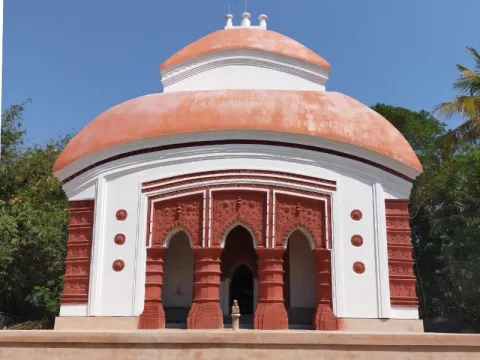
In the hamlet of Mellock (Mellak), adjacent to Samta, stands one of the oldest and most architecturally significant temples in the Howrah district. The Madangopal Jiu Mandir, locally known as Gopaler Mondir, the temple of Gopala (a name for the infant Krishna), is a terracotta-ornamented Atchala structure built in 1651 CE by Mukundaprasad Roychoudhury, a member of the zamindari family that ruled Mellock in the mid-17th century.
The Builder: Mukundaprasad the Wrestler
The founding legend of the temple is inseparable from its builder. Mukundaprasad Roychoudhury was famous throughout the region as a wrestler of exceptional strength. The story goes that he carried two heavy stone dumbbells, one in each arm, across a small wooden bridge over the Rupnarayan each morning on his way to supervise construction, doing so with such ease that neither his arms tired nor the wooden bridge buckled. One of those dumbbells is still kept in the temple compound, a physical survival of the founding legend that adds a pleasingly tangible dimension to a 370-year-old story.
Architecture: The Atchala Style
The Atchala style, in which a curved roof has eight slopes arranged in two tiers, the lower four wider and the upper four narrowing to a single point, is one of the most characteristic forms in Bengali temple architecture, evolving from the shape of the traditional thatched rural house. The Madangopal temple at Mellock is one of the largest Atchala structures in Bengal: approximately 40 feet high, equivalent in scale to a modern three-storey building, with three entrance arches on its south face (the principal facade) and additional entrances on west and east.
The temple is decorated with terracotta panels depicting scenes from the Puranas, episodes from Krishna’s life and decorative motifs characteristic of 17th-century Bengal. The terracotta art tradition of Bengal, which reached its greatest expression in Bishnupur under Malla patronage during the same century, is represented here in a less-visited but genuine example. The craftsmanship, despite considerable weathering, is clearly of quality. The principal deities are Radha and Madangopal Jiu, worshipped in black stone idols.
The temple is currently in a derelict state with renovation work underway. Approach respectfully, remove footwear at the entrance and do not touch the terracotta decorative panels. Access for visitors can be variable; if restricted, accept gracefully.
Comments