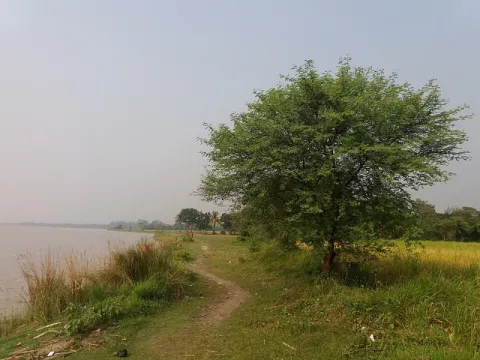
The most distinctive and rewarding activity at Deulti-Samta is walking. The physical setting of Sarat Chandra's fiction is the very landscape here: a village of clay paths winding between homesteads, defined by its paddy fields, mustard crops, bamboo groves, fish ponds and banana gardens. Walking through it with that knowledge is a form of literary comprehension that no amount of reading can substitute.
Station-to-Kuthi Walk (3km, 45 mins)
To reach the Kuthi garden from Deulti station, first cross the highway and take the village road heading west. This path takes you through the village of Mellock, where you can see the Madangopal temple, and continues past paddy fields, bamboo groves and small homesteads. The early morning journey along this route in winter is a particularly wonderful sensory experience in Howrah district, offering sights like flowering mustard fields, frosted bamboo and the comforting scent of wood smoke from breakfast cooking.
Kuthi-to-Riverbank Walk (10-15 mins from the Kuthi)
A short walk through the paddy fields from the Kuthi, following the path Chattopadhyay himself regularly took, brings you to the present course of the Rupnarayan. At the river there is usually a fishing ghat with boats drawn up on the bank. In winter, this is an excellent spot to sit, watch the water and think about what it means to choose this as the place you come to write.
Circular Village Loop (5-6km, 2 hrs)
A more substantial walk loops from the Kuthi northwest through the paddy fields toward the river, follows the bank south for a kilometre, cuts east through the village of Panitras (where Chattopadhyay’s sister lived and which his fiction describes), and returns to Samta via the back lanes. A local guide, available through Nirala Resort or informally through village inquiry, is recommended as the path is not waymarked.
Interactions with villagers during these walks are typically very friendly. In Samta, Chattopadhyay is still a source of authentic community pride, seen not as a distant concept, but as a real person who traveled these very paths. It's common for the village's older residents to share family histories connected to the time Chattopadhyay spent in Samtaber.
Comments