Discover royal palaces, temples and Bardhaman's rich heritage
Location Category
Location Circuits
Location Interest
Location How Many Days
Location Group
Location Content
Text Body
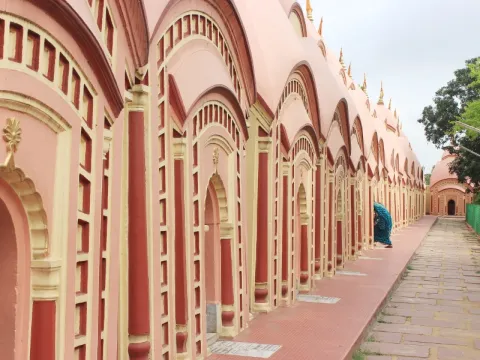
Few cities in the Bengali heartland wear their history quite so openly as Bardhaman. A Mughal-era tomb stands within metres of a colonial triumphal arch. A thousand-year-old goddess temple jostles with a Japanese-built planetarium. And at the edge of town, 108 terracotta Shiva shrines ring two ponds in a hush so complete you can hear pigeons padding across the flagstones. This is a city that has been continuously important, as a Jain centre, a Mughal revenue hub, the seat of one of Bengal’s most powerful Maharajas and a linchpin of the British Raj.
The name Bardhaman (or Burdwan, in its Anglicised form) almost certainly derives from the Sanskrit Vardhamana, meaning “a prosperous and growing place.” Some historians connect it to Mahavira Vardhamana, the 24th Jain tirthankara, who is said to have preached in the region. Whatever the etymology, the prosperity has been demonstrably real: the undivided Bardhaman district was once described in early 20th-century British chronicles as “the richest tract in Bengal and the area of its oldest and most settled cultivation.”
The city’s character was decisively shaped by the Bardhaman Raj (the zamindari dynasty of the Maharajas) whose patronage from the 17th century onward funded temples, palaces, gardens and civic infrastructure on a scale that few provincial Indian cities could rival. The Maharajas were also shrewd political operators: they accommodated the Mughals, then the British, then the nationalists, surviving and thriving across three centuries of upheaval. The red-brick grandeur of Rajbati and the tree-lined boulevards of Golapbag are their enduring gifts to the city.
Beneath this elite history runs a deeper current: Bardhaman is an agricultural city at heart. The fertile Damodar plain around it has supported dense settlement since at least the Chalcolithic period and the city’s markets, its famous GI-tagged sweets and the rhythms of its daily life still pulse with agricultural plenty. It is this combination of royal ambition layered over agrarian rootedness that gives the place its particular warmth.
Title
History and Culture
Is Background Visible
Off
Location Information Items
Location item element
Section Title
Top Sights and Experiences
Text Body
Getting There
By Train: Bardhaman Junction is one of the major junctions on the Howrah-Delhi main line and is exceptionally well served. Dozens of local and express trains run daily from Howrah and Sealdah. Journey time from Howrah is typically 1 hour 20 minutes to 1 hour 45 minutes on an express service. The Howrah-Bardhaman chord line (via Dankuni and Memari) is faster; the loop line (via Bandel) is slightly longer but more scenic.
For day-trippers from Kolkata, early morning departures (before 7:30am) are advisable to maximise your time. Trains are frequent enough that you don’t need to book far in advance for the unreserved or second-class compartments.
By Road: Bardhaman is approximately 105km from Kolkata via National Highway 19 (the old GT Road). In good traffic, the drive takes around 2 to 2.5 hours; weekend traffic can add 30-40 minutes. State buses (SBSTC) run regularly from Kolkata’s Esplanade bus terminus. Private buses are also plentiful.
By Air: The nearest airport is Netaji Subhas Chandra Bose International Airport, Kolkata: approximately 120km from Bardhaman town (around 2.5 hours by car).
Getting Around
The compact heart of Bardhaman is eminently walkable. Curzon Gate, Rajbati, the Mughal tombs and Sarbamangala Temple can all be reached on foot from the station. For the outlying sights (Krishnasayar, Golapbag, Kankaleshwari and especially Nawabhat), you will want wheels.
Auto-rickshaws: The most practical mode of transport in town. They are plentiful outside the station. Toto (electric auto) services are increasingly common and somewhat cheaper.
Cycle-rickshaws: Still found in the older residential neighbourhoods and market areas. Slower, but excellent for short distances when you want to absorb the street life.
Renting a vehicle: For a comfortable full-day circuit, especially if you want to reach Nawabhat, consider hiring a car with a driver from your hotel or from agents near the station.
On foot: The station-to-Curzon Gate walk is around 15-20 minutes and is an experience in itself, taking you through the animated commerce of Station Road and GT Road. Comfortable walking shoes are essential; pavements can be uneven.
Where to Stay
Bardhaman has a reasonable spread of accommodation for a city of its size, skewing toward business hotels and modest lodges rather than heritage boutique properties. Options are concentrated near the station.
Budget: Several lodges and dharamshalas within walking distance of the station. Clean, functional and very local in character. Ask at the station for recommendations as these establishments change frequently.
Mid-range: Business-class hotels cluster on and around Station Road and GT Road. Most offer air conditioning, en-suite facilities and a restaurant. Quality is variable; check recent reviews. The area immediately south of the station has the highest concentration.
Day-trip Option: Given the excellent rail connections from Kolkata (under 2 hours on a good express), a day-trip is entirely viable and removes the need for accommodation. This works well for the one-day itinerary above. Stay-over becomes worthwhile when you want the two-day itinerary or are combining Bardhaman Town with an onward visit to Ambika Kalna the following day.
What to Eat
Food is, without question, the most emotionally charged topic in Bardhaman. The city’s identity is inseparable from its sweets and any visitor who leaves without trying Sitabhog and Mihidana has missed the point rather badly. But the wider food scene rewards exploration too.
The Sweets
Mihidana & Sitabhog: The Bardhaman GI-Tagged Pair
These two sweets (both Geographical Indication-tagged since 2017) are invariably eaten together and their complementary qualities explain why. Mihidana is made from powdered rice (Gobindobhog variety) and saffron, passed through a fine perforated ladle into hot ghee and then soaked in sugar syrup; the result is a miniature relative of boondi, but finer-grained, more fragrant and considerably more delicate. Sitabhog is made from chhena (fresh cottage cheese) and Gobindobhog rice flour rolled into a dough with ghee, extruded through a mould like thin vermicelli, fried and then soaked in saffron-scented syrup; the result resembles a sweet rice dish and is extraordinary paired with tiny gulab jamuns called nikhuti.
Both are highly perishable: consume within the same day and buy only as much as you can eat before returning to your destination. During summer heat, quality deteriorates faster.
Shaktigarh Langcha
While not from Bardhaman town itself (Shaktigarh is a railway station stop on the way), you will encounter this elongated, syrup-soaked milk-solid sweet at virtually every shop. It is softer and less cloyingly sweet than many langcha varieties, and worth trying. Sold by the piece.
Top Sweet Shops
- Ganesh Mistanna Bhandar: GT Road, near the Municipality Office. The most frequently cited address for the best Sitabhog and Mihidana in town. A narrow-lane shop close to Curzon Gate; known for a premium variety made with superior ghee.
- Bhagaban Sweets: Opposite Ganesh Mistanna Bhandar, GT Road. The local favourite that many Bardhaman residents prefer over Ganesh. Worth visiting both and forming your own opinion.
- Sarbamangala Road shops: A string of sweet shops near the Sarbamangala Temple; excellent for fresh prasad-style sweets immediately after a temple visit.
Savoury Food
Bengali cuisine in its home territory has a depth and variety that restaurant menus elsewhere rarely suggest. In Bardhaman:
- Bardhaman Pulao: A fragrant ghee-cooked rice dish, slightly richer than everyday bhaat, that reflects the city’s proximity to premium rice cultivation.
- Shorshe Ilish: Hilsa fish in mustard sauce: the Bengali national dish, elevated when the fish is fresh from the rivers of this district.
- Chingri Malai Curry: Prawn cooked in coconut milk, a luxurious and widely available option.
- Alu Posto: Potato in poppy seed gravy: simple, deeply flavoured, and a reminder that Bengali vegetarian cooking is serious cooking.
- Shukto: A bitter-edged mixed vegetable stew eaten at the start of a meal; rarely found in restaurants but essential to Bengali domestic cuisine. Worth seeking out through a home dining arrangement.
Street Food
Some of the most satisfying eating in Bardhaman happens standing up:
- Phuchka: The Bengali version of gol gappa: crisper shells, tangier filling, and eaten at a more athletic pace than you might expect.
- Ghugni: Spiced yellow peas, dry or with a slight gravy, served in small dona (leaf bowls). A deeply warming snack on a cold morning.
- Luchi Aloo Dum: Deep-fried white flour puffs with spiced potato: the Bengali breakfast of champions, available from early morning.
- Telebhaja: A catch-all term for deep-fried snacks (vegetables, fish, fritters) that appear at almost every roadside stall. The morning Khoai Mela Ground area near the station is a good hunting ground.
- Alur Chop: Spiced potato patties, the Golapbag area street vendors specialise in these.
Restaurants
Options cluster around Station Road and GT Road. Notable choices:
- Bhojohori Manna: Traditional Bengali cuisine in a homely setting near the station. Popular for a proper sit-down lunch.
- Ananda Bhojanalaya: A much-recommended affordable option near the station for authentic local dishes.
- Chhuti Restaurant: A mix of Bengali and North Indian dishes; good for groups with varied preferences.
- Dada Boudi Hotel (street stall): Famous for Kathi Rolls and Mughlai Parathas, the Mughal influe
Best Time to Visit
October to February: The best time is post-monsoon (October-November) when the countryside is lush, air clear and the weather is ideal for walking. Don't miss Durga Puja (usually October) and Kali Puja (November) for city festivities. Maha Shivaratri (February-March) offers a lively experience at the Nawabhat 108 Shib Mandir with a week-long fair and large pilgrim gatherings.
March to May: Manageable in early March but progressively hot by April and unpleasant by May. Sightseeing is possible if you start very early and rest during midday. Sweets (especially Sitabhog and Mihidana) keep better in cooler weather, so quality can dip in the heat.
June to September: The Damodar can flood during heavy years and some lanes become waterlogged. Outdoor sights are harder to enjoy; the city’s green spaces are magnificent but muddy. Travel is possible but requires flexibility.
Title
Things to Know
Is Background Visible
Off
Location Images
Image
Location Banner Image
Image