Explore terracotta temples and a bird-rich oxbow lake nearby
Location Category
Location Circuits
Location Interest
Location How Many Days
Location Group
Location Content
Text Body
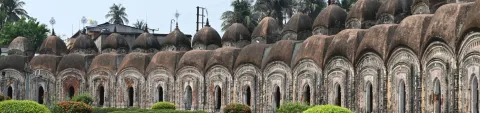
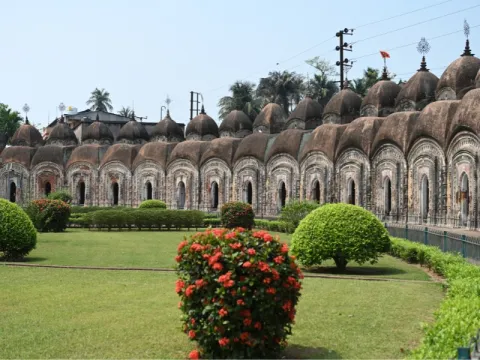
There is a moment, standing at the centre of the Naba Kailash complex in Ambika Kalna, from which all 108 Shiva lingas are simultaneously visible: concentric circles of terracotta shrines radiating outward like a prayer carved in geometry. A few steps across the road, the Rajbari complex unfolds as a century of temple-building ambition in a single walled compound: 25-pinnacled towers, rekha-deul spires and walls dense with terracotta storytelling that begins in the Ramayana and ends in the hunting grounds of eighteenth-century Bengal. Then, in the afternoon, a short journey east brings you to an entirely different world: the vast, bird-filled silence of the Chupi Char oxbow lake, where in winter the reeds and open water host over a hundred species of migratory birds from Central Asia, Russia and beyond. This circuit is Purba Bardhaman’s most architecturally and ecologically diverse day-trip.
History & Character
Ambika Kalna is a city of exceptional antiquity wearing its age with disarming quietness. The first written reference to it appears in the Kubjika Tantra, a sixth-century tantric text. By the seventh century, it was a frontier city of the Tamralipta Kingdom and the ruler Shashanka established a naval base here on the Bhagirathi, exploiting the town’s position as a natural river port. The medieval Bengali text Mangal Kavya, written in 1495, refers to it as ‘Ambowa Muluk’ and a map of Bengal by the European cartographer Von den Brook in 1660 marks it simply as ‘Ambowa’. Two Vishnu idols recovered from the Bhagirathi riverbed have been dated by archaeologists to the tenth or eleventh century. This is a town with deep roots.
The Kalna that visitors see today, however, is overwhelmingly the creation of the eighteenth century. After Maratha raiders (the Bargis) destroyed the Bardhaman Maharajas’ family temple complex at Dainhat, the dynasty chose Kalna for their new thakurbari, a family religious compound of unprecedented ambition. Over roughly a hundred years, successive Maharajas and their queens raised what is now the Rajbari complex: a sequence of temples in every style of Bengal architecture, encrusted with terracotta storytelling of extraordinary quality and range. The 108 Shiva temples were added in 1809 by Maharaja Teja Chandra in a separate ASI-protected compound across the road.
Kalna also carries a distinct Vaishnava identity. Sri Chaitanya Mahaprabhu, the great fifteenth-century mystic and founder of Gaudiya Vaishnavism whose influence on Bengali culture is incalculable, visited the town twice and the Gauranga Mandir here is the only Gaudiya Vaishnavite temple in existence that was built during Chaitanya’s own lifetime. A famous tamarind tree under which Chaitanya met his companion Nityananda is still venerated on the same site. This dual character, Shakta and Shaiva through the Maharajas’ patronage, Vaishnava through Chaitanya’s association, makes Kalna’s sacred landscape unusually layered.
The debate among Bengali travellers over which town deserves the title of ‘Temple City of Bengal’, Bishnupur or Ambika Kalna, is a long and affectionate one. Bishnupur is more famous and better-served by tourist infrastructure. But as a serious student of Bengal temple architecture will tell you: Kalna houses examples of every style the Bengal temple-building tradition produced, while Bishnupur’s temples are largely of laterite stone. In sheer density of surviving terracotta temple architecture, Kalna has the stronger claim. It is also, characteristically, far less crowded
Title
History and Culture
Is Background Visible
Off
Location Information Items
Location item element
Section Title
Top Sights and Experiences
Text Body
Getting There
By Train: Ambika Kalna is on the Bandel-Katwa loop line, ~81km from Howrah. Take a local EMU or express train from Howrah or Sealdah (2.5-3 hours). Aim to arrive by 9-9:30am for a full day; the single afternoon intercity express is not ideal for a day-trip.
By Road: Kalna is ~85-90km (2.5 hours) from Kolkata via the Bandel-Kalna road or Memari/Bardhaman bypass. Google Maps is reliable; road conditions may vary. From Bardhaman, it is ~60km (1.5 hours).
To Purbasthali/Chupi Char: Purbasthali station is two stops beyond Kalna on the same loop line (~20-25 minutes). From Purbasthali station, take a toto or van-rickshaw to the Kasthashali/Chupi Char lakeshore (10-15 minutes). Alternatively, the drive from Kalna takes 30-40 minutes.
Getting Around
Getting around Kalna is straightforward, with several convenient transport options. The most practical and widely used is the toto (electric auto-rickshaw), whose drivers often double as informal guides, familiar with the town's major attractions, visiting hours and able to communicate in basic Hindi and English. Be sure to agree on both the itinerary and fare before setting off. Cycle-rickshaws are available for short journeys, particularly around the older residential neighbourhoods near the Siddheswari Temple and are well suited to navigating narrow lanes at a leisurely pace. If you are travelling from Bardhaman or Kolkata and wish to combine Kalna with a visit to Chupi Char, a hired car offers the greatest flexibility and comfort. Within the temple district, many sights are easily explored on foot. The Naba Kailash Temples and the Rajbari Complex are only moments apart, while the railway station is about a 10–15 minute walk from the historic core. Other attractions, including Siddheswari Temple, Gopalbari and Gauranga Mandir, are around 15–25 minutes away on foot, although a toto makes reaching them quicker and more convenient.
What/Where to Eat
Kalna's small-town culinary scene offers genuine, fresh and affordable food, with excellent fish due to its riverside location. Hotel Priyadarshini, near the bus stand, is the best for tourists and offers a safe, satisfying Bengali thali for lunch. Other small eateries near the main road and bus stand serve variable quality Bengali/North Indian food; choose busy ones.
Street Food & Snacks:
Telebhaja (deep-fried snacks) near the station are a morning ritual.
Muri-mix (spiced puffed rice): ideal pre-temple snack.
Jhalmuri (tangy puffed rice mix) near Rajbari gate: classic Bengali street food.
Sweets:
Lengcha: Elongated gulab jamun cousin, deep-fried and syrup-soaked. Shaktigarh's version (on the Bardhaman road) is famed, but local shops also sell it.
Shor Bhaja: Distinctive fried milk-skin sweet.
Kheer Kodom: Round sweet with a khoa (condensed milk) filling, popular locally.
Sitabhog & Mihidana: GI-tagged sweets from Bardhaman town; harder to find in Kalna but available on the road.
At Purbasthali/Chupi Char:
Basic food shacks cater to birdwatchers with simple, homely Bengali meals (breakfasts/lunches, including fish). The setting by the lake is unique. A substantial meal before the boat ride is recommended.
What to Buy
Kalna is a vital centre for Bengal's handloom textiles, often overlooked for the temples. The weaving belt, including Samudragarh and Dhatrigram, produces textiles rivaling India's best.
Tangail and Jamdani Sarees: Local weavers, many descendants of Dhaka master craftspeople who settled post-Partition, create excellent Tangail and Jamdani sarees in neighbourhood workshops. Tangail sarees are lightweight cotton with intricate borders; Jamdani features floating patterns on muslin using a supplementary weft technique. Buy directly from weavers or co-ops for better prices than Kolkata and the experience of seeing the loom.
Handicrafts and Devotional Items: Shops near the temples sell modest terracotta figurines, puja items and devotional souvenirs, which are practical mementos.
Sweets for the Journey: Roadside shops by the bus stand and station sell local specialities. Langcha is recommended for the return trip as it travels better than Sitabhog and Mihidana.
When to Go
October to February: This is the ideal time to visit Kalna, with pleasant temperatures (17–28°C), clear skies and the Bhagirathi at its most beautiful. From mid-November onwards, migratory birds arrive at Chupi Char, making it an excellent season for birdwatching. If possible, plan your trip around the Kalna Porjoton Utsav (January), when the Rajbari Complex is illuminated for cultural performances and festivities. Photographers will especially appreciate the warm golden light on the terracotta temples at sunrise and sunset.
February to March: Time your visit to coincide with Maha Shivaratri, when the Naba Kailash 108 Shiva Temple comes alive with rituals, devotional music and streams of pilgrims, creating one of the town's most vibrant spiritual celebrations.
October to November: The Lalji Temple hosts its annual Ras festival, celebrating the divine love of Radha and Krishna with kirtan, special rituals and festive darshan in the Rajbari Complex.
March to May: Temperatures climb quickly, making early mornings the best time for sightseeing. Midday heat can be intense and the migratory birds have departed from Chupi Char.
June to September: The Bhagirathi swells with the rains and the surrounding countryside turns a vivid green. However, muddy roads and occasional water ingress around older temple precincts can make sightseeing difficult. This season is best suited to travellers who want to experience the river and rural landscape during the monsoon.
Title
Things to Know
Is Background Visible
Off
Location Images
Image
Location Banner Image
Image