The sacred city of Shiva in Bengal
Location Category
Location Circuits
Location Interest
Location How Many Days
Location Group
Location Content
Text Body
There is a particular quality of stillness at the heart of Tarakeswar that takes most visitors by surprise. On the surface, this compact municipality in the Hooghly district is perpetually animated: the lanes leading to the great temple of Baba Taraknath hum with flower sellers, sacred conch blowers, prasad stalls and the continuous murmur of the faithful arriving by train and bus from across Bengal and beyond. Yet step through the temple gates, pass the Dudhpukur tank and you enter a space where the noise of the world seems to soften into something older and quieter, the hush of genuine devotion.
Tarakeswar, called Baba Dham or the City of Shiva, is one of West Bengal’s most important Shaivite pilgrimage centres. The presiding deity is Lord Taraknath, worshipped here as a swayambhu (self-manifest) Shivalinga. This Shivalinga is traditionally believed to have remained concealed in the forest until it was brought to light by the devout efforts of an ordinary family in the early 18th century. The present temple, built in 1729 by Raja Bharamalla, is a handsome example of Bengali ata chala architecture and has remained a place of unbroken worship ever since.
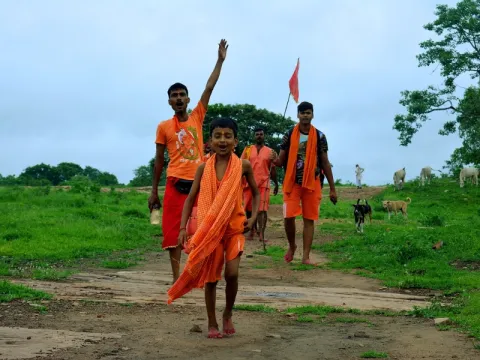
The statistics are staggering. The Shravan Mela in Tarakeswar is one of the largest annual religious gatherings in West Bengal. It draws lakhs of pilgrims each year during the month of Shravan (July-August), which is considered the holiest period in the Shaivite calendar. On the Mondays of Shravan, saffron-robed Kanwariyas (Shiva devotees) complete a barefoot walk of nearly 40km, carrying sacred Gangajal (Ganges water) on a bamboo pole from the Nimai Tirtha Ghat at Baidyabati (Sheoraphuli) to pour over the Shivalinga. The entire route becomes a river of saffron cloth and the chant of ‘Bol Bam!’ stretches unbroken across the landscape.
But Tarakeswar has more than spectacle. The spiritual fabric of the town is woven with connections to Bengal’s greatest religious figures: Sarada Devi, the consort of Ramakrishna Paramahamsa, is said to have visited the temple of Taraknath multiple times. For the inquisitive traveler, the sprawling region rich with Indian history, presents a remarkable selection of day-trip destinations. Highlights include Kamarpukur (the birthplace of Ramakrishna) and Jayrambati (the birthplace of Sarada Devi), as well as the French colonial promenades of Chandannagar, the Portuguese basilica in Bandel and the magnificent terracotta temples found in Antpur and Bansberia.
This guide is designed for all visitors: the devout pilgrim arriving for Shivaratri; the cultural traveller threading together Bengal’s colonial, spiritual and artistic heritage; the day-tripper from Kolkata curious about the temple town just over an hour away by train. Tarakeswar is a place that repays every kind of attention.
History and Legend
The Discovery of the Swayambhu Linga
The founding legend of Tarakeswar is one of the characteristic narratives of sacred geography in Bengal: a miraculous self-revelation of the divine, witnessed by the humble and pure of heart. The account centres on Vishnudas, a devoted follower of Shiva who had come from Uttar Pradesh to settle in the Hooghly region with his family. The local community initially viewed Vishnudas with suspicion. However, he is reported to have earned the villagers' trust and respect after proving his spiritual virtue by fearlessly seizing a red-hot iron bar and emerging completely unscathed.
Some time after this, Vishnudas’s brother, while passing through the nearby forest, observed an extraordinary sight: cows were spontaneously releasing their milk onto a single spot on the ground, as if making an offering. The discovery of a Shivalinga by the brothers and local villagers at the spot piqued their interest. What they unearthed was a Swayambhu Linga, an ancient symbol believed to have manifested divinely from the earth rather than being carved or placed by human hands. The community built a small temple on the spot, which became the nucleus of what is today the great Taraknath Mandir.
The deity revealed through this discovery is worshipped as Taraknath, a name that carries multiple resonances. In the Puranic tradition, Taraknath refers to Shiva as the vanquisher of Taraka, the demon whose defeat required the birth of Skanda (Kartikeya), the son of Shiva. At its core, the name signifies ‘Lord who delivers across the ocean of existence’ (Tara). This meaning presents the figure as the ultimate liberator, the one who guides and carries devotees across the vast ocean of continuous birth, death and rebirth. It is this soteriological meaning that has made Taraknath so deeply beloved in Bengal, a state where the aspiration toward moksha (liberation) has always run alongside the earthlier currents of agricultural and commercial life.
The Temple Under Raja Bharamalla (1729)
The present temple structure was built in 1729 by Raja Bharamalla, also recorded as Bharamall Rao in some sources, the Malla king of Bishnupur. Historical accounts record that Bharamalla was guided to the site by a divine dream in which Lord Taraknath appeared and directed him to build a worthy temple over the Swayambhu Linga. The king obliged, commissioning the construction of the atchala structure that still stands today, along with the Natmandir (the congregational hall in front of the sanctum), the Dudhpukur tank to the north and the subsidiary shrines of the complex.
The Atchala style, a form specific to Bengali temple architecture, features a distinctive curved roof with four ascending tiers above the sanctum and extended verandas and galleries for devotees. The Natmandir in front has a tetrahedral veranda with three vaulted railings on its roof, providing sheltered space for the large numbers of worshippers who have always gathered here. The terracotta decorative elements of the temple, now mellowed to deep ochre, are characteristic of the period and share aesthetic kinship with the famous terracotta temples of Bishnupur and Kalna elsewhere in West Bengal.
Under Bharamalla’s patronage, the Taraknath temple became the focal point of a rapidly growing pilgrimage settlement. The reputation of Baba Taraknath as a wish-fulfilling deity spread through Bengal and beyond, drawing devotees from distant regions who arrived with hopes of healing, resolution of difficulties and spiritual liberation. The urban growth of Tarakeswar is a prime example of a distinct characteristic of North Indian pilgrimage towns: a settlement forming and expanding to cater to a sacred site and its visitors.
The Malla Kings and Bishnupur Connection
The involvement of the Bishnupur Malla dynasty in Tarakeswar is significant. The Mallas were instrumental in promoting Bengali temple architecture and terracotta art. Their patronage led to the creation of the exceptional collection of temples at Bishnupur (currently nominated as a World Heritage site) between the 17th and early 18th centuries. The construction of the Taraknath temple at Tarakeswar represents the extension of this royal patronage of Shaivite culture into the Hooghly district and helps explain the architectural and decorative kinship between the Tarakeswar temple and the Bishnupur tradition.
Sarada Devi, Ramakrishna & the Broader Spiritual Landscape
Tarakeswar’s place in the wider spiritual landscape of 19th-century Bengal is deepened by its association with Sarada Devi (1853-1920), the spiritual consort of Ramakrishna Paramahamsa. The area encompassing Tarakeswar, Kamarpukur and Jayrambati forms a deeply sacred triangle in the Hooghly district, maintaining a profound spiritual resonance. Ramakrishna was born in Kamarpukur and Sarada Devi in Jayrambati; both villages lie approximately 50-60km from Tarakeswar. Sarada Devi's pilgrimages to the Taraknath temple in Tarakeswar further bridged the Vaishnava-Shakta world of Ramakrishna's followers with the Shaivite traditions of the region.
Modern History
Tarakeswar was granted municipal status on 6 August 1975 and has developed steadily as an administrative and commercial centre alongside its religious identity. The Howrah-Tarakeswar branch rail line, part of the Eastern Railway network, has connected the town to Kolkata since the 19th century and remains the primary artery of the pilgrim economy today. In 2023, the town earned a notable distinction: it was recognized as the least polluted city in Central and South Asia. This achievement, which saw its PM2.5 levels meet WHO guidelines, is largely attributable to the town's minimal industrial presence and the clean air provided by its surrounding agricultural area.
Title
History and Culture
Is Background Visible
Off
Location Information Items
Section Title
Top Sights and Experiences
Text Body
Getting There
By Train (Recommended): The easiest and most authentic way is the frequent, cheap and atmospheric Eastern Railway branch line from Howrah Junction (Kolkata) to Tarakeswar station. The 58km journey takes 1.5-2 hours and is popular with pilgrims. The journey itself is a cultural experience, especially during Shravan with Kanwariyas chanting 'Bol Bam!'. The temple is about 1km from Tarakeswar station (auto/cycle-rickshaw or walk).
By Bus: Tarakeswar has the largest bus terminus in Hooghly district, with over 50 routes, including direct services to Howrah, Dharmatala (Kolkata) and numerous major towns across West Bengal (e.g., Bankura, Burdwan, Digha). It's a practical alternative for those not on the Howrah-Tarakeswar rail line.
By Road: Driving from Kolkata takes approximately 1.5-2 hours (60-85km) via NH-19/Durgapur Expressway or the Singur Highway. Private taxis are available for a comfortable door-to-door journey.
By Air: The nearest airport is Netaji Subhash Chandra Bose International Airport in Kolkata (70-80km away). From the airport, allow 2-3 hours for a taxi connection to Tarakeswar, or take a taxi/metro to Howrah for the train.
Getting Around
Tarakeswar is a small, walkable municipality (3.88km²). The station is 1km from the temple; the walk is pleasant. Cycle-rickshaws are the main local transport, available town-wide, including for the station-temple route. Auto-rickshaws serve longer local and nearby village trips. Shared autos connect Tarakeswar with Arambagh and surrounding villages. For day trips to Kamarpukur, Jayrambati, Bandel, Chandannagar and others, renting a private taxi is the most flexible option (agree on rates in advance). Drivers often serve as informal guides. Buses from the central terminus also connect to most district destinations, but with longer travel times.
What to Eat
Tarakeswar's food scene, deeply Bengali, reflects its identity as a pilgrimage town, focusing on sweets, devotional street food and simple rice-and-fish meals, often found near the temple.
Temple Street Food & Prasad: The lanes leading from the railway station to the temple are lined with vendors selling flowers, tulsi garlands, bel leaves (sacred to Shiva), clay lamps and an array of foods both sacred and secular. Look for stalls selling bhog prasad: cooked rice, vegetables and sweet preparations that have been offered at the temple and are distributed to pilgrims. Accepting and eating prasad is an act of participation in the temple’s devotional life, not merely a snack.
Sweets: No visit to Tarakeswar is complete without engaging with the town’s outstanding sweet shops. Bengal’s traditions of mishti (sweets) are on full display here. Key items to look for:
- Rasgulla: The defining sweet of Bengal: fresh chhena (cottage cheese) balls cooked in sugar syrup. The local Rasgulla of Hooghly district is particularly prized.
- Sandesh: Finely worked chhena sweetened and shaped into discs, squares, or moulds. The sandesh of Tarakeswar and the surrounding district is considered among the finest in West Bengal.
- Mishti Doi: Thickened, sweetened yogurt. The version made in Hooghly is distinctive for its soft and spongy texture.
- Pantua: Deep-fried sweet dumplings in sugar syrup. A staple of temple-town snack culture across Bengal.
- Pithe: Steamed sweet rice cake with a coconut and jaggery filling, most commonly available around harvest festivals but found year-round in Tarakeswar’s sweet shops.
Note: During Shravan and on Mondays (considered Shiva’s day), many local establishments serve only vegetarian food as a matter of devotional observance.
When to Go
October to February: Best time to visit. The weather is cool with clear and dry skies. You can also catch the celebrations of Durga Puja and Kali Puja. Shivaratri (February-March) draws huge crowds.
March to April: Warming but manageable; Gajan/Charak Puja (mid-April); spring flowers.
May to June: Hot, humid pre-monsoon; quieter for tourism.
July-August: Shravan Mela (greatest pilgrimage); extraordinary atmosphere; guaranteed rain.
September : Monsoon end; quieter post-Shravan; lush green.
Mass Pilgrimage: Any Shravan Monday (July-August) or Maha Shivaratri (February-March).
Note: Peak periods require advance accommodation booking.
Title
Things to Know
Is Background Visible
Off
Location Images
Image
Location Banner Image
Image