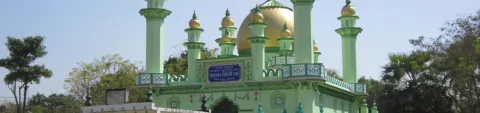
A vibrant Sufi shrine town
Location Category
Location Circuits
Location Interest
Location How Many Days
Location Group
Location Content
Text Body
There is a particular quality of crowd that gathers at Furfura Sharif that you will not encounter at any other site in Hooghly District, or indeed at most sites in West Bengal. It is not the quiet, individually-absorbed devotion of the Kamarpukur ashram, nor the tourist-adjacent reverence of the colonial churches at Bandel. It is something older and more collective: a press of pilgrims moving with intent, the air thick with attar and rose water, loudspeakers carrying qawwali across the rooftops of white-domed tombs, and vendors of green-and-gold chadars calling from every lane. Furfura Sharif is a living dargah town of the first order, the most important Islamic pilgrimage site in West Bengal, and arguably the most significant in the whole of eastern India outside of Bengal's own history.
Furfura Sharif is a pilgrimage village in Jangipara block of Hooghly district, within Serampore subdivision, roughly 35-40km from Kolkata by road. The settlement is centred on the shrine complex associated with Hazrat Abu Bakr Siddique (1846-1939), the founding pir of the Furfura Sharif silsila. His tomb, and those of his immediate descendants and associated saints, draw pilgrims from every Muslim-majority district of West Bengal, from Bangladesh, from the Assam valley, from Bihar and Jharkhand, and from the Bengali diaspora communities of Europe and the Gulf. On ordinary days the complex receives thousands of visitors; during the annual urs (the death anniversary of the founding peer) estimates of attendance range from several hundred thousand to over a million across the multi-day observance, making it one of the largest periodic religious gatherings in the Indian subcontinent.
For the non-Muslim traveller, Furfura Sharif presents a different kind of encounter than the other clusters in this guide. This is not a heritage site or a museum; it is a fully functioning, intensely alive centre of Sufi Islamic devotion, and the protocol of visiting requires attentiveness and genuine respect. Those who approach it with curiosity and an appropriate awareness of what they are entering will find it one of the most viscerally memorable experiences available in Hooghly District: a landscape saturated with scent and sound, a theology expressed through the human body in prostration, a tradition of devotion that has absorbed and reinterpreted the syncretic currents of Bengal's religious history in distinctive ways.
History & Foundation
Furfura's emergence as a centre of Islamic sanctity is rooted in the life and teaching of Hazrat Peer Abu Bakr Siddiqui, who was born in 1845 in the village of Furfura into a family of scholars and Sufi practitioners. The Furfura silsila, the chain of spiritual transmission, traces its lineage through the Qadiri and Chistia orders, two of the most widely followed Sufi tariqas in the Indian subcontinent, and ultimately to the Prophet Muhammad through Abu Bakr Siddiq, the first Caliph of Islam, from whom the family name derives.
Abu Bakr Siddiqui received his religious education in Bengal and at centres of Islamic learning in north India, and returned to Furfura to establish a khanqah (a Sufi hospice and centre of teaching) that became one of the most influential in the Bengal Presidency by the late nineteenth century. His particular approach combined rigorous observance of Islamic law (shariat) with the inner spiritual discipline of Sufi practice (tariqat), and his teaching attracted followers from across the social spectrum: rural cultivators, urban professionals, scholars, and political figures. By the time of his death in 1939, his khanqah had produced hundreds of khalifas, initiated deputies who carried his teaching to communities across Bengal, Assam, Bihar, and beyond.
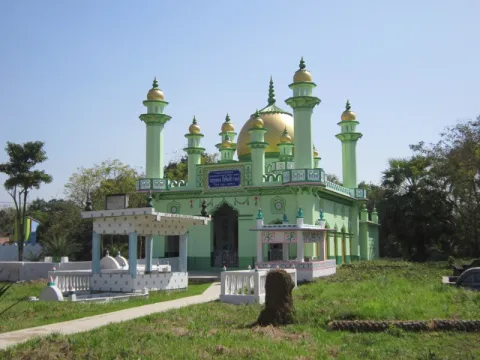
The impact of the Furfura silsila on the religious life of Bengali Muslims in the twentieth century has been immense and is arguably comparable, within the Muslim community, to the impact of the Ramakrishna movement on Bengali Hindus. The peer's descendants have continued the tradition of teaching and initiation, and the dargah complex has been progressively developed around the original tomb, which remains its spiritual centre. The complex today encompasses multiple dargahs (of the founding peer and his descendants), a substantial mosque, a madrasa, a langar (communal kitchen and feeding hall), and an extensive bazaar of devotional goods.
Title
History and Culture
Is Background Visible
Off
Location Information Items
Section Title
Top Sights and Experiences
Text Body
Getting There
From Kolkata to Furfura Sharif
Train/Bus: From Kolkata, visitors usually reach Furfura Sharif either by road or by suburban rail followed by a short road transfer. Current public routing commonly uses stations such as Baruipara or Mirzapur Bankipur, while West Bengal Tourism lists Balarambati as the nearest railhead; exact routes should be checked before travel.
Private Car/Taxi : 2-2.5 hour drive (longer during the urs festival). Book in advance for the urs due to congestion and potential surcharges.
Pilgrim Buses (Urs Only): During Urs, special buses or increased public transport may run from Kolkata to Furfura Sharif, typically early morning.
Getting Around
The Furfura Sharif complex is compact and walkable. The main dargah is 400-500m from the approach road, and other sites (subsidiary dargahs, mosque, madrasa, langar hall) are within a ten-to-fifteen-minute walk. While easy on normal days, foot movement is slow during the urs due to crowds. Cycle rickshaws serve the nearest bus stop on ordinary days but roads become pedestrian-only during the urs. Auto-rickshaws connect to surrounding villages and the Goghat road. No internal vehicle hire is needed.
What to Eat
Furfura Sharif's food culture centers on the dargah's communal hospitality. The Langar, open to all, is the best place to eat, offering standard meals (rice, dal, vegetable, sometimes meat) daily, dependent on donations. During the urs, massive quantities of festival biryani are served. A small donation is appropriate, but payment is not accepted.
Approach lanes feature tea stalls selling strong, sweet, North Indian-style chai, samosas, jalebi, and kachori. On Fridays and during urs, vendors sell excellent Calcutta-style mutton biryani (with potato), distinguished by slightly more robust spicing. Basic full-meal restaurants offer simple, halal, affordable Bengali Muslim food (rice, dal, meat curry).
The local cuisine reflects Bengali Muslim traditions, distinct from Mughal and typical Hindu Bengali cooking. Key dishes to seek out include:
- Mutton rezala (fragrant yoghurt-cardamom curry, often Friday/urs)
- Nihari (slow-cooked meat broth, early morning during urs)
- Sweets like shahi tukra (bread pudding), sewai (vermicelli in milk, Eid breakfast), and halwa (semolina/carrot sweet, festivals/langar).
The entire area is halal.
When to Go
Annual Urs (Date Varies): The most significant event at Furfura Sharif, drawing thousands of pilgrims from across eastern India. The shrine comes alive with qawwali, large-scale langar, and round-the-clock devotional activity. Accommodation and transport should be arranged well in advance.
October to March: The best time for a regular visit, with pleasant weather ideal for walking through the shrine complex and surrounding bazaar. Thursday evening qawwali gatherings and Friday Juma prayers are particularly atmospheric.
April to June: Visits are manageable on ordinary days if planned carefully. Arrive early in the morning and leave before midday to avoid the intense heat. Carry water and expect limited shade in the bazaar and approach roads.
July to September: Expect muddy roads, intermittent rain, and humid conditions. While travel can be more challenging, devotional activities continue uninterrupted, with some qawwali sessions moving indoors.
Thursdays: Weekly devotional gatherings attract larger crowds, especially in the evening during qawwali performances.
Title
Things to Know
Is Background Visible
Off
Location Images
Image
Location Banner Image
Image