Shrines, Mosques & Sacred Spaces
The Furfura Sharif complex is not a single building but an organic accumulation of sacred spaces that has grown over more than a century around the original khanqah and tomb. The layout is, by the standards of India's great dargahs, relatively intimate: the distances between principal sites are walkable, the lanes between them shaded and vendor-lined, and the overall atmosphere is of a living neighbourhood that happens to be organised around devotion rather than commerce, though the two are, here as at most dargahs, deeply intertwined.
The Principal Dargah of Hazrat Abu Bakr Siddiqui
Hours: Open daily from Fajr (pre-dawn prayer) to Isha (night prayer); the complex never fully closes during the urs
Entry: Free; offerings are entirely voluntary
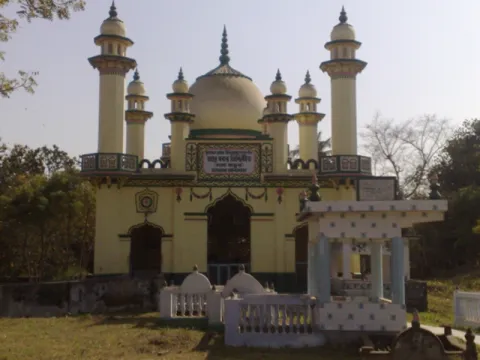
The tomb of the founding peer is the spiritual and geographic centre of the complex and the destination of most pilgrims. Set within a white-domed shrine structure of modest but dignified proportions, the dargah is approached through a succession of courtyards whose character changes as you move inward: the outermost is a broad paved space where vendors sell chadars, rose petals, attar, and incense; the middle courtyard is shaded and quieter, where pilgrims pause to compose themselves before entering; the inner chamber houses the tomb itself, covered in green-and-gold cloth (chadar) offerings and surrounded by the silver railing (zarih) customary at important South Asian shrines.
The experience of entering the inner chamber is sensory and immediate: the concentrated smell of rose water and attar applied to the zarih by thousands of hands, the sound of prayers murmured in Arabic and Bengali simultaneously, the physical press of bodies in prostration and supplication, and the quality of light, filtered through latticed screens, augmented by the glow of votive lamps, that gives the chamber an atmosphere entirely removed from the ordinary world outside. For devotees, this crossing of the threshold (the act described in the dargah tradition as crossing into the peer's ‘court’) is the central act of the pilgrimage. For respectful non-Muslim visitors, it is an experience of collective devotion whose force is palpable regardless of one's theological position.
Offering a chadar (a decorated cloth sheet) draped over the zarih is one of several important devotional acts at the tomb. Chadars are sold outside the complex in a range of sizes and elaborateness, from simple cotton sheets to embroidered silk pieces. Pilgrims carry the chadar in procession through the complex, often accompanied by qawwali musicians, before placing it on the tomb. Non-Muslim visitors are welcome to observe but should not participate in the chadar offering unless specifically invited to do so.
The Dargahs of the Descendants
The complex contains multiple additional dargahs (shrines of Abu Bakr Siddiqui's sons, grandsons, and associated saints) distributed through the compound and the surrounding lanes. Each has its own community of devotees, its own caretakers (khadims), and its own ritual schedule. The most significant are those of Abu Bakr Siddiqui's eldest son and principal spiritual successor, whose tomb is located adjacent to the main dargah, and of several other family members whose descendants continue to lead the Furfura silsila's various branches.
Walking between these subsidiary dargahs is one of the most rewarding ways to understand the spatial and social organisation of the complex. Each dargah is a node in a network of devotion, teaching, and family authority that is the silsila made physical: the chain of transmission expressed as a chain of tombs through which the pilgrim moves, making offerings at each and accumulating the barakat (spiritual blessing) that is the dargah pilgrimage's primary purpose.
The khadims (hereditary caretakers of specific shrines) are worth engaging with respectfully if the opportunity arises. They are repositories of oral history about the complex, the peer's life, and the specific traditions associated with individual shrines. Some speak English; most require Bengali or Urdu. A small donation to the shrine charity box, combined with expressed interest in the history of the dargah, is usually sufficient to open a conversation.
Comments