Getting There
By Train: The most comfortable and atmospheric way to arrive. Purulia Junction is the main railhead, served by South Eastern Railways on the Adra-Tata Nagar route. From Kolkata (Howrah), the rail distance is approximately 322km. Several trains make the journey, including the Chakradharpur Express (18011), Rupasibangla Express (12883) and the Howrah-Purulia Express (12827). The fastest services take approximately 5 hours 25 minutes. From Purulia Junction, hire a private car or taxi to Baghmundi/Charida (approximately 35-40km, 1 to 1.5 hours depending on road conditions).
By Road: From Kolkata, the road distance is approximately 320-335km via NH2 or SH5, making it feasible but long as a drive.The roads through Purulia district and up into the hills become progressively narrower and more winding as you approach Baghmundi, scenic but not fast. A private car or hired taxi from Purulia town is the standard approach to reaching the sites themselves, as local bus services, while they exist, are infrequent and slow.
By Air: The nearest airport is Birsa Munda Airport, Ranchi in Jharkhand, approximately 87km from the Ajodhya Hills area. From Ranchi, hire a taxi to Baghmundi. This option is worth considering for travellers coming from distant cities if flight connections are convenient.
Getting Around
There is no organised local transport between Pakhi Pahar, Charida and other sites in the Ajodhya Hills circuit. The standard and highly recommended approach is to hire a private car for the day from Purulia town or Baghmundi. Drivers familiar with the circuit will know all the sites and can negotiate the winding hill roads with appropriate care. Rented motorcycles are an option for adventurous solo travellers, available from Purulia town. The roads are generally well-surfaced on main routes but can be rough on minor tracks so ride carefully, especially after rain. Walking between Pakhi Pahar and Charida themselves is feasible for the fit and unhurried, as they are close to each other, but the distances to other sites in the circuit make a vehicle essential for a full day's sightseeing.
Where to Stay
There are no accommodation options in Charida village itself. The bases for staying in this area are Baghmundi and the broader Ajodhya Hills area, where a range of options has grown up in recent years to cater to the increasing trickle of tourists.
- Malgudi Resort: A well-regarded property near the Ajodhya Hills offering comfortable cottages with forest views, authentic Purulia-style home cooking and proximity to Pardi Dam, Charida and Pakhi Pahar. Operates in the spirit of an eco-retreat with a warm family atmosphere. A reliable first choice for mid-range travellers.
- Gitanjali Forest Retreat, Baghmundi: A forest-set property with a garden and reasonable facilities including WiFi. Good for those who want a comfortable base without excessive frills.
- Bamni Tourist Lodge: A functional, simple option in Baghmundi for budget travellers. No-frills but serviceable.
- Matha Forest Resort: Located near Matha Forest with tent accommodation set amid trees, free WiFi and private parking. Good for travellers who want an immersive nature experience.
- Ajodhya Hill Arcade: Features cottages and tents with attached western bathrooms. Double-bedded cottages from approximately Rs 3,500/night; tents from Rs 1,800/night. Food packages available at around Rs 600 per day per person.
- Ajodhya Guest House (The Weekender), Baghmundi: A homestay with sweeping hill views, generator backup and double-bed tent options with private bathrooms. The Upper Dam, Lower Dam and Charida are all within 10km. A good choice for the authentic homestay experience.
- Government Bungalows: The Purulia District government maintains a list of official accommodation options in Baghmundi and the Ajodhya area, which can be booked through the official district tourism channels. These are often economical and well-located, though facilities are basic.
Pro tip: Book in advance for the November-March peak season, especially over weekends and around the Chhau Mask Festival period. Availability shrinks fast on long holiday weekends when urban families from Kolkata and Asansol descend on the hills.
What/Where to Eat
Options for eating out are limited in this rural corner of Purulia, which is precisely as it should be in a place this gloriously off-grid. Most visitors eat at their homestay or resort, where home-cooked meals are prepared from locally sourced ingredients. The food of Purulia reflects the district's tribal and Bengali heritage with some Jharkhand-influenced crossovers. Look for:
- Panta Bhaat: Fermented rice soaked overnight in water, a staple of the rural Bengali table that is cooling in summer and deeply comforting in winter.
- Posto dishes: Bengali preparations using khus khus (poppy seeds) ground into paste, used with potatoes, vegetables, or as a simple fried preparation. Creamy, nutty and very satisfying.
- Litti-Chokha: A cross-border adoption from Bihar and Jharkhand: baked wheat balls stuffed with spiced roasted gram flour (sattu), served with a smoky mash of roasted aubergine and tomato. A roadside staple that, done well, is extraordinarily good.
- Seasonal Saag: Wild and cultivated leafy greens, prepared simply with mustard oil and garlic. Varies by season and what the forest and fields offer.
- Chhana sweets: Fresh-curd based sweets in the Bengal tradition: simple, milky and deeply satisfying as a dessert or afternoon snack.
- Mahua: The flower of the mahua tree (Madhuca longifolia) is an important food and beverage ingredient in tribal culture. Mahua liquor, distilled from fermented flowers, is the traditional drink of the Santhali and Munda communities and can sometimes be sampled in village contexts, so approach with appropriate curiosity and respect.
Roadside tea stalls are found at intervals along the main roads and are the social hubs of rural Purulia. A stop for tea and a conversation, however broken by language barriers, is one of the simple pleasures of travelling in this part of Bengal.
What to Buy
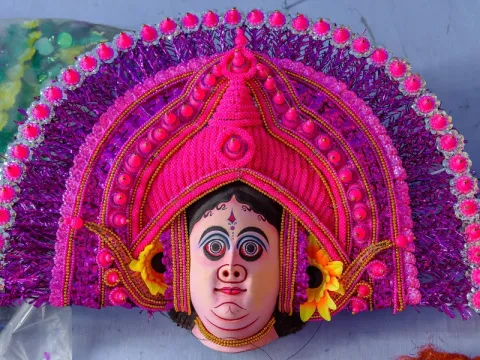
Charida is the obvious and essential shopping destination. Chhau masks make remarkable souvenirs and are genuinely unique to this village, GI-tagged, culturally significant and impossible to fake with any real artistry. Small decorative masks begin at around Rs 100; a medium-quality piece with decent detail costs Rs 500-1,500; and a fine, large, performance-quality mask with intricate decoration can reach Rs 3,000-5,000 or more. Buying directly from the artisan's workshop rather than from a middleman ensures more of the money reaches the maker.
Other crafts worth looking for in the broader Purulia area include terracotta figurines, tribal jewellery (particularly silver and beaded pieces), bamboo crafts, handloom textiles in tribal patterns and forest produce such as wild honey and dried flowers available at local haats (weekly markets).
The Charida Folk Art Centre cooperative is a reliable and ethical place to make purchases, with transparent pricing and the knowledge that proceeds directly support the artisan community.
When to Go
October to March: This is the optimal window for visiting Pakhi Pahar and Charida. The weather is crisp and clear, the sky turns a deep winter blue over the hills and temperatures are comfortable for walking and trekking. This is also the peak festival season in Purulia, where the great tribal festivals of Bandna, Tusu and Baha occur across this span and the Chhau Mask Festival takes place in December and January.
February to March: These months bring a bonus – the palash tree (Butea monosperma, the Flame of the Forest) breaks into a spectacular bloom of deep orange-red, transforming the hillsides and sal forests into what feels like a landscape on fire. This brief, ravishing window between late February and mid-March is reason enough to time a visit specifically.
July to September: This period turns the landscape intensely green and the waterfalls at Bamni and Turga surge magnificently. Trails become slippery and some roads can be affected, but for travellers who relish lush solitude and are prepared for wet conditions, the monsoon has its own melancholy beauty.