The Village
Hidden away in the Ajodhya Hills, the small village of Charida in the Baghmundi block is one of those places where an entire community has been shaped, artistically, economically, and spiritually, by a single craft. This is the undisputed capital of Purulia Chhau mask making, and has been for approximately 150 years.
The story of how this came to be is rooted in royal patronage. During the reign of King Madan Mohan Singh Deo of Baghmundi, the king invited skilled artisans from the Sutradhar community of Burdwan to settle in Charida, granting them land in exchange for their services as idol-makers for the palace. In time, these craftsmen turned their skills to the masks required for Chhau dance performances, and so a tradition was born. The first masks created here, the Kirat and Kiratni representing the divine forms of Shiva and Parvati, were the work of a craftsman named Buddeshwar, who is venerated as the founding father of Charida's mask-making tradition. A statue in the village honours his legacy.
Today, estimates suggest that somewhere between 115 and 500 families in Charida are involved in mask-making, a range that reflects the fact that many households participate in different stages of the process without exclusively identifying as mask-makers. The village has been officially recognised as a Rural Craft Hub by the Government of West Bengal in collaboration with UNESCO. In 2018, Purulia Chhau masks received the Geographical Indication (GI) tag, formally recognising the craft's unique cultural and regional identity.
Walking Through the Village
Arriving in Charida for the first time is an exercise in sensory recalibration. On both sides of the main village road, the outer walls of homes and workshops are covered in masks: fierce demon faces, beatific goddesses, snarling animal forms, all blazing with acrylic colour against whitewashed walls. The effect is of walking through a fever-dream gallery that has no roof and no entry fee.
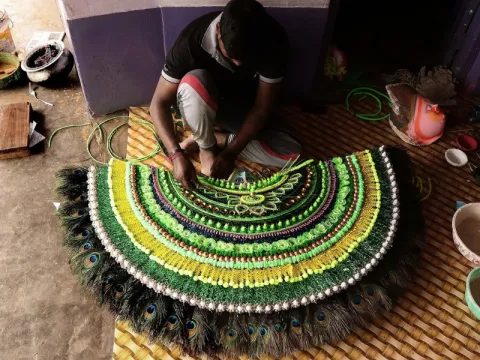
Step into any of the open workshops, most of which are simply the front rooms of family homes, and you will find the mask-making process at some stage of completion. Men typically handle the structural work: layering paper over clay moulds, applying thapi (a smoothing tool), shaping noses and eyes and brows. Women and children join in for the decorative stages, applying paint, attaching peacock feathers, gluing sequins and zari, fixing plastic flowers and coloured jute for hair. The atmosphere is one of cheerful industry: conversation, the smell of glue and paint, children watching with curiosity or lending small hands to simpler tasks.
Mask-makers are generally welcoming to respectful visitors. If you ask questions about process, about characters, about which deity this bright-eyed face represents, you are likely to receive a tour of the workshop, a demonstration of technique, and possibly tea. The key word here is respectful: these are working homes, not museums and the craft is both livelihood and cultural identity.
Article Content
Text Body
Is Background Visible
Off
Published on
Article Image
Image
Updated On
Read Time
3
Article Type
Location
Article Videos
Is Background Visible
Off
Upload Video
Content Family
General Purpose
Image Gallery
Upload Images
Is Background Visible
Off
Images View Mode
Simple
Video Gallery
Is Background Visible
Off
Upload Video
gallery view mode
horizontal
action if location
default
Comments