In the footsteps of Ramakrishna and Sarada Devi
Location Category
Location Circuits
Location Interest
Location How Many Days
Location Group
Location Content
Text Body
There is a moment, somewhere on the red laterite road between Kamarpukur and Jayrambati, when the mango orchards close overhead, the village sounds drop away and you find yourself in a landscape that has changed very little in two centuries. Paddy fields stretch to a flat horizon fringed with palm trees. A pair of white cranes stand motionless at the edge of a tank. The sky is enormous. It is the kind of scene that makes the biographical accounts of Sri Ramakrishna Paramahamsa suddenly legible: this is the world that shaped him and it is, astonishingly, still largely intact.
By any conventional measure, Kamarpukur and Jayrambati are modest hamlets in the interior of West Bengal, the first in Hooghly district, the second in Bankura, lying just a short distance apart and unified by the sacred legacy of Sri Ramakrishna and Sri Sarada Devi. About a hundred kilometres from Kolkata, removed from the river towns and the colonial-era heritage corridors, these quiet settlements sit on red-soil farmlands and together form one of Bengal's most revered pilgrimage clusters. Kamarpukur was the birthplace of Sri Ramakrishna, born on 18 February 1836, whose life and teachings inspired the Ramakrishna movement and profoundly influenced Swami Vivekananda. Jayrambati was the birthplace of Sri Sarada Devi, born on 22 December 1853, who became a central spiritual figure in her own right within that tradition.
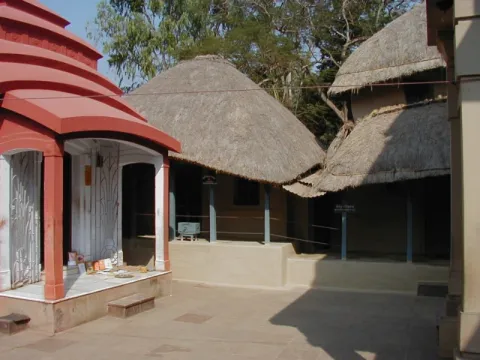
The Ramakrishna Math and Mission has developed both villages as pilgrimage sites, constructing temples, ashrams and guest houses around the original birthplace compounds. What they have not done and what makes the cluster so rewarding for the thoughtful traveller, is sanitise or over-formalise the landscape. Beyond the immediate temple precincts, the villages remain genuinely rural: cows amble along the lanes, women carry water pots on their heads past the same tank where Ramakrishna bathed as a child and the red dust of the laterite roads settles on everything with democratic impartiality. The pilgrimage here is as much about landscape and village atmosphere as about specific monuments.
This is not a cluster for those seeking architectural spectacle or colonial drama. It is for those drawn by spiritual biography, rural Bengal and the particular quality of stillness that attaches to places where important lives were lived. Come with time, come with some knowledge of Ramakrishna's life and come, if possible, in winter, when the air is clear and the light on the rice fields turns golden.
History & Significance
Kamarpukur in the early nineteenth century was a modest agricultural village on the red laterite plateau of south-western Bengal, fertile enough to support paddy cultivation and mango orchards, but remote from the river trade routes that enriched the Hooghly corridor to the east. The village had a handful of temples, a weekly market, a community of weavers and artisans and the usual social hierarchy of rural Bengal. The Chatterjees, a family of Brahmin priests of modest means, occupied a small compound near the centre of the village and it was here that Khudiram Chatterjee and his wife Chandramani Devi had their fourth child on the eighteenth of February 1836. They named him Gadadhar. He would later be known to the world as Ramakrishna.
Ramakrishna spent his childhood and early adolescence in Kamarpukur, absorbing the village's devotional atmosphere, its Shiva temples, its kirtan gatherings, its Vaishnava traditions, before leaving for Kolkata around age sixteen to assist his older brother Ramkumar, who ran a Sanskrit school in the city. After the Dakshineswar Kali Temple was consecrated in 1855, both brothers became associated with its worship and on Ramkumar's death the following year, Ramakrishna assumed the role of priest. He returned to Kamarpukur periodically throughout his life and his biography is saturated with references to specific places in and around the village: the Yogi’s Shiva temple, the bathing tank, the mango orchards, the road to Sihar. To walk through the village with even a passing knowledge of his life is to move through a densely annotated landscape.
Sarada Devi was born in the neighbouring village of Jayrambati in 1853, the eldest daughter of Ramachandra Mukhopadhyay and Shyamasundari Devi. Betrothed to Ramakrishna at the age of five, a customary arrangement in rural Bengal at the time (though the marriage was never consummated), she came to live with him periodically from around age eighteen. After Ramakrishna's death in 1886 she became the spiritual mother of the nascent Ramakrishna movement, guiding the disciples who would go on to found the Math and Mission. She died in Kolkata in 1920, but her birthplace in Jayrambati has been preserved and developed as a pilgrimage site of equal importance to Kamarpukur.
Both villages are maintained by branch centres of the Ramakrishna Math and Ramakrishna Mission. The monastic order traces its origins to the Baranagar monastery established shortly after Ramakrishna's death in 1886; the Mission was formally founded by Swami Vivekananda on 1 May 1897. Legally and financially separate but closely interrelated, the two organisations have built temples, guest houses, hospitals, schools and rural development programmes in both villages, transforming what were once remote agricultural settlements into well-managed pilgrimage destinations. The institutional presence is conspicuous and it brings its own aesthetic, but it has also preserved sites that might otherwise have been lost and created the conditions under which visitors from anywhere in the world can come and stay comfortably.
Title
History and Culture
Is Background Visible
Off
Location Information Items
Location item element
Section Title
Top Sights and Experiences
Text Body
Getting There
Train: Take a Howrah-Arambagh line train to Arambagh (2.5-3 hrs; trains every 1-2 hrs). From the Arambagh bus stand (10-min walk/short auto ride), frequent buses go to Kamarpukur (45-60 mins; first bus ~6:30-7am). Connect to Jayrambati from Kamarpukur or directly from Arambagh on some routes.
Bus: SBSTC/private buses run from Esplanade, Kolkata, to Arambagh and beyond (3-4 hrs). Check at Esplanade for Kamarpukur direct services.
Private Taxi/Car: Drive from central Kolkata via NH-16 to Arambagh takes ~2.5-3 hours. Pre-book a private car.
Getting Around
The principal sites within Kamarpukur are easy to cover on foot. Jayrambati lies only a short distance away and most visitors make the transfer by auto-rickshaw, cycle-rickshaw or hired car, though some pilgrims still prefer to walk between the two villages in cool weather.
What to Eat
Food in the Kamarpukur-Jayrambati cluster is simple and predominantly vegetarian. Pilgrims can usually obtain bhog or prasad at the ashram dining halls at midday and in the evening, with coupons collected in the morning. Tea stalls and small local eateries around the village centres provide chai and basic snacks throughout the day.
Local specialities, rooted in the agricultural economy, include seasonal items: aamer ambol (a raw-mango condiment), khejur gur and nolen gur (date-palm jaggery, available in winter), moa (a puffed-rice sweet), payesh (rice pudding) and taler bora (palmyra-fruit fritters, eaten in monsoon and early autumn).
Best time to visit
October to March: The ideal time to visit. This period offers dry, cool weather (18-30°C), passable roads, beautiful fields (green paddy, gold harvest, bare earth) and pleasant walking. November to December: Good time to visit due to the coolest weather, best light and nolen gur availability.
April to June: Summer is difficult, temperatures hit 38-43°C, heat is intense and shade is minimal. Visit early (by 9am, finished before noon) if you must.
July to September: Monsoon brings lush landscapes and high drama, but also challenges: slippery, occasionally flooded roads, bus disruptions and mud. September is the gentlest of the monsoon months with lush, tapering rains and crowd-free, ideal for experienced travellers.
Key Dates:
These draw large crowds but offer an incredible atmosphere.
Ramakrishna Jayanti: late Feb/early March, bringing festive energy to Kamarpukur
Sarada Devi Jayanti: late December, making Jayrambati a focal point for thousands of pilgrims Kali Puja/Diwali: October-November, atmospheric village celebrations
Durga Puja: October, Jayrambati's Simhavahini Puja
Title
Things to Know
Is Background Visible
Off
Location Images
Image
Location Banner Image
Image