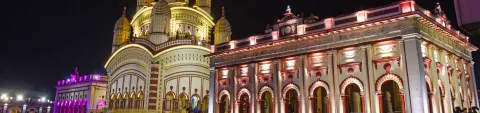
The two most revered temples along the banks of the Hooghly River
Location Category
Location Circuits
Location Interest
Location How Many Days
Location Group
Location Content
Text Body
There is a bend in the Hooghly River, about 20km north of central Kolkata, where the sacred and the extraordinary press together so tightly they become indistinguishable from one another. This is Dakshineswar: part suburb, part pilgrimage city, wholly unlike anywhere else in West Bengal. The air here carries incense and river-mist in equal measure. Barefoot devotees press through narrow lanes hung with marigold garlands. Sadhus meditate beneath the shade of old trees. Ferryboats churn across the brown water toward the ochre battlements of Belur Math on the opposite shore.
The Dakshineswar-Adyapeath Belt is not a tourist circuit in any conventional sense. It has no ticketing system, no air-conditioned museum lobbies, no glossy orientation boards. What it has instead is something rarer: an unbroken, living spiritual tradition that has shaped the intellectual and devotional life of Bengal for nearly two centuries. Here, the foundational figures of this riverbank – Rani Rashmoni, Sri Ramakrishna Paramahamsa, Swami Vivekananda and Sri Annada Thakur – are not relegated to the status of mere historical footnotes. They are presences, their rooms preserved, their stories retold daily in the songs of the Natmandir.
Come for the temples. Stay for the river. Leave with the strange, quiet feeling that something in you has been rearranged.
The Village Before the Temples
During the early 19th century, Dakshineswar was essentially a wooded village situated on the Hooghly's eastern bank. Its name originated from the Sanskrit word Dakṣiṇeśvara, which refers to a form of Shiva. The ancient lingam temple dedicated to this form of Shiva was located about 1.5km north of the future site of the famous Kali temple. The locality was known then as Deulpõtā, a name that hints at older, submerged temples. Dense vegetation screened the riverbank. The land itself was unremarkable, yet a curious detail set it apart: a section of it resembled a tortoise's back. This shape held significance in Tantric tradition, as it was considered an auspicious form for the worship of Shakti.
Rani Rashmoni and the Dream
In 1847, a wealthy zamindar named Rani Rashmoni was preparing to make a grand pilgrimage to Kashi (Varanasi). According to a tradition upheld at this riverbank, the Goddess Kali appeared to her in a dream, instructing her to construct a temple on the spot. This vision came just as her fleet of 24 boats, laden with family, staff and provisions, was on the verge of setting sail.
Rashmoni was no ordinary devotee. Despite being a woman from the Mahishya community, a caste considered outside the ritual pale by the orthodox Brahmin society of the time, she was renowned throughout Bengal for her philanthropy. Furthermore, she was formidably wealthy and politically astute. She purchased 54.4 bighas of land in Dakshineswar. Part of the land had been a Muslim burial ground; another part belonged to a European named James Hastie. The choice of this religiously mixed site to consecrate a Hindu temple was not accidental: Rashmoni's vision of worship was explicitly inclusive.
Construction began in 1847. On the auspicious occasion of the Snana Yatra, eight years and nine hundred thousand rupees after the project began, the image of Bhavatarini Kali was installed on a thousand-petaled silver lotus. The installation, which took place on 31 May 1855, was marked by festivities that attracted over a hundred thousand Brahmins. The Dakshineswar Kali Temple was born.
Rashmoni survived the inauguration by barely five years, dying in February 1861. The movement she initiated would be continued by a young priest from Kamarpukur. This priest, Gadadhar Chattopadhyay, would later be known to history as Sri Ramakrishna Paramahamsa.
Ramakrishna: The Mystic of Dakshineswar
Ramakrishna arrived at the temple in 1855 as an assistant to his elder brother Ramkumar, who had been appointed head priest. When Ramkumar died the following year, Ramakrishna took over as priest of the main Kali shrine. The subsequent three decades were marked by extraordinary events: a time of profound mystical experience, including trances, visions and ecstasies, which attracted scholars, aristocrats and spiritual seekers from all over India to this riverbank.
Ramakrishna explored not only the devotional traditions of Hinduism but also Islam (retreating to a spot northeast of the pond, now marked as Gaji Tala, where he is said to have followed Islamic practice for a period) and Christianity. The site's ultimate philosophical contribution was his conclusion that all religious paths converge upon a singular truth, a tenet that subsequently fueled the genesis of one of India's major spiritual movements.
His room in the northwest corner of the temple courtyard, with its semicircular verandah overlooking the river, is preserved as a shrine. His wife, Sri Sarada Devi, who came to be revered as the Holy Mother, stayed in the Nahabat near the temple precincts; her small ground-floor room is now a shrine. The entire complex is saturated with the presence of these two figures.
Among Ramakrishna's disciples was a brilliant young man named Narendranath Datta, who would eventually electrify the world's religious imagination at the Parliament of Religions in Chicago in 1893 as Swami Vivekananda, and who would go on to found the Ramakrishna Mission on the opposite bank of the Hooghly at Belur.
Sri Annada Thakur and Adyapeath
The origin story of the area's second major spiritual hub is just as extraordinary. In 1915, Annada Charan Bhattacharya, a successful Ayurvedic physician and devoted follower of Ramakrishna, experienced a series of supernatural visions. These visions featured a spectral image of the Goddess Kali moving through Kolkata and frequent dreams of a monk calling him to renounce his secular life.
Acting on what he took to be Ramakrishna's dream-given guidance, Bhattacharya and three others searched a pond at Kolkata's Eden Gardens located near a coconut and a pakur tree. There, they unearthed a small, meticulously detailed black marble Kali idol, less than a foot tall, with jewelled eyes. He brought this figure home for his daily worship.
The narrative continued with more mystical instructions, including the idol's immersion and a subsequent miracle, eventually leading to a vision for a charitable complex. This plan detailed an institution providing refuge for widows and orphans, along with medical and educational services. The centerpiece was a unique architectural design of three tiered temples: Sri Ramakrishna at the base, Adya Ma in the center and Radha-Krishna at the summit. The Siddhotsab event on January 14, 1921 marked the official establishment of the Dakshineswar Ramakrishna Sangha Adyapeath, commonly known as Adyapeath.
Title
History and Culture
Is Background Visible
Off
Location Information Items
Section Title
Top Sights and Experiences
Text Body
Getting There
By Metro: Since 2021, the Blue Line offers an efficient 35-45 minute air-conditioned journey from central Kolkata (Esplanade, Dum Dum, Belgachia) directly to Dakshineswar Station.
By Local Train: Trains from Sealdah take 30 minutes, stopping 400 metres south of the temple amidst local shops. Long-distance trains like the Kanchenjunga Express also stop here.
By Bus: Regular buses from Esplanade take 45-60+ minutes depending on traffic. Metro or train is recommended for weekends and festivals.
By Ferry: A scenic 15-25 minute ride crosses the Hooghly from Belur Jetty (near Ramakrishna Mission) to the temple, operating from 7:30am to 7:30pm.
By Air: Netaji Subhash Chandra Bose International Airport is 8km away, reachable by taxi in 20-40 minutes.
Getting Around
Within the belt, walking is the best option. The distance between the Kali Temple and Adyapeath is about 1km, requiring a 10-15 minute walk to the south via D.D. Mondal Ghat Road. Auto-rickshaws and cycle-rickshaws are abundant for those who prefer not to walk. For the return journey to central Kolkata, the metro is usually the fastest option; for Belur Math, take the ferry.
What to Eat
Like most Indian holy sites, the area operates on the belief that devotees should be fed generously and affordably.
Adyapeath Prasad: The region’s most meaningful meal. Daily, between 300 and 1,000 visitors receive free bhog (rice, lentils, vegetables and sweets) prepared according to divine instructions and served without distinction of caste or creed. Arrive late morning for the full experience.
Temple Food Plaza: A clean, functional vegetarian food court on AC Sarkar Road serving South Indian and Bengali staples.
Belur Math: Simple vegetarian food is available on-campus, though more diverse dining is found across the river or toward Howrah.
When to Go
October to March: This is the ideal time to visit, with cool, dry weather and clear skies. Mornings are especially beautiful, lit by Bengal's distinctive winter light — golden and crisp, with river mist lingering at dawn before giving way to warm sunshine by mid-morning. The major festival season, including Durga Puja and Kali Puja, falls within this period, lending the town an especially vibrant atmosphere.
April to June: Temperatures steadily climb towards 40°C, accompanied by rising humidity before the monsoon. Visitor numbers are lower, making for a quieter experience, but the heat can be intense, so plan outdoor activities for early morning or late afternoon and stay well hydrated.
July to September: The river is at its most dramatic, flowing deep and fast with brown-gold silt, while the temple's rain-washed colours stand out vividly against brooding monsoon skies. However, heavy rainfall can disrupt travel. If travelling in August or September, check local weather and road conditions before setting out.
Title
Things to Know
Is Background Visible
Off
Location Images
Image
Location Banner Image
Image