Explore a riverside forest named after author Bibhutibhushan Bandyopadhyay
Location Category
Location Circuits
Location Interest
Location How Many Days
Location Group
Location Content
Text Body
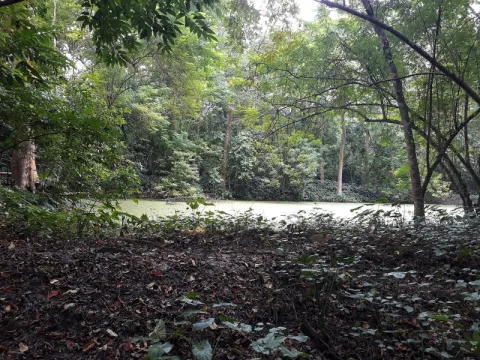
Somewhere between the rice paddies of the Bongaon subdivision and the winding channel of the Ichamati River, the ancient waterway that now forms part of the Indo-Bangladesh border, there is a small wedge of forest that carries one of the most resonant names in Bengali literature. Bibhutibhushan Wildlife Sanctuary, still called Parmadan Forest by virtually everyone who knows it, is not a place that announces itself. It sits quietly off the bus route, accessed by van-rickshaw down a narrow road, bounded on three sides by the slow bends of the Ichamati.
At 0.68 square kilometres, Bibhutibhushan Wildlife Sanctuary is one of West Bengal’s smallest wildlife sanctuaries. Small though it is, the forest remains an unusual refuge in the densely settled landscape of North 24 Parganas. The forest is home to more than 380 chital (spotted deer), a boisterous population of common langurs and a birdlist that has attracted the attention of ornithologists and citizen-naturalists alike, including the electrifying Indian Paradise Flycatcher and the imperious Crested Serpent Eagle. The Ichamati River forms a natural border with Bangladesh, surrounding communities along its banks. A boat journey on this river offers one of the district's most serenely beautiful experiences, as you glide past the reflection of the forest and see village fishermen along the Bangladesh bank.
The sanctuary honours Bibhutibhushan Bandyopadhyay (1894-1950), whose family roots lay in the Bongaon region of North 24 Parganas. His writing is deeply shaped by the rural and riverine worlds of Bengal, and Ichhamati in particular gives the Ichamati River a lasting literary afterlife. A walk through Parmadan feels like stepping into a novel by Bibhutibhushan Bandyopadhyay: sunlight filters through the sal canopy, a deer is barely discernible in the dense undergrowth, and the Ichamati River shines subtly near the edge of the trees.
From Deer Park to Sanctuary
The story of Parmadan as a managed wildlife space begins in 1964, when fourteen chital were released into this patch of reserved forest on the Ichamati bank. The release was an act of far-sighted conservation thinking in a district that had been radically transformed by the demographic shockwaves of the 1947 Partition of India. The massive influx of refugees from East Bengal, who crossed the newly established Bangladesh border, created immense strain on the limited land resources throughout North 24 Parganas. Natural forest here was already essentially gone, eaten by agriculture and settlement. Parmadan was a deliberate attempt to hold a fragment back.
In 1980, the forest was formally gazetted as Parmadan Wildlife Sanctuary under the provisions of the Wildlife (Protection) Act 1972, officially moving it from reserved forest status to a dedicated protected area. The sanctuary was renamed in 1995 to honor the novelist Bibhutibhushan Bandyopadhyay. Bandyopadhyay, whose ancestral home was in Gopalnagar, Bongaon, within this landscape, was the author of the novel Ichamati. This novel, set on the river that surrounds the forest, was posthumously recognized with the Rabindra Puraskar, West Bengal's highest literary honour.
The Ichamati & the Partition Landscape
The Ichamati River is at the heart of this place in every sense. Originating as a bifurcation of the Mathabhanga River near Majidia in Nadia's Krishnaganj block, it flows south through Nadia and North 24 Parganas, forming a serpentine natural border with Bangladesh for much of its lower course. The river gave its name to one of Bibhutibhushan's most important novels: Ichhamati (translated into English as Ichhamoti), a sweeping saga set in the 19th century that captures the feudal, riverine Bengal of indigo planters, caste society and peasant revolts.
Bibhutibhushan Bandyopadhyay: The Forest's Namesake
To understand why this patch of woodland bears the name it does, one must know something of the man. Bibhutibhushan Bandyopadhyay (12 September 1894 - 1 November 1950) is considered one of the greatest novelists of modern Bengali literature. Martin Seymour-Smith, in his Guide to Modern World Literature (1973), described him as ‘perhaps the best of all modern Indian novelists,’ writing that ‘probably nothing in twentieth-century Indian literature, in prose or poetry, comes to the level of Pather Panchali.’
His novels Pather Panchali and Ichhamati are set in the Bengal landscape including the Bongaon region. His deep feeling for the natural world suffuses everything he wrote: the murmur of palash flowers, the flight of a brahminy kite over the paddies, the quality of morning light on a village pond. The acclaimed Apu Trilogy, directed by Satyajit Ray, brought Bibhutibhushan's world to a global audience through cinematic adaptations of Pather Panchali and its sequel, Aparajito. Visiting Parmadan is, for devotees of Bengali literature or Ray's cinema, a small pilgrimage: this is the landscape, on this very river, where the imagination that created Apu was nurtured.
The Landscape
Parmadan Forest occupies a peninsula of land formed by a great bend in the Ichamati, bounded on its north, south and east sides by the river and to the west by the villages of Parmadan and Jhupa. This riparian configuration means that wherever you stand inside the forest you are never far from the sound and sight of water. The Ichamati river presents itself here as a wide, sluggish channel. While it flows slowly during the dry season, it undergoes a dramatic swelling during the monsoon. On the far bank, visible from the riverside path, are the paddy fields, fishing boats and thatched houses of Bangladesh.
The forest is classified as northern tropical moist deciduous, with a distinctive two-storied open canopy. Official forest documents record 214 plant species, including trees, shrubs, herbs and two species of bamboo, weaving through the dense understorey. The riverbanks are characterized by prominent hijal (Barringtonia acutangula) swamps, which possess great beauty during the monsoon season when their flowers drop in crimson spikes above the water. This is a remarkable botanical count considering the sanctuary spans less than one square kilometre; layers of vegetation create a complex microhabitat that supports an outsized diversity of animals.
The Sundarban Connection
Parmadan's formal inclusion within the Sundarban Biosphere Reserve designation is not merely administrative. North 24 Parganas is the district where the world's largest mangrove ecosystem meets the intensely cultivated Gangetic plains and the ecological threads connecting these different habitats run through the wetlands, waterways and forest fragments of the district's interior. Parmadan sits at the northern end of this corridor, serving as a refuge and waypoint for species moving through an otherwise highly degraded landscape.
Trees & Plant Life
The dominant trees of Parmadan Forest are sal (Shorea robusta), teak (Tectona grandis), arjun (Terminalia arjuna) and shisham (Dalbergia sissoo), with bamboo thickets weaving through the lower canopy. The riverside hijal trees are a particular feature, their gnarled, water-tolerant roots gripping the Ichamati bank and providing roost sites for a variety of waterbirds. The sanctuary's most noticeable inhabitants are the deer herds, which thrive in a green, almost enclosed interior that creates an ideal habitat.
Mammals
Despite its small size, the sanctuary supports a modest mammal assemblage in addition to its enclosed deer population, including rhesus macaques and small mammals recorded by the Forest Department. The headline residents are:
- Chital/Spotted Deer: The sanctuary is best known for its spotted deer population: in the 2019 eco-sensitive-zone notification, the Forest Department recorded about 381 deer within a sanctuary fenced on all sides. The fenced deer enclosure near the entrance is the prime viewing spot, especially around 9am when forest officials conduct the daily morning feeding. This drawing spectacle is particularly delightful for visiting children. Free-ranging herds are also active throughout the forest at dawn and dusk.
- Common Langur: A boisterous, highly visible population of these silver-grey primates inhabits the upper canopy. These primates are the forest's loud, early-warning system. Their sharp, repetitive, bark-like alarm call often alerts others to something noteworthy in the vicinity, earning them a reputation as noisy neighbors.
- Rhesus Macaque: Also present, typically in the forest margins and near the entrance area.
- Jackal: More often heard than seen; their chorus at dawn and dusk is one of the characteristic sounds of Parmadan.
- Indian Porcupine: Nocturnal; most likely encountered by overnight guests, shuffling through the undergrowth after dark.
- Jungle Cat: Elusive, occasionally reported by forest guards and patient early-morning visitors.
- Mongoose & Black-naped Hare: Both commonly encountered darting across the trails.
Reptiles
The forest and its riverbanks support a variety of reptiles. Reticulated and Indian rock pythons are reported, as are monitor lizards (Varanus bengalensis) which are frequently seen basking on sunny riverbanks. Freshwater turtles use the Ichamati margins. The sanctuary's proximity to the Sundarban corridor means the occasional estuarine crocodile has been recorded in the river, though not within the forest itself.
Birds
Birdlife is one of Parmadan’s chief strengths. A multi-season study conducted between 2013 and 2016 recorded 102 species, while a shorter Nature Mates dataset from May 2023 logged 49 species over two survey days. Together, they suggest a small but notably productive birding site. Notable species include:
- Indian Paradise Flycatcher: The most spectacular bird of the forest. The adult male trails impossibly long white ribbon-like tail feathers as it flits through the sub-canopy, making it one of the most visually extraordinary birds in India. Its presence here is a highlight for any visiting birdwatcher or photographer.
- Crested Serpent Eagle: A powerful, round-winged raptor that regularly soars over the forest and river margins. The bird's characteristic, loud presence, signaled by a ringing, two-note whistle, is frequently heard before it comes into view.
- Great Tit, Rose-ringed Parakeet, Alexandrine Parakeet: All common and conspicuous, filling the canopy with colour and noise.
- Kingfishers (Common, White-throated, Pied): The Ichamati riverbanks are ideal kingfisher habitat; three species are regularly recorded.
- Herons & Egrets (Grey, Purple, Little, Intermediate, Great Egret): Abundant along the hijal-fringed banks.
- Owl species (Spotted Owlet, Brown Fish Owl): The overnight visitor has a good chance of hearing the Fish Owl calling across the river after dark.
- Drongos, Orioles, Bee-eaters & Rollers: All present and easily observed.
- Migratory species (Oct-Feb): Winter brings a range of warblers, flycatchers and occasionally rarer visitors moving along the Gangetic corridor.
Title
History and Culture
Is Background Visible
Off
Location Information Items
Section Title
Top Sights and Experiences
Text Body
Getting There
By Public Transport: Travelling by train and local bus offers the most authentic way to reach Parmadan and allows visitors to experience the rural landscapes of North 24 Parganas.
Route 1 (via Ranaghat – Recommended):
Take a train from Sealdah to Ranaghat Junction (approximately 1.5 hours). From Ranaghat, board a bus to Sindrani (around 45 minutes), followed by an auto-rickshaw or van rickshaw to Parmadan (15–20 minutes).
Route 2 (via Chakdaha):
Take a train from Sealdah to Chakdaha Junction, then board Route 32 bus to Sindrani. From there, continue by auto-rickshaw to Parmadan. Chakdaha is a convenient alternative transport hub south of Ranaghat.
Route 3 (via Bongaon):
Take a train from Sealdah to Bongaon Junction (approximately 2 hours), followed by Route 92 bus to Naldungri, the nearest bus stop to the sanctuary. From Naldungri, hire a van rickshaw for the remaining 3 km to Parmadan.
By Car: Driving is the most convenient option for families, groups and visitors planning to stay overnight in the area.
Via NH-112 (Jessore Road): Drive north from Kolkata through Bongaon, then continue towards Duttafulia and Helencha via Naldungri. The journey covers approximately 100–110km and takes around 2.5–3 hours, depending on traffic.
Via NH-12: Follow NH-12 north towards Chakdaha or Ranaghat, then head east via Sindrani to Parmadan.
Navigation apps reliably recognise "Parmadan Forest" and "Bibhutibhushan Wildlife Sanctuary." Visitor parking is available near the entrance.
By Air: The nearest airport is Netaji Subhas Chandra Bose International Airport (CCU) in Kolkata, approximately 100km away. From the airport, visitors can either hire a taxi directly to Parmadan or travel to Sealdah Railway Station and continue by train using one of the routes above. There are no regional airports serving the area.
Opening Hours: Sunrise to sunset (approx. 6am–5pm); confirm with the forest office as times vary seasonally.
Entry Fee: Rs 100 per person under the current Forest Department conservation-charge order; children below five are exempt.
Photography: Mobile phone and tablet photography are free; DSLR and video cameras are charged Rs 200.
Guide: Forest guards/guides available at entrance; a guide is recommended, especially for birding.
Note: Timings, guide availability and local arrangements should be confirmed with the Forest Department before travel, as these may change.
What to Eat
The Bamboo Chicken, a regional delicacy of chicken slow-cooked inside a bamboo hollow over an open fire, is highly recommended. While meals are generally part of overnight packages, day visitors can sometimes arrange a simple lunch by calling the camps in advance.
Best time to visit
November to February: Peak season and the best time to visit. Cool, pleasant weather, excellent wildlife visibility and abundant migratory birds create ideal conditions for exploring the forest and the banks of the Ichamati River.
October & March: Pleasant shoulder months with warm days and relatively light visitor numbers. October marks the arrival of the first migratory birds and the forest remains lush after the monsoon, while March offers good wildlife viewing during the cooler morning hours.
April to June: Summer brings high temperatures and humidity, with daytime highs often reaching 35–40°C. Wildlife activity is largely confined to the early morning, making dawn visits the most comfortable and productive.
May to June (Firefly Season): A remarkable natural spectacle unfolds as thousands of fireflies illuminate the forest after dusk. Although the heat can be intense during the day, evening visits during this brief seasonal display are especially memorable. The pre-monsoon Ichamati River is also particularly scenic at this time.
July to September: The monsoon transforms the forest into a lush green landscape, with the Ichamati in full flow. While the scenery is spectacular, heavy rainfall can make trails muddy, boat rides unpredictable and wildlife more difficult to observe. This season is best suited to experienced nature enthusiasts rather than first-time visitors.
Title
Things to Know
Is Background Visible
Off
Text Body
Gopalnagar: Bibhutibhushan's Ancestral Home
Gopalnagar, on the Ichamati, is a literary pilgrimage to Bibhutibhushan Bandyopadhyay's ancestral home. The author spent his formative years here, taught at the local institution and featured the landscape in his fiction. The preserved house and village evoke his novels. It is also the birthplace of Dinabandhu Mitra, author of Nildarpan. Both writers' heritage homes are in Gopalnagar (Mitra's at Chouberia) and can be visited together for a rich literary-historical outing.
Taki & the Indo-Bangladesh Ichamati Border
Taki, approximately 50km north of Parmadan, is a compelling stop on the Ichamati. Sitting on the Indo-Bangladesh border, divided only by the river's width, it has a unique atmosphere: old zamindarbaris line the waterfront, fishing boats cross constantly and simultaneous Durga Puja immersions occur from both countries. It's developed as an eco-tourism and heritage destination, with the Sundarban Bio-Diversity and Interpretation Centre (Mini Sundarban/Golpata Forest) nearby.
Chandraketugarh: Ancient Bengal's Forgotten Capital
Chandraketugarh, 60-70km southwest of Parmadan near Berachampa, is one of India's most underappreciated archaeological sites, dating to at least the 3rd century BCE. Possibly the ancient Gangaridai/King Sandrocottus's fortified urban centre and river port, it flourished through the Mauryan, Gupta and Pala-Sena periods. Surviving features include substantial earthen ramparts, mounds and exceptional excavated terracotta art (plaques, figurines, coins) spanning Bengali civilization. The Chandraketugarh Museum in Berachampa displays 244 artefacts.
Barrackpore: Colonial Heritage on the Hooghly
For those using the western corridor, Barrackpore offers colonial heritage: it was an early British military settlement and the site of the 1857 Sepoy Mutiny's first shots. Key sites include Gandhi Ghat, Mangal Pandey Park and the Flag Staff House. A visit links Barrackpore's colonial history with Parmadan's indigo-era history, creating a continuous narrative of British rule in Bengal.
Title
Nearby Excursions
Is Background Visible
Off
Location Images
Image
Location Banner Image
Image