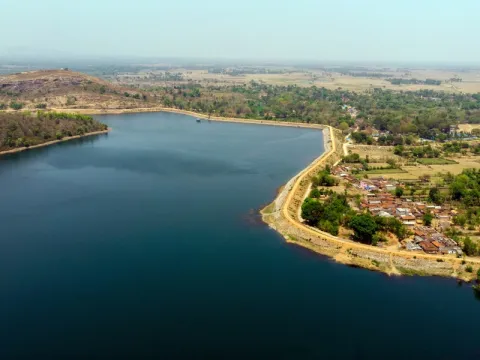
Out where West Bengal collides with Jharkhand, the land changes its mind. The flat, river-fed plains of southern Bengal crumple upward into the eastern toe of the Chota Nagpur Plateau and the soil turns abruptly red. This is Purulia. Nestled within its western folds are two of eastern India’s most rewarding weekend getaways: the serene, island-dotted Murguma Dam and the dramatic, 500-step descent of Bamni Falls.
Neither is a marquee destination. You will not queue. You will not be pestered by touts. You may, in fact, wonder once or twice whether you've taken the right turn. That is precisely the point.
Why come here? Three good reasons, in roughly this order:
The landscape: The Ajodhya Hills are remarkably old, being composed of billion-year-old gneiss and they wear their age well. Rolling, rounded summits clad in sal and segun forest; rivulets that vanish for half the year and roar for the other half; islands sitting plump in the middle of a man-made lake. It looks like nowhere else in Bengal.
The tribal cultural seam: This is Santhal country, with Munda, Bhumij and Birhor communities woven through it. Down in the village of Charida, an hour's drive away, families have been hand-carving the spectacular masks for the Chhau dance for generations. You can watch them work. You can buy a mask for less than a coffee in a Kolkata mall.
The Palash bloom: For roughly three weeks each spring, from the back half of February into the first half of March, the Butea monosperma trees explode into red-orange flame. The hillsides look as if someone has set them tastefully alight. It is one of the great seasonal spectacles of eastern India and almost no one outside Bengal seems to know about it.
Getting There
By Train: The most useful station is Purulia Junction, on South Eastern Railway's Adra-Tatanagar route. From Kolkata's Howrah and Shalimar stations, the Howrah-Chakradharpur Express (18011), Rupasi Bangla Express (12883) and Howrah-Purulia Express (12827) all serve it; the fastest take a touch over five hours. Purulia town is about 50km from Murguma and 45km from the Bamni Falls trailhead.
If you prefer a different angle of approach, Barabhum is about 30 minutes east of Purulia by road and closer to the southern face of the Ajodhya Hills, while Muri Junction in Jharkhand is the natural railhead for Murguma, allowing you to reach the dam in well under an hour from there. Jhalda station is the literal closest stop to Murguma at around 16km, though fewer trains call.
By Air: There's no airport in Purulia itself. The two practical options are:
- Birsa Munda Airport, Ranchi: about 95-120km depending on which corner of the hills you're heading for. This is the closer and faster option, with a decent road through Muri.
- Netaji Subhas Chandra Bose International Airport, Kolkata: about 250km from Purulia. Workable as a fly-and-train combination but a long haul if you try to drive it in one go.
By Road: From Kolkata, expect six to seven hours via Durgapur, Bankura and Raghunathpur on NH19. Both government and private buses (some with AC) run from Esplanade and Karunamoyee to Purulia town, after which you'll need a hired car. Self-drivers should fill up before climbing into the hills because there is no fuel station on the Ajodhya Hilltop, a detail that has stranded more than one optimistic visitor.
From Ranchi, the drive is about three hours and pleasant the whole way.
Getting Around
Public transport is patchy and disinclined to follow a published timetable. Realistically, you have three options:
- Hire a car for the day at Purulia Junction or Barabhum (Rs 2,500-4,000 typical, depending on the route and your bargaining). Most drivers know the standard sightseeing loop.
- Resort car packages: most properties at Murguma and the hilltop will arrange a driver for full-day or half-day circuits.
- Two-wheeler: fine for the confident, with the caveat that hilltop roads are narrow, monsoon roads are slick and the petrol situation is what it is.
Where to Stay
Accommodation around Murguma and Ajodhya is in three rough tiers. None of it is luxurious by city standards. Treat that as part of the appeal.
- Eco huts and tented camps at Murguma: Palash Bitan Jungle Eco Huts (mud cottages and tents) is the best-known, set a few hundred metres from the lake, with attached western bathrooms, basic heating in the cold months and a central dining area. A handful of newer competitors have appeared along the same road. Expect roughly Rs 2,500-4,500 per night including meals at the time of writing; rates spike sharply during palash season and over Christmas/Holi. Book a fortnight ahead in peak weeks; book a month ahead for the palash window.
- Resorts and lodges on the Ajodhya Hilltop: Cluster of mid-range options including Hotel Jiva, Pearl Tree Hotel & Resorts, Kushal Palli Resort and Ayodhya Guest House. These are convenient bases for Bamni, Turga, Pakhi Pahar and the dams. Standards vary; read recent reviews. Power cuts happen.
- Government and budget options: The West Bengal Government runs a youth hostel on the hilltop with bookings made online, which is among the cheapest options available, though facilities are spartan. The Forest Rest House at the hilltop and at Matha Range Office can also be booked through the Forest Department; they are atmospheric, lightly maintained and need to be locked in well in advance. The WBCADC (Bibhabori / Malabika) complex in Purulia town is another reliable, vegetable-garden-fronted option with organic food, useful as a fallback when the hills are full.
A growing trickle of homestays operate in Digardi, Sonakupi and around Kenkechi Hill, mostly arranged informally through resort owners or local fixers. These are the most rewarding stays for travellers genuinely interested in tribal life.
What/Where to Eat
Most resorts and homestays serve a fixed daily menu that typically includes rice, mushur or arhar dal, a vegetable curry, an egg or chicken dish and occasionally fish brought up from Kolkata or sourced from the Murguma reservoir. Quality varies wildly: properties that grow their own vegetables and source local poultry punch far above the average.
Look out for the genuinely local:
- Pithe-puli (sweet rice cakes): at their best around mid-January's Poush Sankranti
- Mahua-flower preparations: an acquired taste tied tightly to tribal cuisine and ritual
- Palash leaf plates and bowls, used as biodegradable serveware in many traditional households
- Handia (rice beer): the staple festive drink of Santal communities, offered occasionally by hosts; accept respectfully if you wish, decline politely if you don't
Carry your own snacks for sightseeing.
When to Go
November to February: Cool, dry, generally cloudless. Daytime temperatures sit comfortably in the high teens to low twenties Celsius; nights at Murguma can drop to around 3°C in late December and early January, so bring a proper jacket if you mean to camp. This is when the dams look bluest, the air is at its clearest and migratory birds drop in on the Murguma reservoir. It is also when you'll have the most company so book accommodation a fortnight ahead and longer over Christmas, New Year and Republic Day.
Late February to Mid-March: If you can possibly time your visit for the last week of February through the second week of March, do it. The palash bloom is short, slightly weather-dependent (a hot February pulls it forward) and worth rearranging your trip for. The hills around Murguma turn vermilion. Holi falls inside this window most years, which adds an extra layer of festivity but also fills every bed for hundreds of kilometres.
April to June: Daytime highs push past 40°C in the plains; the hilltop is appreciably cooler but still uncomfortable from late morning to mid-afternoon. The dam levels drop. Most travellers skip this window, which means cheap rooms and empty trails if you can handle the heat. Carry electrolyte sachets, start early, retreat at noon.
July to September: This is Bamni's moment. Out of season the falls dwindle to a trickle; in late July and August they are a proper roaring cascade. The whole landscape goes emerald-green, mist drapes the hilltops and the smell of wet earth on red lateritic soil is something you'll remember years later. The trade-off is leeches on the trails, slick steps and roads that occasionally wash out. Drive carefully.
October: Post-monsoon, pre-tourist-season. Greenery still saturated, waterfalls still flowing, weather already pleasant, prices still low, crowds still thin. If you're flexible, this is a sleeper choice.
Use Murguma or the Ajodhya Hilltop as a base and you can fold in several worthwhile detours over a long weekend.
Charida Village: Twenty kilometres from the Bamni gate, this is where the famous Chhau dance masks are made. About thirty families work in studios open to visitors; you can watch the layering of paper and clay over carved moulds and buy masks for anywhere from Rs 150 (small wall-hangers) to several thousand (full-sized performance pieces). It's the most quietly impressive cultural stop in the whole circuit and absolutely unmissable if you have any interest in folk art.
Pakhi Pahar (Bird Hill): A cliff face into which an artist named Chitta Dey and his collaborators carved an immense flock of birds. Genuinely strange and rather moving; about 25km from the hilltop.
Turga Falls and Turga Dam: Smaller and steeper than Bamni, with a similarly demanding stair descent. Many travellers do Bamni and Turga on the same day.
Upper Dam and Lower Dam (PPSP): The two reservoirs of the pumped-storage scheme. The Upper Dam viewpoint, in particular, gives you a clean panoramic shot of the hill country and is a popular sunset stop.
Marble Lake: A small and oddly turquoise quarry lake sits near the hilltop. It is mildly photogenic and easy to combine with other stops.
Khairabera Lake and Mathaburu (Matha Hill): Quieter alternatives on the southern side, with eco-resorts and good trekking. If you have a third day, devote it to this side.
Deulghata Temples: Eleventh-century brick temples about 15km north of the hills; understated, atmospheric, archaeologically significant.