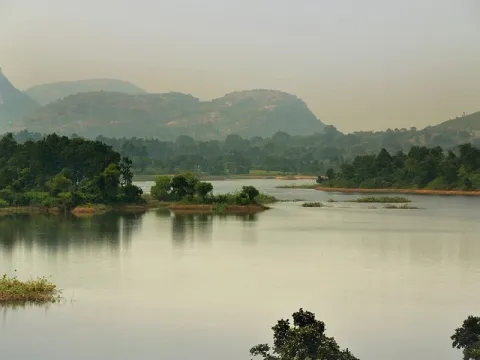
Drive in via the Begunkodar-Murguma road and the dam reveals itself slowly: first a scrubby tribal hamlet of mud-walled houses with painted geometric motifs, then a glimpse of water through the trees, then suddenly the full breadth of the reservoir, with small green islands sitting on its surface like turtles. Murguma is impounded across the Saharajhore, a tributary of the Kangsabati River and is fed by a confusion of small streams running off the Ajodhya Hills directly into the lake.
It is, on paper, a rural irrigation project. In practice, it has become one of those quiet, accidentally beautiful waterscapes that tribal communities and a small, devoted band of Bengali photographers know about. The government tourism brochure puts it on the cover. Foreign guidebooks have not yet caught up.
The locals are mostly Santhal, whose villages cluster around the lake's rim. Agriculture, consisting of millet, paddy and some pulses, keeps the economy ticking. A few households now run small homestays and tent camps; a few more sell tea and biscuits to visitors. Tourism is a recent enough arrival that it still feels gentle.
Walk the dam wall and the lakeside trails: Allow at least an hour for the dam itself and the immediately surrounding paths. The light at dawn and just before sunset is the photographer's reward, casting palest pinks across the water as the hills transition from bottle-green to indigo. Move quietly and you'll pick up cormorants on the islands, kingfishers on the dead branches and, if you're lucky, the resident foxes that work the scrub at dusk.
Article Content
Text Body
Is Background Visible
Off
Published on
Article Image
Image
Updated On
Read Time
3
Article Type
Location
Article Videos
Is Background Visible
Off
Upload Video
Content Family
General Purpose
Image Gallery
Upload Images
Is Background Visible
Off
Images View Mode
Simple
Video Gallery
Is Background Visible
Off
Upload Video
gallery view mode
horizontal
action if location
default
Comments