Joychandi Pahar, in the Raghunathpur subdivision of Purulia district, is one of those places that resists easy definition. It is at once a pilgrimage site, a rock climber's training ground, a weekend escape for Kolkatans hungry for open sky and a piece of living cinema: the brooding landscape that Satyajit Ray chose for his fictional kingdom of diamonds and tyranny in Hirak Rajar Deshe.
The hill is modest in height but immense in character. Its hard granite outcrops, draped in dry deciduous forest, rear up abruptly from the red laterite plains of the Rarh region, forming a small cluster of four rocky summits. At the highest point sits the Maa Joychandi Temple, a modest shrine to the presiding goddess that draws devoted pilgrims year-round and throngs of worshippers during the December festival. Below and around, the land unfurls in an almost cinematic composition of rice paddies, tank ponds, sal groves and village lanes where goats wander and children watch strangers with undisguised curiosity.
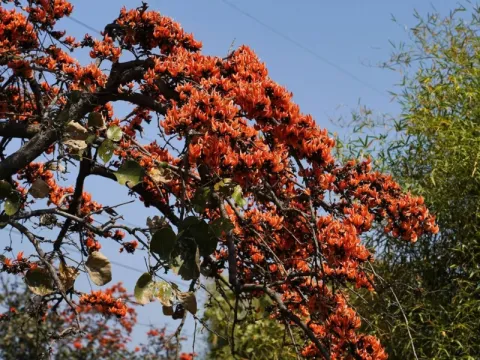
Joychandi Pahar is not a destination for creature comforts. It does not have luxury hotels, curated coffee shops, or organised tour desks. What it has is something rarer: genuine rural West Bengal, largely unpolished, extraordinarily vivid and breathtakingly beautiful, especially in spring when the Palash trees erupt into flame-orange bloom.
Empires, Rebellion & the Goddess of the Hill
The name Joychandi belongs to the goddess who has been worshipped on this hill for centuries, a form of Chandi, the fierce and protective mother deity whose temple crowns the summit. Local tradition holds that the goddess is particularly powerful here and the surrounding district of Purulia, once part of the ancient Manbhum region, has long been a landscape of deep tribal and Hindu religious syncretism, where Santhal and Kurmi traditions coexist with Shaivite and Shakta worship.
The hill's recorded history grew more turbulent in the modern era. During the Indian Rebellion of 1857, the great uprising against British East India Company rule, the region around Raghunathpur became a theatre of resistance and the remote, rocky terrain of Joychandi Pahar provided cover and concealment for those opposing colonial authority. This tradition of the hill as a place of sanctuary for fighters and freedom-seekers persisted into the independence movement of the twentieth century.
The Raghunathpur subdivision sits at the administrative and cultural crossroads of what was once a richly layered princely and tribal territory. The broader Purulia district, which borders the Chota Nagpur Plateau, is home to significant Santhal, Munda, Bhumij and Kurmi communities, each with their own languages, festivals and relationships to the land. The subdivision's old temples, some dating back to the eleventh century, speak to the antiquity of settlement in this seemingly remote part of the subcontinent.
The Chota Nagpur Plateau geology that shapes Joychandi Pahar is itself ancient, comprising some of the oldest rock formations on the Indian subcontinent, worn and sculpted over hundreds of millions of years into the rounded, boulder-strewn hillscapes that define Purulia's distinctive silhouette. The district sits on the plateau's lowest step, where it transitions into the Bengal plains, creating a landscape of undulating red earth, scattered outcrops and seasonal streams that swell dramatically in the monsoon.
Hirak Rajar Deshe & Joychandi Pahar
In 1980, the great Bengali filmmaker Satyajit Ray brought his camera to these granite slopes to film Hirak Rajar Deshe (“The Kingdom of Diamonds”), the beloved sequel to his earlier Goopy Gyne Bagha Byne. The film's landscape, with its stark rocky hills, wide open skies and a sense of theatrical, almost mythic desolation, perfectly matched Ray's vision of a tyrannical king's remote domain. Many scenes were filmed on and around the Joychandi hills and it is largely due to this film's enduring popularity in Bengal that the hill became a tourist destination at all. Cinephiles visit half to see the temple, half to stand inside a Ray film.