Inside Kolkata's astronomy museum
Article Content
Text Body
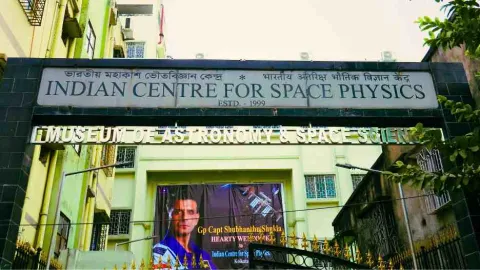
From the outide, The Museum of Astronomy and Space Science, nestled inside the Indian Centre for Space Physics (ICSP) near Mukundapur, seems extremely ordinary. In fact, you would hardly believe that it would be important enough to host Group Captain Shubhanshu Shukla, the astronaut who spent 18 days aboard the International Space Station as part of the Axiom Mission 4 in June–July 2025. But it did, just a few days ago.
In fact, it is special enough to have been inaugurated by Rakesh Sharma, the first Indian to go to space. So, it should be a must-visit for aviation buffs, history enthusiasts as well as anyone interested in space.
Is Background Visible
Off
Upload Images
Image Caption
The museum has more than 1,200 artefacts on display.
Upload Image
Image
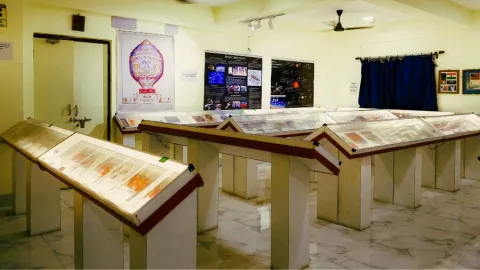
Image Section Title
Why is it special?
Is Background Visible
Off
Images View Mode
Simple
Text Body
Those visiting Kolkata usually check out its colonial architecture, food and rich cultural heritage. Very few visitors, and even residents of the city, however, expect to encounter a museum where Moon dust, Martian rock, a strand of Neil Armstrong's hair and fossils dating back millions of years are kept quietly inside well-lit displays. This particular museum has more than 1,200 artefacts on display across 5,000 square feet tracking the history of flight, astronomy and space travel.
Here’s a look at what else you can see inside.
Is Background Visible
Off
Upload Images
Image Caption
The Wright Flyer
Upload Image
Image
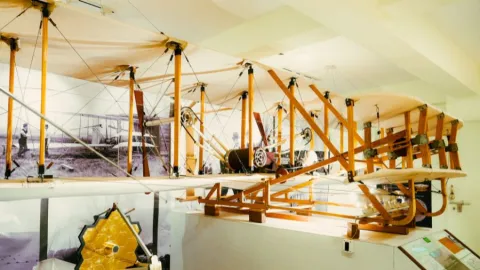
Image Section Title
The first flyers
Is Background Visible
Off
Images View Mode
Simple
Text Body
Visitors to the museum are greeted with a replica that looks almost delicate: the Wright Flyer, the aircraft that carried humans into the air for the first time in 1903. The model aircraft, complete with its wooden frame and wings made out of white cloth, looks straight out of the pages of a history book.
Kept alongside it is a shiny metal model of Sputnik, a small sphere launched by the Soviet Union in 1957 that startled the world and marked humanity's first step into space.
A few steps away, several scale models of early satellites and probes as well as photographs of early balloons trace early aviation and space exploration.
Is Background Visible
Off
Upload Images
Image Caption
(top to bottom; left to right) Models of Apollo 11 Lunar Lander, Sputnik 1; Saturn V rocket, ESA's INTEGRAL Spacecraft; ALMA Telescope, Space Shuttle Discovery
Upload Image
Image
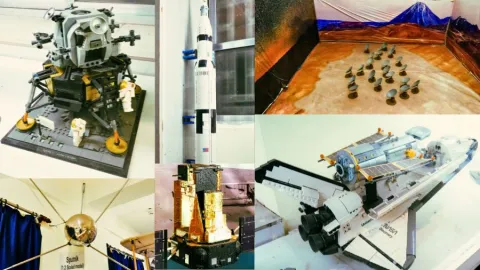
Image Caption
(left to right) Model of the ISS and NASA's Apollo 11 command module model placed next to each other; replica of different space dust.
Upload Image
Image
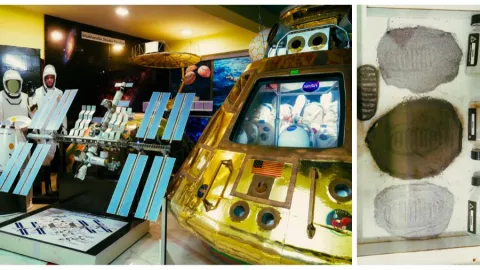
Image Section Title
Models galore
Is Background Visible
Off
Images View Mode
Simple
Text Body
One of the museum's most captivating displays is NASA's Apollo 11 command module model, complete with scaled figures of its three astronauts seated inside. The cramped interior — recreated with careful detail — conveys the courage and vulnerability of the mission that placed humans on the Moon. In its backdrop are photographs of the actual module splashing down in the Pacific Ocean and the recovery of its crew after its historic flight that put astronauts Neil Armstrong and Buzz Aldrin on the surface of the Moon in 1969.
Inside the same room, recently christened as the Shubhanshu Shukla Pavilion, stands a 1:60 scale model of the International Space Station (ISS), its interconnected modules arranged like a mechanical organism floating in space. All of the modules are clearly identified by signage, giving viewers an insider view of the space station. The gallery also has photographs from the Axiom Mission 4 and a popular photo-op spot — a life-size astronaut cut-out that invites visitors to imagine themselves orbiting Earth.
The room next door houses a replica of the Saturn V rocket model procured from NASA itself. Apart from this, there is a model of the lunar lander, poised as if moments from touching down on the Moon's surface. A replica of NASA's Discovery space shuttle is also on display here.
These models in themselves offer a visual timeline of how spaceflight evolved from singular missions into sustained programmes and multiple-use spacecraft such as NASA's Discovery space shuttle.
Is Background Visible
Off
Upload Images
Image Caption
(left to right) Replica of the James Webb Space Telescope; a 30-metre optical telescope.
Upload Image
Image
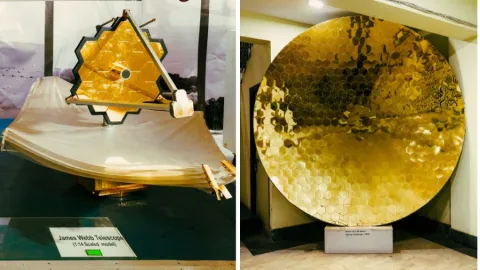
Image Section Title
The tale of telescopes
Is Background Visible
Off
Images View Mode
Simple
Text Body
Humans have always been intrigued by distance. Telescopes, one of the earliest tools used in navigation as well as charting stars, are still as relevant today as they were centuries ago. Beyond human spaceflight, this museum devotes significant space to the use of telescopes and how they evolved through time. There is a detailed model of the Hubble Space Telescope, which helped us gather vast amounts of data as well as interpret it into astronomical maps and study space phenomena.
Kept alongside this is a striking representation of the James Webb Space Telescope, the largest telescope in space. This telescope uses a main mirror complemented by hexagonal mirrors and was launched in 2021 by NASA. Models of ground-based observatories are also on display, including the ALMA telescope array in Chile. In the lobby of the museum, a model of Foucault's pendulum quietly illustrates Earth's rotation.
Is Background Visible
Off
Upload Images
Image Caption
Fragments of meteorites and other space debris.
Upload Image
Image
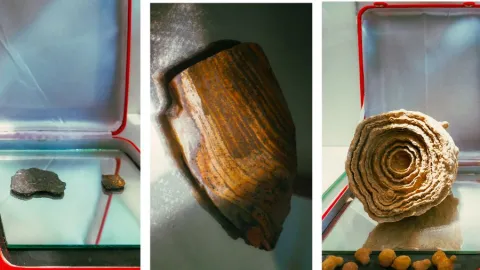
Image Section Title
The star attractions
Is Background Visible
Off
Images View Mode
Simple
Text Body
What elevates the museum from impressive to unforgettable is its collection of authentic artefacts. Display cases hold items that have travelled beyond Earth. There is a display case that shows Moon rock material. Alongside this is a rock fragment from Mars, and visitors can get a touch-and-feel experience of these.
Hair strands of Neil Armstrong, the first human to walk on the surface of the Moon, are also on display here: amongst the most globally sought-after artefacts. There is also a dedicated section where items used on spacecraft, including a body restraint strap used aboard Space Shuttle Atlantis during STS-135, its final mission, are displayed. These objects, gathered from international auctions and private donations, offer visitors something rare: a physical connection to places they may never visit.
Is Background Visible
Off
Upload Images
Upload Image
Image
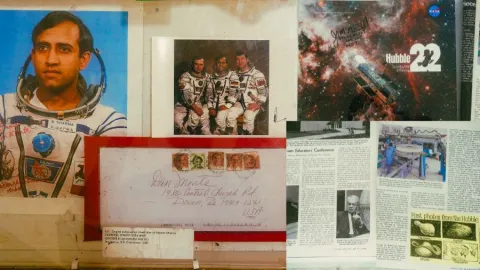
Image Section Title
The space travellers
Is Background Visible
Off
Images View Mode
Simple
Text Body
Lining the walls of the museum are autographed photographs of astronauts and cosmonauts from across the world. Amongst them, one can easily see Yuri Gagarin's autographed photograph. Gagarin, a Soviet Union cosmonaut, was the first man in space and orbited the Earth back in 1961. Also on display is the autograph and photograph of Valentina Tereshkova, the first woman in space, who was also part of the Soviet space programme.
There is a photograph of Wing Commander Rakesh Sharma, India's first astronaut, on board the Soyuz T-11. A closer look reveals his autograph across the picture and holds special significance, as Sharma himself had inaugurated the museum.
Is Background Visible
Off
Upload Images
Image Caption
Original works, signed diaries and other documents can be found inside the museum.
Upload Image
Image
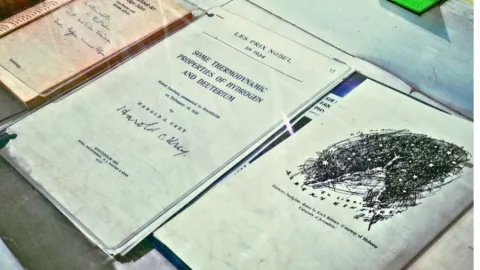
Image Section Title
A tale of legends
Is Background Visible
Off
Images View Mode
Simple
Text Body
One of the museum's most stunning spaces is the room that plays host to the diary of astrophysicist Meghnad Saha, who gave the world the Saha equation and was an alumnus of Presidency University in Calcutta. The gallery also has written words and solved equations by greats such as Satyendra Nath Bose, Jagadish Chandra Bose and Marconi amongst others.
Another rare display is a 1919 New York Times carrying news of Arthur Eddington's confirmation of Einstein's theory of general relativity, alongside an interview with Einstein himself.
Books signed by Moon-walking astronauts sit alongside volumes autographed by Roger Penrose, Subrahmanyan Chandrasekhar, Robert Millikan and Jayant Narlikar, turning the room into a quiet archive of scientific thought.
Links between early Calcutta and space
This museum has in its coffers an original newspaper clipping that dates back to 1757 and chronicles an incident that unfolded in Calcutta's Fort William nearly two centuries before the Space Age. Following the capture of Fort William in June 1756, Siraj ud-Daulah, the Nawab of Bengal, confined a group of British and Anglo-Indian prisoners overnight in a small room within the fort complex. Many reportedly died inside the room due to suffocation.
You might ask why such an artefact is housed in an aviation museum of all places. Answer is, this incident later came to be referred to as the “Black Hole of Calcutta” by the British and soon entered the English language as a symbol of extreme confinement, darkness and inescapability. Later, astrophysicists adopted the term black hole to describe collapsed stars.
Is Background Visible
Off
Upload Images
Image Caption
Detailed write-ups on Kolkata's space connection
Upload Image
Image
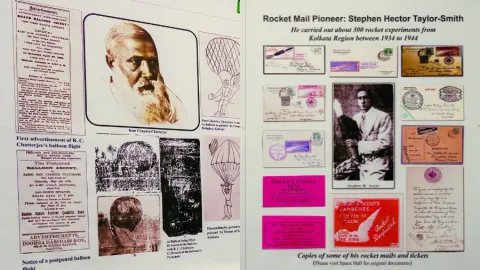
Image Section Title
Honouring the forgotten ones
Is Background Visible
Off
Images View Mode
Simple
Text Body
The museum is a tribute to early Indian and international pioneers. It commemorates Ram Chandra Chatterjee, India's first aeronaut, and Stephen Hector Taylor-Smith, who conducted nearly 300 rocket experiments in and around Calcutta and established the rocket mail between 1934 and 1944 — a little-known chapter of aerospace history rooted in Bengal. For any history or travel buff, this museum offers a great learning experience.
Fact file:
Although ICSP came into being in 1999, the Museum of Astronomy and Space Science was inaugurated by the first Indian in space, Wing Commander Rakesh Sharma, back in 2023.
Address: 466 Barakhola, Netai Nagar, Mukundapur, Kolkata, West Bengal – 700099
Timings: 9am–6pm (closed on Wednesdays)
Entry: Rs 100
Guided tours available for large groups
Is Background Visible
Off
Published on
Article Image
Image
Updated On
Read Time
5-min read
Article Type
Story
Article Image Caption
The Museum of Astronomy and Space Science is housed within the Indian Centre for Space Physics (ICSP). (All pictures by Krishnungshu Gangopadhay)
Article Videos
Is Background Visible
Off
Upload Video
Display Type
Long Description
Content Family
General Purpose
Image Gallery
Upload Images
Is Background Visible
Off
Images View Mode
Simple
Video Gallery
Is Background Visible
Off
Upload Video
Summary
The Museum of Astronomy and Space Science, an unassuming building located in a residential neighbourhood with several hospitals off EM Bypass, is home to an expansive collection of artefacts and displays that track aviation history and space travel through time. From scale models of the ISS and first-generation satellites to real space rocks and memorabilia, this museum has it all.
gallery view mode
horizontal
sub title
From Moon dust to Neil Armstrong's hair, this building holds over 1,200 artefacts related to humanity's space race
banner image
Image
banner image mobile
Image
Detail Page Title
Journey through space and time at Mukundapur's Astronomy Museum
Comments