South of Rabindra Sarobar and Gariahat, at Metro Line 1’s southern terminus, Tollygunge holds two inheritances side by side: colonial-era private clubs and the working infrastructure of a once-major film industry.
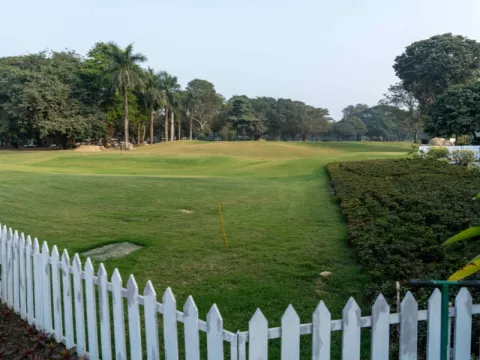
The Royal Calcutta Golf Club (1829), claimed as the oldest golf club outside the British Isles and the roughly hundred-acre Tollygunge Club, with its own stables, tennis courts and pool, preserve colonial Calcutta’s leisure culture with little irony.
The other Tollygunge is Tollywood, a term older than most assume. American cinematographer Wilford E. Deming coined it in 1932, a full generation before “Bollywood” was applied to Mumbai. In the 1930s, West Bengal was the centre of Indian cinema and the industry rivalled Mumbai in prestige through the 1950s. Studio Para, the studio district, once held at least nine functioning studios, including Indrapuri (1917) and Technicians’ Studio, founded as Kali Films in 1934 and run cooperatively by its technicians from 1951. Ritwik Ghatak shot Meghe Dhaka Tara there; Ray shot Apur Sansarand Teen Kanya there; Aparna Sen made Parama there.
New Theatres, opened in 1930 under B.N. Sircar, introduced India’s integrated studio system. Tagore filmed Natir Puja there in 1932 on his 71st birthday; Uttam Kumar, the actor who defined Bengali cinema’s commercial golden era, shot celebrated work in the same building. Ray himself lived in Ballygunge, ten minutes north, while his films took physical form here.
The studios aren’t open to the public, but the lanes of Studio Para along NSC Bose Road, with their costume suppliers, make-up workshops, equipment yards and technicians’ canteens, repay an unstructured hour on foot.
Article Content
Text Body
Is Background Visible
Off
Published on
Article Image
Image
Updated On
Read Time
2
Article Type
Location
Article Videos
Is Background Visible
Off
Upload Video
Content Family
General Purpose
Image Gallery
Upload Images
Is Background Visible
Off
Images View Mode
Simple
Video Gallery
Is Background Visible
Off
Upload Video
gallery view mode
horizontal
action if location
default
Comments