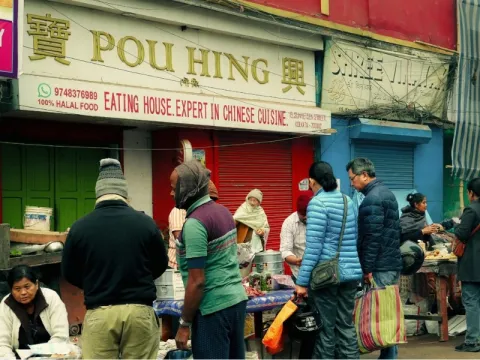
Tiretta Bazaar takes its name from Edoardo Tiretta, a Venetian nobleman and onetime companion of Casanova who, after fleeing scandal in the East Indies, rose to become Superintendent of Roads and built a private market here in the 1780s. Today the neighbourhood comes alive before dawn with what’s often billed as India’s only Chinese breakfast market: from roughly 6 to 8:30am, elderly vendors from the dwindling Chinese-Kolkatan community set up folding tables serving dumplings, fish ball soup, sticky rice, century eggs, steamed buns and fried rice noodles for a few rupees a bowl.
The Chinese presence runs deeper. The first recorded Chinese settler in Bengal, Tong Atchew, established a sugar mill at Achipur (33km south) in the late 18th century; a temple and cemetery survive there today. The community around Tiretta Bazaar grew separately through the 19th century, reaching perhaps 20,000 by the early 20th, sustained by tanneries, carpentry, dentistry and restaurants alongside Taoist temples and Chinese schools. The 1962 Sino-Indian War was the decisive blow: the government interned thousands of Chinese-Indians, some families here for generations, at the Deoli camp in Rajasthan without trial, while properties were seized and livelihoods ended by punitive licensing. Emigration to Canada, Taiwan and Australia followed, and the community (perhaps 2,000 people today, by some counts fewer) has never recovered. What remains is more like a memorial held together by family loyalty, religious practice and a food culture that refuses to be absorbed.
The Sea Ip Church in Chattawala Lane, dating to 1905, is the most accessible of six surviving Chinese temples. “Sea Ip” renders the Cantonese for “Four Districts,” reflecting the association of Guangdong immigrant families who maintain it. Its first-floor shrine holds Kwan Yin, Goddess of Mercy, beside Choi San, God of Prosperity, beneath a roof imported whole from China and a carved wooden form shaped like a boat, cut from a single tree trunk. Visitors may view the shrine from its threshold. On Blackburn Lane, the Toong On Church (built 1924), dedicated to the warrior god Kuan Ti, once had Nanking, India’s first Chinese restaurant, on its ground floor; the temple was locked away for nearly thirty years after Nanking shut, reopening only after a 2012 court settlement.
Article Content
Text Body
Is Background Visible
Off
Published on
Article Image
Image
Updated On
Read Time
2
Article Type
Location
Article Videos
Is Background Visible
Off
Upload Video
Content Family
General Purpose
Image Gallery
Upload Images
Is Background Visible
Off
Images View Mode
Simple
Video Gallery
Is Background Visible
Off
Upload Video
gallery view mode
horizontal
action if location
default
Comments