Tagore's abode of peace and learning
Location Category
Location Circuits
Location Interest
Location How Many Days
Location Group
Location Content
Text Body
Nestled in the red soil countryside of Birbhum district, approximately 160 kilometres north of Kolkata, Santiniketan is where Nobel laureate Rabindranath Tagore brought his revolutionary vision of education to life, creating a university town that harmoniously blends learning, nature, art, and culture. The name itself, meaning “abode of peace”, captures the essence of this serene cultural oasis.
Today, Santiniketan (technically a neighborhood within Bolpur town) remains a living testament to Tagore's ideals, where classes are still held beneath sprawling mango trees, students cycle through tree-lined paths, and the air vibrates with Rabindra Sangeet (Tagore's songs). Whether you're a culture vulture, a Tagore devotee, or simply seeking refuge from urban chaos, Shantiniketan offers an experience that's distinctly, enchantingly Bengali.
History
The story of Santiniketan begins in 1863 when Maharshi Debendranath Tagore (Rabindranath's father) leased 20 acres of land featuring two distinctive chhatim trees for just Rs. 5 annually. He built a meditation retreat here and named it Santiniketan. Debendranath, a key figure in the Brahmo Samaj reform movement, established a Brahmo prayer hall (Upasana Griha, often called Kaanch Mandir or Glass Temple) on December 21, 1891 (7 Poush 1298). The annual Poush observance in Santiniketan later grew into Poush Mela (the fair itself began in 1894).
Rabindranath first visited Shantiniketan in 1878 at age 17. In 1901, he founded a school called Brahmacharyaashrama (later known as Patha Bhavana) with just five students, envisioning an educational system rooted in nature and freedom of thought. After winning the Nobel Prize in Literature in 1913, Tagore expanded his vision, founding Visva-Bharati in 1921 as an international centre of humanistic studies where “the world meets in one nest”. Following India's Independence, Visva-Bharati became a central university and Institution of National Importance in 1951. The entire complex was inscribed as a UNESCO World Heritage Site in 2023, recognising its unique approach to pan-Asian modernity and cultural synthesis.
Title
History and Culture
Is Background Visible
Off
Location Information Items
Location item element
Section Title
Top Sights and Experiences
Text Body
Getting There
By Train: The best option. Bolpur (Shantiniketan) station (BHP) is well-connected to Kolkata (Howrah and Sealdah). Santiniketan Express (from Howrah) and Kavi Guru Express (from Sealdah) are excellent daily options, taking about 2.5–3 hours.
By Air: The closest airport is often Kazi Nazrul Islam Airport (Andal/Durgapur) (about ~55–70 km from Bolpur/Santiniketan by road, depending on where you’re staying). Netaji Subhas Chandra Bose International Airport (Kolkata) (about ~160 km) offers far more flights. From either airport, continue by taxi (or taxi + train).
By Road: Well-maintained roads connect Santiniketan to Kolkata (160km, 3-4 hours by car). State-run and private buses operate regularly. The scenic drive passes through rural Bengal's countryside.
Getting Around
Toto (E-Rickshaw): This is the primary mode of transport. You can hire one for the whole day for a fixed price to take you on a standard sightseeing circuit.
Cycle Rickshaw: For shorter distances within the campus or to your guesthouse, the classic cycle rickshaw is a charming option.
On Foot: The Visva-Bharati campus is best explored on foot. Wear comfortable shoes and give yourself a full day to wander its tree-lined paths.
What to Eat
Santiniketan is a delight for foodies, especially those looking for authentic Bengali cuisine.
Several trendy cafes have also popped up, serving good coffee, pastries, and continental snacks.
Must-try Dishes:
Mutton ghugni (a Santiniketan favourite).
Egg chop / chops & muri culture (tea-stall snack ecosystem: shingara, phuchka, etc.).
Birbhum’s Tantipara Jalebi (a storied, long-running fair tradition).
Shopping
Handicrafts & Textiles
Amar Kutir: Primary cooperative for local artisans. Browse batik prints, kantha embroidery, leather goods, terracotta items, and dokra metalwork. Prices are reasonable and proceeds support local craftspeople.
Biswa Bangla Store: Government emporium selling certified handicrafts, handloom textiles, and artisanal products from across West Bengal.
Sonajhuri Haat: Saturday market offering the widest selection of handicrafts, tribal jewelry, handwoven fabrics, and folk art at negotiable prices.
What to Buy
Batik fabrics - Hand-printed textiles in traditional and contemporary designs
Kantha-stitched items - Embroidered sarees, dupattas, bedspreads, and wall hangings
Terracotta pottery - Traditional Bengal earthenware and decorative items
Leather goods - Bags, wallets, and accessories from Amar Kutir
Madhubani paintings - Artists from Bihar bring these intricate folk art pieces
Taant saris - Traditional Bengali handloom sarees
Dokra metalwork - Ancient tribal metal casting technique creating unique figurines
Patachitra scrolls - Traditional scroll paintings depicting mythological stories
Tagore literature and music - Books, CDs, and recordings available near campus
Visitor Rules & Access Notes
- This is a working university and living heritage site. Some zones may be open only at certain hours, only on certain days, or only via official guided access.
- Guided heritage walk model (recent pattern): Visitor entry to the core heritage/ashram precinct has at times been managed via Sunday heritage walks in timed batches, with tickets issued at a campus museum counter on the day. Rules commonly include no videography and limited group sizes.
- Museum hours and closures vary. Many sites observe midday closures and weekly closed days; verify timings locally (your hotel or a campus counter will usually know the latest).
- Photography: Often allowed outdoors; restricted indoors (especially in museums/archives and during prayers). When in doubt, ask first.
Best Time to Visit
Best Time: October to March offers pleasant weather with temperatures ranging from 10-35°C. This period also encompasses Santiniketan's two major festivals.
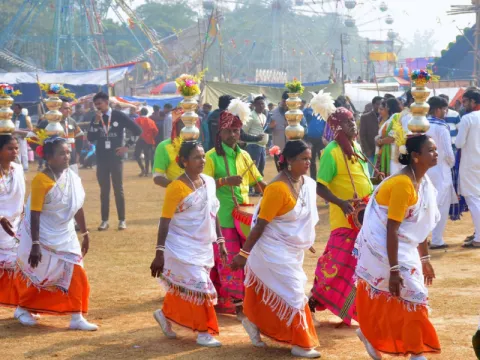
Peak Season: December (Poush Mela) and March (Basanta Utsav/Holi) see massive crowds with up to 40,000 daily visitors. Book accommodation well in advance during these times.
Shoulder Season: October-November and January-February offer comfortable weather with fewer crowds and easier access to attractions.
Avoid: April and May bring scorching heat (up to 42°C), making outdoor exploration uncomfortable.
Monsoon: June to September sees moderate rainfall. The Kopai River, usually dry, comes alive during this season, though accessing riverbanks can be difficult.
Title
Things to Know
Is Background Visible
Off
Text Body
Sriniketan
Just a short ride from Santiniketan, Sriniketan was developed as Tagore’s centre for rural reconstruction, focused on agriculture, craft livelihoods, village education, and community development. If Santiniketan is the ‘arts-and-ideas’ heart, Sriniketan is the ‘craft-and-fields’ counterpart. Visit for a quieter, more local view of the region: small craft outlets, rural landscapes, and (in season) fairgrounds connected to Sriniketan Utsav.
Kankalitala Temple: Located roughly 9–15 km from Bolpur (about 20–30 minutes by road, depending on route and traffic), this famous Kali temple attracts devotees from across the region. Baul musicians often perform in the temple area.
Surul Rajbari: A 275-year-old zamindari palace showcasing Bengal's aristocratic heritage. The family had close ties with the Tagores.
Raipur Rajbari: A 150-year-old zamindari estate, now partially ruined but historically significant. The Raipur zamindar sold land to Tagore's father for establishing Visva-Bharati.
Tarapith: About 80 kilometres from Santiniketan, this major Shakti Peetha temple dedicated to goddess Tara is one of Bengal's most important pilgrimage sites.
Mama Bhagne Hills: Striking rock formations with precariously balanced boulders, popular for photography and short treks.
Amkhoi Wood Fossil Park (near Ilambazar): Displays petrified wood fossils estimated at 15–20 million years old and is set up for geo-education and conservation.
Title
Nearby Excursions
Is Background Visible
Off
Location Images
Image
Location Banner Image
Image