A crown of hills around a sea of silence
Location Circuits
Location Interest
Location How Many Days
Location Group
Location Content
Text Body
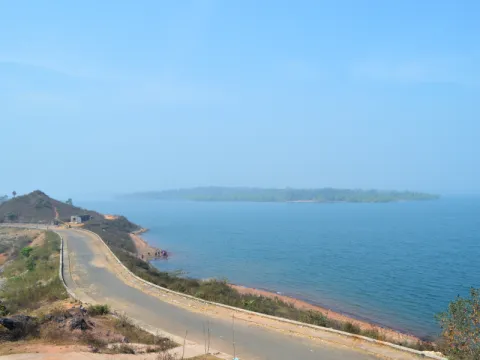
Tucked away in the red-earth landscapes of Bankura district in western West Bengal, Mukutmanipur is one of those rare destinations that has managed to remain under the radar. Named for the crown-like ring of hillocks (mukut means crown) that encircle it, this small settlement sits at the confluence of the Kangsabati and Kumari rivers, where India's second-longest earthen dam, Kangsabati Dam, has created a vast, mirror-still reservoir stretching across 86 square kilometres.
This is not a place for adrenaline junkies or nightlife seekers. Mukutmanipur rewards the patient traveller, the one who finds joy in watching a molten orange sunset dissolve into a sheet of silver water, or in the rhythmic thump of a tribal drum drifting across the forest at dusk. Think of it as Bengal’s answer to the quiet corners of Kerala’s backwaters, minus the crowds and the price tags.
History & Background
The Bankura district has been inhabited since antiquity, with the Malla dynasty ruling the region for centuries from their capital at Bishnupur, some 70km to the east. The area around Mukutmanipur was historically home to Santali and other Adivasi communities whose cultural imprint still defines the region’s character.
The story of today’s Mukutmanipur begins with the construction of the Kangsabati Dam, an ambitious irrigation and flood-control project launched in the mid-20th century. The dam was built at the confluence of the Kangsabati and Kumari rivers to irrigate roughly 8,000 square kilometres of agricultural land across Bankura, Purulia, Paschim Medinipur and parts of upper Hooghly. The resulting reservoir stretches across a vast basin studded with submerged hillocks and forested islands, one of Bengal’s most evocative natural landscapes. During excavation, workers unearthed an ancient Shiva Lingam and a stone statue of Parsvanath, the 23rd Jain Tirthankara, artefacts that hint at a much older sacred geography.The name Mukutmanipur itself is poetic: the surrounding hillocks form what locals describe as a mukut (crown) around the water, with the settlement as its jewel (mani).
Title
History and Culture
Is Background Visible
Off
Location Information Items
Section Title
Top Sights & Experiences
Text Body
Getting There
By Road from Kolkata
This is by far the most popular approach and, for many, one of the highlights of the trip. The roughly 250km drive takes 5 to 6 hours depending on traffic and your route. Two main routes are available:
Route 1: The Shorter Way (~241km)
Kolkata → Tarakeswar → Arambagh → Bishnupur → Bankura → Mukutmanipur. Shorter in distance but road quality varies, especially on the final stretch after Bankura.
Route 2: The Smoother Way (~270km)
Kolkata → Dankuni → Bardhaman → Durgapur (NH 19) → Bankura (SH 9) → Mukutmanipur. The extra 30km is worth it for the significantly better roads, particularly the four-lane national highway stretch to Durgapur.
By Train
Trains run regularly from Howrah Station in Kolkata to Bankura Junction, taking roughly 3 to 3.5 hours. From Bankura, local buses and shared jeeps cover the remaining 55km to Mukutmanipur in about 2 hours. Expect basic, often crowded vehicles on this final leg. Alternatively, hire a private car from Bankura station.
By Air
The nearest airport is Kazi Nazrul Islam Airport in Durgapur, about 117km from Mukutmanipur, though it operates limited domestic services. Most visitors fly into Netaji Subhas Chandra Bose International Airport in Kolkata (237km away) and continue by road.
Getting Around
Mukutmanipur is small enough that getting around is straightforward, though options are limited. Auto-rickshaws and cycle rickshaws are the primary modes of local transport and can be flagged down easily near the bus stand and drive along the dam.
For the dam drive, you’ll need either your own vehicle or a hired auto-rickshaw. The 11km paved road along the top of the dam requires a free pass, issued at the dam entry point between 10am and 4pm (bring your driving licence and vehicle registration). On weekends, when the pass office may be closed to four-wheelers, autos are the only option for traversing the dam.
Boats are the other key mode of transport, particularly for reaching the Bonpukuria Deer Park island and Pareshnath Temple. Boat services operate from the dam area and from near the Mohana (confluence point).
What to Eat
Mukutmanipur is not a dining destination. Options are limited and you won’t find anything resembling a Kolkata restaurant scene. But the food you do find is hearty, fresh and deeply Bengali.
Bengali Thali: Most hotel restaurants serve a standard Bengali meal (bhaat, dal, maachher jhol, sabji and mishti) that is comforting and reliable. The quintessential Bengali thali (steamed rice with a progression of dishes from bitter shukto to sweet) is the way to eat here. Key dishes to seek out include:
Maachher Jhol: The classic Bengali fish curry, light and fragrant with turmeric and mustard.
Posto dishes: Poppy-seed pastes paired with potatoes (alu posto) or pointed gourd (potol posto) are Bankura specialities.
Echorer Dalna: Unripe jackfruit curry, often called the vegetarian’s meat in Bengali cuisine.
Luchi with Alur Dom: Deep-fried puffed bread with spiced potato curry is classic Bengali comfort food.
Pithe and Puli: Traditional rice-flour cakes and dumplings, particularly prevalent in winter.
Khichuri Bhog: If you visit the Ambikanagar Temple during lunchtime, you might be treated to the traditional khichuri bhog (a sacred meal of rice and lentils) served to devotees.
Sweets: Bengal’s legendary sweet tooth is alive and well in Bankura district. Look for the local Mecha Sandesh and Pera (a granular milk sweet that is a Bankura speciality). Khejur Gurer Payesh (rice pudding made with date-palm jaggery) is a seasonal winter delicacy that is absolutely worth seeking out.
Best Time to Visit
October to March (Recommended): The ideal time to visit Mukutmanipur is during the winter months, when daytime temperatures remain a pleasant 18–25°C and skies are generally clear. The reservoir is at its most striking, migratory birds arrive in large numbers and the surrounding sal forests take on warm golden and amber hues.
Spring (February–March): As winter gives way to spring, the landscape is transformed by blooming palash (Flame of the Forest) trees. Hillsides and forest edges are set ablaze with vibrant shades of orange and red, making this one of the most picturesque times of the year.
Monsoon (June–September): The rains replenish the reservoir, turning the region lush and verdant. While the scenery is at its most dramatic, heavy rainfall can make roads slippery and occasionally disrupt boat services. It is advisable to check local conditions and allow for possible delays.
Summer (April–May): Summer is generally the least favourable season to visit. Temperatures frequently exceed 40°C, water levels in the reservoir recede and outdoor exploration can be uncomfortable. Most travellers prefer to avoid Mukutmanipur during the peak heat.
Title
Things to Know
Is Background Visible
Off
Text Body
Bishnupur (70km, ~2-2.5 hours)
The former capital of the Malla dynasty is a treasure trove of terracotta temple architecture, and an essential day trip from Mukutmanipur. The most famous sites include the Rasmancha (a unique pyramidal structure built in 1600 CE), the Jor Bangla Temple with its exquisite terracotta panels depicting scenes from the Ramayana and the Madan Mohan Temple. Bishnupur is also renowned for its Baluchari silk sarees and the iconic Bankura Horse terracotta figurines. The drive passes through atmospheric sal forest.
Jhilimili (15km)
A dense forest settlement reached via a spectacular drive from Ranibandh (a quaint village in Khatra) through towering sal forest. Jhilimili sits atop a hillock surrounded by sparkling micaceous soil that glints in the sunlight. The forest is alive with birdsong, and the winding road through the trees on both sides is beloved by motorcyclists. Basic forest department accommodation is available.
Khatra
The nearby subdivision headquarters makes a useful stop for supplies and has a few modest eateries. The Masak Hill near Khatra offers a short trek (about 1km walk) with panoramic views of the town and the Kadamdeuli Dam nearby is a lesser-known birdwatching spot.
Title
Nearby Excursions
Is Background Visible
Off
Location Images
Image
Location Banner Image
Image