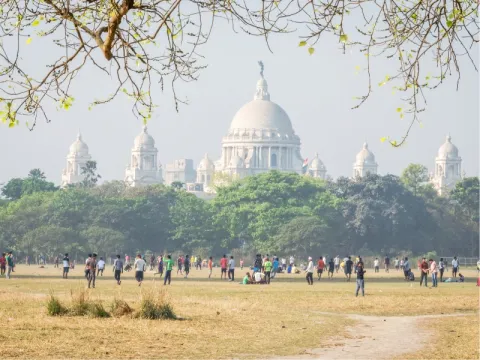
At 3.5 kilometres long, the Maidan is one of Asia’s largest urban parks and Central Kolkata’s green heart. Its origins are martial: Clive cleared the jungle here in 1758 so the guns of the new Fort William could fire unobstructed. What began as a defensive buffer became the city’s primary lung, sports ground, racecourse and shared public living room. It is not manicured but a vast, slightly unkempt expanse where the city exercises, most visibly in the early morning: cricketers, footballers, tai chi practitioners, mounted police running polo chukkers and racehorses from the Royal Calcutta Turf Club along the southern track.
Its sporting pedigree runs deep. Eden Gardens, established 1864 at the Maidan’s northwestern corner, is India’s oldest cricket stadium and its most storied: host to the 1987 and 2016 World Cup finals, to VVS Laxman and Rahul Dravid’s legendary 2001 recovery innings against Australia and to India’s first day-night Test in 2019. Now seating around 68,000 (down from over 100,000 pre-renovation), it remains the home ground of Bengal cricket and the Kolkata Knight Riders, and a match here ranks among the city’s genuine first-order cultural experiences. The Royal Calcutta Turf Club has run races here since 1847, and the Calcutta Polo Club, founded 1862, is reckoned the oldest polo club in continuous operation anywhere, still contesting the Ezra Cup with the Victoria Memorial as backdrop.
The Maidan’s monuments form a small history of political memory: British-era equestrian statues of administrators still stand, while more loudly symbolic figures like Curzon were removed after independence, their pedestals reused for Gandhi and Nehru. A 1970 statue of Lenin marks the state’s communist history near Esplanade, opposite the Ochterlony Monument, a 48-metre Greek Doric column on an Egyptian base topped by a Turkish cupola, renamed Shahid Minar in 1969. Red Road, cutting through the park, hosts the Republic Day parade each January. Fort William itself remains an active military installation, closed to the public but visible from Queens Way. St Paul’s Cathedral, the Birla Planetarium and the Victoria Memorial anchor the park’s southern end, and at the river’s edge, Prinsep Ghat, a colonnaded 1843 riverside terrace named for the scholar who deciphered the Brahmi script, is one of the city’s most atmospheric evening spots.
Article Content
Text Body
Is Background Visible
Off
Published on
Article Image
Image
Updated On
Read Time
2
Article Type
Location
Article Videos
Is Background Visible
Off
Upload Video
Content Family
General Purpose
Image Gallery
Upload Images
Is Background Visible
Off
Images View Mode
Simple
Video Gallery
Is Background Visible
Off
Upload Video
gallery view mode
horizontal
action if location
default
Comments