Bengal's hidden heritage corridor
Location Category
Location Circuits
Location Interest
Location How Many Days
Location Group
Location Content
Text Body
In the flat alluvial plains of Hooghly district, roughly 50-70 km northwest of Kolkata, lies a constellation of villages that most travellers whizz past on the Howrah-Bardhaman railway line without a second glance. That would be a mistake. The Itachuna-Khanyan-Antpur heritage belt is one of rural Bengal’s most rewarding cultural corridors: a stretch where 18th-century Maratha palace grandeur, exquisite terracotta temple art and the spiritual birthplace of the Ramakrishna monastic order converge to form a brilliant weekend road trip.
This is not a manicured tourist circuit. There are no ticket counters staffed by bored guides, no air-conditioned coaches and no souvenir shops selling miniature Howrah Bridges. Instead, you will find yourself riding a battery-powered toto rickshaw down lanes flanked by paddy fields to explore local village clusters, eating luchis off a steel thali in a 250-year-old courtyard and standing alone before terracotta panels so intricate they would put many a museum exhibit to shame. What this belt offers is nothing less than a time portal into Bengal’s layered past and it asks for little in return beyond a sense of curiosity and a willingness to slow down.
History & Context
The Maratha Connection
Between 1741 and 1751, Bengal suffered a series of devastating raids by Maratha cavalry forces, known locally as the Bargis. Led by commanders such as Bhaskar Pandit, the general and dewan of Nagpur's ruler Raghuji Bhosle, these mounted warriors swept through the countryside collecting chauth (one-quarter of the provincial tax revenue) by force. The terror they inflicted entered Bengali folk memory and nursery rhymes alike.
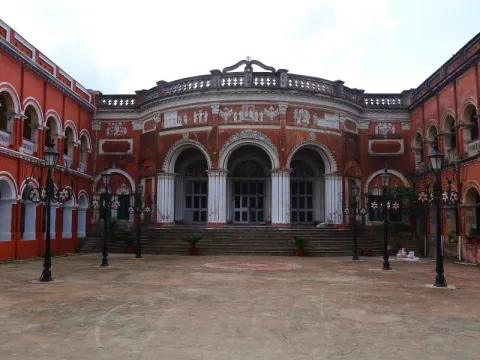
Yet the aftermath of these raids had an unexpected cultural consequence. After their campaigns wound down, some Maratha families stayed on in Bengal, settling in the fertile Hooghly hinterland. They traded, farmed, married into local families and over generations became so deeply assimilated that their Marathi surname ‘Kundan’ evolved into the Bengali ‘Kundu.’ It was the Kundan-Kundu lineage that built the grand palace at Itachuna in 1766, a physical testament to the transformation of raiders into rooted zamindars.
Spiritual Crossroads
A few kilometres south, Antpur was already an established seat of Vaishnava and Shaivite worship. The Radha Govind Jiu temple, built in 1786 by Krishna Ram Mitra, Diwan of the Bardhaman Raj, reflected a conscious effort to reinvigorate Hindu devotion during a period of political flux. Durga worship in Bengal had already been powerfully revived several decades earlier by Nabakrishna Deb of Shovabazar Rajbari; the Antpur temple's terracotta panels attest to how deeply that revival had permeated popular religion by the late 18th century. But Antpur’s greatest claim to significance came a century later: on the night of 24 December 1886, nine young disciples of Sri Ramakrishna, led by Narendranath Datta (the future Swami Vivekananda), gathered around a sacred fire at Antpur and took an informal collective vow of world-renunciation, an act that the Ramakrishna tradition regards as the spiritual seed of the monastic order that would later be formally constituted at Baranagore in 1887 and institutionalised as the Ramakrishna Mission in 1897.
Binding these locations together is Khanyan, a small railway junction on the Howrah-Bardhaman main line, which also serves as the gateway to the ancient temple town of Pandua and the Shiva-Shakti pilgrimage centre of Mahanad.
Title
History and Culture
Is Background Visible
Off
Location Information Items
Section Title
Top Sights and Experiences
Text Body
Getting There
By Train
From Howrah Station, board any Bardhaman-bound train or a Memari / Pandua local on the Howrah-Bardhaman main line. Alight at Khanyan station (next stop after Talandu). Journey time is approximately 1-1.5 hours. At Khanyan, take the left exit. Auto-rickshaws and toto (battery-powered three-wheelers) are readily available; Itachuna Rajbari is a 10-minute toto ride.
By Road
From Kolkata, cross the Vidyasagar Setu (Second Hooghly Bridge) and take the Durgapur Expressway towards Bardhaman. At Bosipur, exit and drive approximately 19 km towards Halusai, then turn left onto the Polba-Khanyan road. Itachuna Rajbari is on the left-hand side, about 10 minutes past Halusai. Total driving time: approximately 1.5-2 hours. An alternate route runs via Dankuni, Janai, Mosat and Shiakhala to reach Antpur directly.
By Air
The nearest airport is Netaji Subhas Chandra Bose International Airport (CCU) in Kolkata, approximately 48 km from Antpur. Hire a taxi or self-drive from the airport.
Getting Around
A private car or hired taxi is the most comfortable way to connect the different sites in the belt. Public transport (buses and auto-rickshaws) links Khanyan to Pandua and Mahanad, but services can be infrequent. Toto rickshaws are ubiquitous for short hops. If visiting Antpur separately, buses run from Howrah, Haripal and Arambagh (routes 9, 9A, 10 from Haripal). The nearest rail station for Antpur is Haripal on the Howrah-Tarakeswar line (about 13 km away).
What to Eat
At Ramakrishna Math, Antpur, the simple vegetarian prasad is filling and flavourful.
Best Time to Visit
Winter (November-February): Winter is considered the absolute best season for a visit. During these months, the conditions are cool and dry, with comfortable temperatures ranging from 12-25°C.
Spring (March-April): Spring is an excellent time to visit. The weather transitions into warm, pre-monsoon conditions and it provides an opportunity to experience the local Holi festivities.
Monsoon (June-September): The monsoon season is highly atmospheric but can be challenging for travel. You can expect hot and humid conditions accompanied by heavy rain, though this weather does turn the surrounding landscape beautifully lush and green.
Autumn (October-November): Autumn is a very good time to plan your trip. The weather becomes pleasant again and the timing perfectly coincides with the vibrant Durga Puja season.
Title
Things to Know
Is Background Visible
Off
Location Images
Image
Location Banner Image
Image
