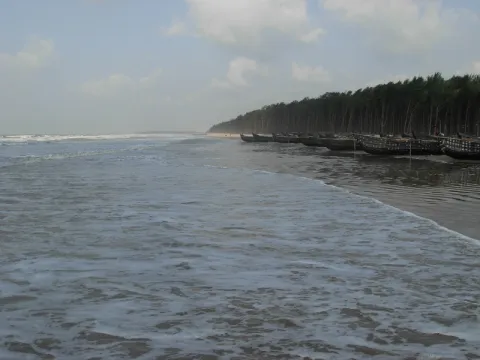
Five kilometres south of Digha's neon-lit promenade, the casuarina forest thins, the souvenir shops fall away and a long stretch of soft sand unfurls toward the Odisha border. This is Udaypur, Bengal's final stretch of coastline before the state line, a working fishermen's beach that moonlights as an escape valve for travellers who arrive in Digha only to regret the crowds. There are no high-rises, no neon, no booming sound systems. Just grounded fishing boats painted in vibrant cyans and reds, woks of mustard-oil bubbling beside makeshift bamboo stalls and a wide, flat expanse of sand that glows pink at sunrise. Udaypur answers a very specific question: can I have Digha's seafood and sunshine without Digha's chaos? Yes, just barely. The beach is a roughly 3km arc of pale sand backed by a dense ribbon of jhau (casuarina) trees, planted decades ago to hold the dunes against cyclones and now doubling as the only shade for miles. A fishing hamlet of the same name sits just behind the treeline; villagers pull their boats onto the sand each evening and local women run the beachfront food stalls during the day.
What you get here that you don't quite get at Digha proper: a horizon largely uninterrupted by concrete, seafood that was swimming just a few hours ago, a scooter ride along the shoreline at the speed of a slow jog and the small thrill of straddling a state border on foot.
Getting There
From Kolkata
By train: The most efficient option is the 12857 Tamralipta Express, which departs Howrah around 6:45am and arrives in Digha just after 10am. The 22897 Kandari Express and 22895 Howrah–Digha Super AC Express are other reliable daily options, along with several MEMU/EMU specials. Book through IRCTC at least a week ahead during the season. Digha railway station (officially Digha Flag Station) is the end of the line, with easy auto/toto connections to the beach.
By road: Volvo, deluxe and West Bengal State Transport buses run frequently from Esplanade and Karunamoyee to Digha, taking around 4 1⁄2 to 6 hours depending on traffic on NH-16 and the Kona Expressway. By car, the journey is about 185km via the Kona Expressway, NH-16 and NH-116B, passing through Kolaghat, Nandakumar and Contai. Allow 4 to 5 hours, including a chai stop at one of the Kolaghat dhabas (the kachori-aloo dum is non-negotiable).
From Digha, Udaypur is an easy final leg. Totos (battery e-rickshaws) from the bus stand, railway station or New Digha promenade cost around Rs 100–150, while autos are slightly more. From New Digha, motor-vans and totos are usually around Rs 70–100, with shared totos sometimes available for Rs 20–30 a head. The seaside promenade between New Digha and Udaypur is paved, cyclone damage permitting and the 2–3km stretch can be walked in about 40 minutes when the weather is kind. You can also rent a two-wheeler in Digha and ride down by yourself; the route is straightforward and signposted in Bengali and English.
From Bhubaneswar/Puri
By train: Take a train to Balasore (Baleswar); most Howrah–Chennai and Howrah–Puri services stop here. From Balasore, Udaypur is around a 90-minute drive (about 70km) via Jaleswar. Alternatively, get off at Jaleswar and take a shared cab for the final stretch.
By road: If travelling by road from Bhubaneswar or Puri, head towards Balasore and Jaleswar before continuing to the Talsari–Udaypur side of the border.
Where to Stay
Udaypur itself has limited accommodation; most visitors base themselves in Digha or New Digha and treat Udaypur as a half-day trip. If you want to stay on the beach, your options are essentially one.
In Udaypur
- Oceana Tourist Complex. Run by the West Bengal State Fisheries Development Corporation (WBSFDC), this is the only proper hotel within walking distance of Udaypur Beach. It sits about 3-5 minutes’ walk from the sand, set in a small landscaped garden with a pond. AC and non-AC cottages; rooms are spacious, clean and quiet. Food is available on site (book meals ahead with the caretaker; fresh fish and crab on request). Book through the WBSFDC website (wbsfdc.com) in advance; rooms are limited and Bengali tourists know about it. Indicative rates: Rs 1,500-3,000 a night depending on room and season.
In Digha and New Digha
For more choice and amenities, base yourself 3-5km away. New Digha is closer and quieter; Old Digha is busier and has a bigger restaurant and shopping strip.
- Mid-range: Hotel Sea Hawk (WBTDC, New Digha), Hotel Sonar Bangla (WBTDC, Old Digha), Larica Sairaj are reliable government and mid-tier options with sea views, Rs 2,500-5,000.
- Budget: dozens of guesthouses near both railway stations, Rs 600-1,500.
- Top-end: the resort scene here is modest by Indian beach standards. Expect 3-star comfort rather than 5-star polish. Rs 5,000-9,000 in season.
- In Talsari (Odisha side)
- If you want to bracket the border, Talsari has a small cluster of hotels and an Odisha Tourism Panthanivas. These accommodations are basic and clean and they are within walking distance of a beach that is arguably even prettier than Udaypur and certainly emptier. A useful base for visiting Chandaneswar Temple and the Bichitrapur mangroves.
What/Where to Eat
Beach shacks and stalls: Rough-and-ready bamboo setups behind the casuarinas. Order bhetki fry (battered Asian sea bass), chingri (jumbo prawns) in a turmeric-mustard masala, kakra (mud crab) curry, or whole pomfret pan-fried with green chilli. Rice and dal usually available; ask. Quality varies from stall to stall, so you should pick the busiest one.
Oceana Complex restaurant: The dining room at the State Fisheries Department's resort serves the most reliable sit-down meal in Udaypur: simple Bengali fish thalis, prawn malai curry and a creditable crab masala. Not gourmet, but consistent. Open to non-residents.
For everything else, head to New Digha. A 5-minute auto ride gets you to a strip of restaurants doing Bengali, North Indian, Chinese and South Indian. Hotel Sea Hawk's restaurant and the various WBTDC outlets are dependable. The Digha Mohana fish market, located between Old and New Digha, is worth a wander even if you are not buying, especially since the sight of fresh hilsa in season is remarkable.
The catch shifts with season, but a rough calendar:
- Hilsa (ilish): monsoon and just after, July to October. The crown jewel.
- Pomfret, bhetki, parshe: year-round.
- Mud crab (kakra): best in winter.
- Tiger prawns (galda chingri/bagda): year-round, bigger in winter.
When to Go
October to February: This is the sweet spot. Days hover between 22°C and 28°C, the sea is calm enough for a knee-deep paddle and the casuarinas hum pleasantly in the dry breeze. Bengali tourists descend in force during the Durga Puja holidays (late September/early October), the Christmas-New Year week and Poush Mela weekends in late December and accommodation in nearby Digha books out and rates spike by 50-80%. If you prefer photographing the shoreline to competing for a spot on it, visit on a weekday in late November or early February.
March to early-June: This period turns hot and increasingly muggy; daytime highs can hit 38°C and the sand becomes a punishment by mid-morning. Come at sunrise or skip it.
Mid-June to September: This is monsoon. The beach itself is moody and atmospheric, but the sea is rough, water sports shut down and the region has a recent history of serious cyclones. Aila (2009), Amphan (2020), Yaas (2021) and Dana (2024) all battered this coast, occasionally tearing up sections of the seafront promenade. Check conditions before travelling and don't bet on getting in the water.