Four ancestral family pujas show the many faces of Bengal’s greatest festival
Article Content
Text Body
Beyond Kolkata's spectacular pandals, extravagant installations and multimillion-rupee celebrations, Bengal's ancestral homes preserve a quieter, more intimate expression of Durga Puja. Within old mansions and beneath the arches of traditional thakur dalans, generations gather to uphold rituals shaped by family histories, inherited beliefs and enduring traditions.
From Howrah and Hooghly to Bankura and Nadia, these four household Pujas reveal the remarkable diversity of Bengal's greatest festival.
Is Background Visible
Off
Upload Images
Image Caption
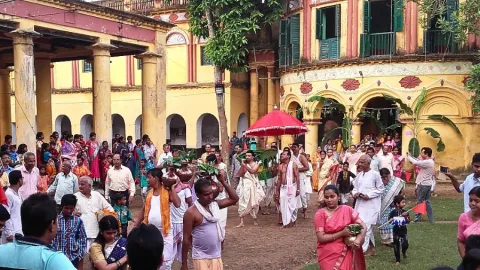
Dutta Chowdhury family members sitting in their Thakur dalan. (Picture by Amitabha Gupta)
Upload Image
Image
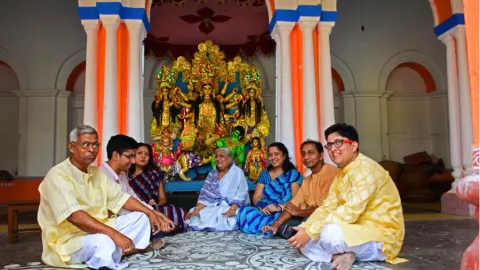
Image Section Title
Howrah
Is Background Visible
Off
Images View Mode
Simple
Text Body
Andul's Dutta Chaudhuri Family
Among Bengal's oldest family-organised Durga Pujas, the Dutta Chaudhuri family's celebration at Andul, Howrah, dates to the late sixteenth century. Initiated by zamindar Ramsharan Dutta Chaudhuri (1548–1606), it has survived more than four centuries of political change and family division.
Family accounts trace the lineage to Purushottam Datta, who migrated from Kanauj in the eleventh century and settled at Bally. His descendants Kanai Dutta and Kanai's son Murari served as treasurers under Sikandar Shah and received the title 'Biswas'. Murari's son Tekari moved to Andul, acquired considerable property and, as collector of the pargana, earned the title 'Chaudhuri'. A later rift among Tekari's descendants divided the family: Ramsharan's brothers, Gobindasharan and Harisharan, moved away, while Ramsharan remained at the ancestral residence and continued its traditions.
The Puja began in a thatched aatchala beside the Saraswati river. Ramsharan's son Kashishwar later built a permanent Durga dalan, which collapsed in 1923 and was replaced by the present structure.
Is Background Visible
Off
Upload Images
Image Caption
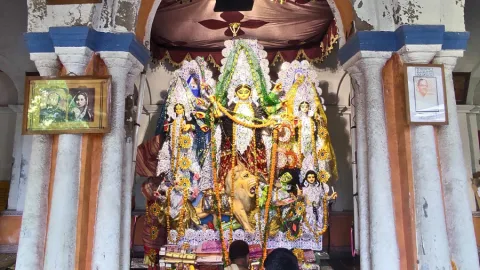
The Durga idol of Andul's Dutta Chowdhury family. (Picture by Amitabha Gupta)
Upload Image
Image
Is Background Visible
Off
Images View Mode
Simple
Text Body
The goddess is worshipped as Sri Sri Rajarajeshwari Thakurani Mata, believed to be the sister of the family deity, Sri Sri Rajarajeshwar Narayan. Following the Brihat Nandikeshwar Purana, the rituals begin with Bodhon twelve days before the principal Puja. Kathamo Puja, once observed on Ulta Rath, is now held on Janmashtami.
The idol's distinctive tanachauri backdrop features three panels depicting Dakshina Kali, Jagaddhatri and Vishnu reclining on Ananta Shesha Nag.
The food offerings to the goddess include khichuri, fried vegetables, payesh, chutney and sweets. The family's signature sweet, Agamonda, made with coconut, mewa and kheer and garnished with pistachios, almonds and raisins, is a particular speciality. Pulao joins the menu on Navami.
Unmarried women wear sankha (conch-shell bangles) throughout Devi Paksha, reflecting the belief that the goddess is the family's daughter. The goddess wears a green veil from Sasthi to Navami and a red one on Dashami.
Is Background Visible
Off
Upload Images
Image Caption
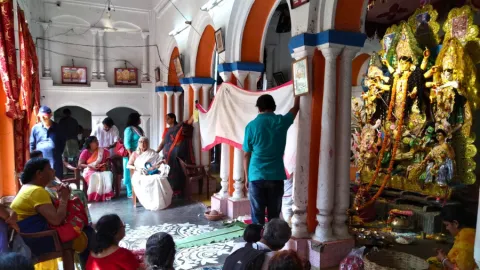
Family members attending the puja held at the Durga dalan of the Dutta Chowdhury ancestral home. (Picture by Amitabha Gupta)
Upload Image
Image
Is Background Visible
Off
Images View Mode
Simple
Text Body
Navami features Kalo Pradip Aarti, followed by the extinguishing of 28 inverted lamps to ward off evil. Kumari Puja honours two girls, one Brahmin and the other non-Brahmin. Animal sacrifice is avoided, although a symbolic shatrubali ritual sacrifices a rice-flour effigy representing an enemy.
During prasad distribution, the family still recites the phrase, "Baba, Ramsharan's kadai dharo". Rooted in memories of financial hardship, the expression conveys the hope that future generations will be spared similar adversity.
On Dashami, the women perform Thakur Boron before the goddess is taken for immersion. While the family's earlier immersion ghat lay on the banks of the Saraswati River now they go to a nearby waterbody in Dule Para.
Is Background Visible
Off
Upload Images
Image Caption
The Shiva-Durga idol which is worshipped by the Adhya Family at Chinsurah. (Picture by Poulomee Auddy)
Upload Image
Image
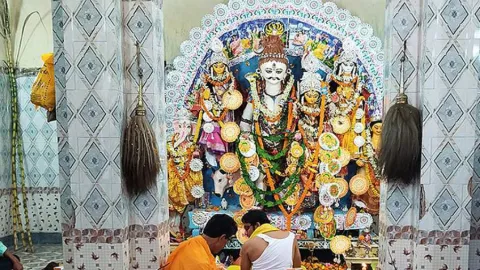
Image Section Title
Hooghly
Is Background Visible
Off
Images View Mode
Simple
Text Body
Chinsurah's Adhya Bari
In Chinsurah, the historic Dutch settlement in Hooghly district, Adhya Bari preserves a 290-year-old Durga Puja distinguished by its unusual iconography and Vaishnav traditions.
The family originated in Adisaptagram. Badan Chandra Adhya, a prosperous gold merchant of the Subarna Banik community, established the Puja at a three-arched thakur dalan in Panchanantala.
His grandson Yogendralal Adhya, popularly known as Yagu Master, was station master at Hooghly when Bengal's first passenger railway began operating between Howrah and Hooghly on 15 August 1854. His fame survives in a Bengali comic folk rhyme about a man rushing to catch a train to visit his in-laws. Today, descendants of Yogendralal's seven sons continue the tradition from ancestral houses clustered around the family's thakurbari.
Preparations begin with Kathamo Puja on Rath Yatra. Generations of artisans, priests and confectioners have remained associated with the celebrations, while Bodhon and Chandipath commence on Pratipad, the day after Mahalaya.
Is Background Visible
Off
Upload Images
Image Caption
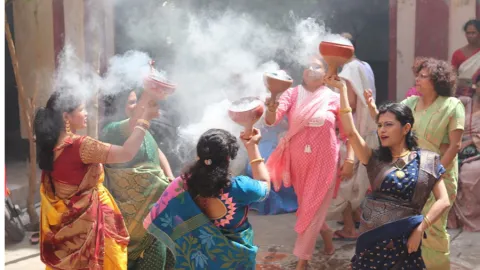
Women of Adhya Bari, dancing with dhunuchis on Bijoya Dashami. (Picture by Poulomee Auddy)
Upload Image
Image
Is Background Visible
Off
Images View Mode
Simple
Text Body
The family follows Vaishnavism, worshipping Sri Sri Shyamrai Jiu, a form of Radha-Krishna consecrated around 1730. Dol, Raas Yatra and Janmashtami are celebrated with equal devotion. The principal attraction, however, is the goddess herself. Unlike the familiar ten-armed Mahishasuramardini, she appears with two hands, seated peacefully on Shiva's lap in Abhaya Mudra, the gesture of protection and reassurance. Worshipped as Hara Gauri alongside Shiva and her children, she embodies a gentler, familial aspect of divinity.
The idol wears heirloom gold and silver jewellery and traditional daker saaj made with colourful foil and silver sequins. Silver ritual accessories, including Shiva's damru, have been preserved for decades. During Nabapatrika Snan at Sandeswartala Ghat, the procession is accompanied by an enormous umbrella with a silver handle.
Food is integral to the celebration. Bhiyen, the preparation of traditional confections, is completed nearly a week before the puja. All the cooking is done by a cook who travels from Bhadrak in Odisha, assisted by the household's women.
Rice-based annabhog is not traditionally offered here. The food offerings to the goddess include luchi, radhaballavi, five varieties of fried vegetables, halwa, payesh, padma nimki and various narus. On Ashtami, a naivedya containing approximately 37 kilograms of rice is presented.
Is Background Visible
Off
Upload Images
Image Caption
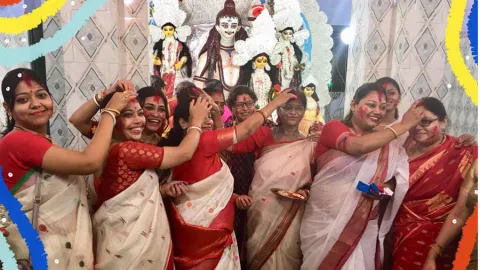
Sindoor Khela on Bijoya Dashami at Adhya Bari. (Picture by Poulomee Auddy)
Upload Image
Image
Is Background Visible
Off
Images View Mode
Simple
Text Body
During Sandhi Puja, male family members light 108 lamps; this is followed by dhuno porano. Navami features Kumari Puja and hom or yajna.
Dashami begins with Darpan Visarjan, followed by Devi Boron and Kanakanjali. Dhunuchi Naach and Sindoor Khela precede immersion at Sandeswartala Ghat. Bijoya concludes the celebrations as relatives exchange sweets, embrace one another and seek their elders' blessings.
Is Background Visible
Off
Upload Images
Image Caption
The Durga dalan of Boro Taraf along with the with Natmandir. (Picture by Amitabha Gupta)
Upload Image
Image
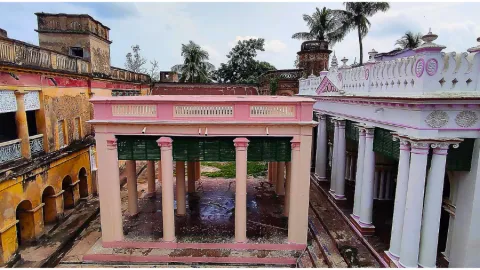
Image Section Title
Bankura
Is Background Visible
Off
Images View Mode
Simple
Text Body
Hadal-Narayanpur's Mondals
In the twin villages of Hadal-Narayanpur, beside the Bodai river in Bankura, the Mondal family demonstrates that Durga Puja need not depend on the traditional dhak. Instead, dhol, jagajhampa or charkoti kettle drums, and "band-party" percussion create a distinctive musical accompaniment.
The family traces its origins to Kalipada Ghosh, a Sadgop who migrated from Burdwan to Hadal. His descendant Muchiram Ghosh, an associate of Shubhankar Das, the renowned mathematician and Tarafdar of Parulia under the Malla ruler Gopal Singh Dev, received the title 'Mandalpati' by royal sanad. The family adopted the surname Mondal and traces its lineage to Sanando Mondal, a newborn named to commemorate the occasion.
Over time, the family divided into three branches, Boro Taraf, Mejo Taraf and Choto Taraf, each with its own architectural landmarks and Puja traditions.
Is Background Visible
Off
Upload Images
Image Caption
The Durga idol of the Bara Taraf branch of the Mondal family. (Picture by Amitabha Gupta)
Upload Image
Image
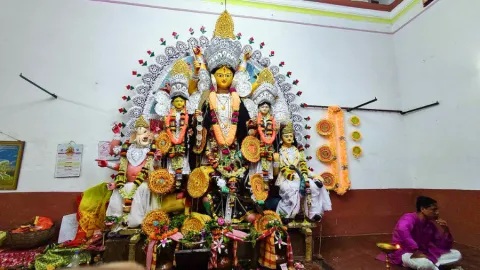
Image Caption
Bara Taraf's Nabapatrika being taken to the local pond for Snan. (Picture by Souvik Mondal)
Upload Image
Image
Is Background Visible
Off
Images View Mode
Simple
Text Body
Boro Taraf has an imposing mansion, Durga dalan, natmandir, rasmandap and a Radha-Damodar temple housing a Shalgram stone deity. Mejo Taraf has a Nabaratna temple with elaborate terracotta ornamentation, built in Nrisingha Murari Mondal's time. Choto Taraf has another Nabaratna temple, built by Baburam Mondal, along with its own natmandir and Durga dalan. All three branches feature terracotta representations of Durga as Singhabahini.
Approximately 250 years old, the Boro Taraf Puja is the oldest of the three. The same artisan family has crafted its idol for five generations, beginning work on Janmashtami and finishing before Sasthi. The clay and sacred Ganges water are brought from Katwa.
From Dwitiya, following Mahalaya, the musicians assemble at the natmandir.
The Boro Taraf idol recalls Bishnupur's famous Mrinmoyee Durga, although its face looks straight ahead rather than sideways. Unlike Bishnupur's single-figure representation, the goddess appears with her family, her face considerably larger than those of her children. White shola ornaments adorn the idol, while a gold crown and other gold ornaments are added before Bodhon. Donated gold jewellery is preserved by the debottar estate.
Is Background Visible
Off
Upload Images
Image Caption
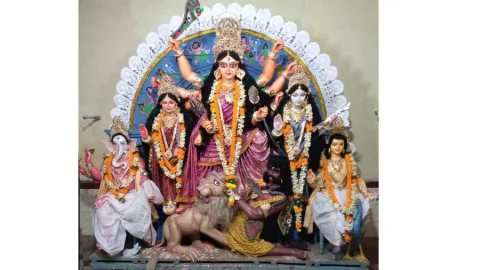
An idol of the Mejo Taraf, Mondal family. (Picture by Arkadeep Mondal)
Upload Image
Image
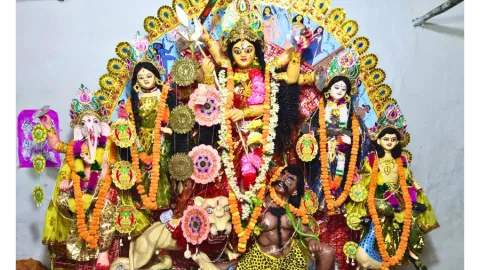
Image Caption
An idol of the Choto Taraf branch. (Picture by Himanka Sekhar Mondal)
Upload Image
Image
Is Background Visible
Off
Images View Mode
Simple
Text Body
Mejo Taraf once worshipped a painted Pot Durga but now uses a clay idol. They also lack a permanent Durga dalan. Choto Taraf has a permanent shrine, and its idol resembles Mejo Taraf's, differing from Boro Taraf's in ornamentation and chalchitra design.
Rituals follow the Gupta Press Panjika and an old handwritten family notebook. Saptami's Nabapatrika ceremony includes a grand procession.
Following Vaishnav traditions, the offerings consist of fruits, sweets and luchi, without cooked rice. Thirteen varieties of sweets are presented, including an enormous kadma from Mankar in Purba Bardhaman. Animal sacrifice is avoided, though white gourd and sugarcane are symbolically sacrificed.
On Dashami, a chyang fish is sacrificed before the family partakes of non-vegetarian food. The men perform Boron before the goddess is immersed in the Bodai river. The kathamo is then retrieved, marked with vermilion and preserved for the following year, while the women take part in Sindoor Khela.
Three branches, three distinctive expressions of devotion and one enduring heritage make this celebration remarkable.
Is Background Visible
Off
Upload Images
Image Caption
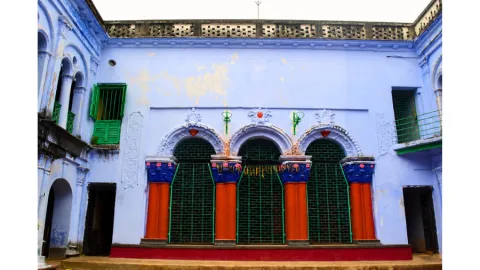
The two-storeyed mansion of the Pal family at Ranaghat with its Corinthian pillars and two lion statues. (Picture by Amitabha Gupta)
Upload Image
Image
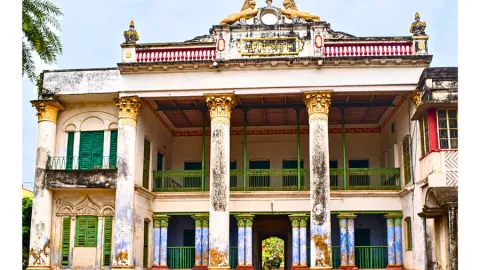
Image Section Title
Nadia
Is Background Visible
Off
Images View Mode
Simple
Text Body
Ranaghat's Pal Bari
In Biswaspara, Ranaghat, the imposing Pal Bari stands as a testament to Lal Gopal Pal's rise from poverty and the traditions he established. Its two-storeyed façade, Corinthian pillars and paired lion statues convey considerable grandeur, yet its Durga Puja remains rooted in domestic rituals rather than extravagant spectacle.
Believed to be approximately 150 years old, the Puja began in a smaller house in the late nineteenth century; the present mansion was built around 1900. According to Lal Gopal's great-grandson, Dilip Paul, it is not known whether Lal Gopal's father, Gopeshwar, or earlier ancestors worshipped Durga.
Born into a poor family of potters from Dignagar, Nadia, Lal Gopal left school after Class V and worked in a grocery shop for a salary of one anna. Impressed by his diligence, his employer helped him set up a business in clothes and groceries. Lal Gopal prospered, acquired land and property, built the mansion and established a school in Ranaghat in 1926.
The family continues daily worship at its Shiva temple, while a debottar trust finances the Puja. Four family branches, or shariks, organise the celebrations by rotation.
Is Background Visible
Off
Upload Images
Image Caption
The Thakur dalan of the Ranaghat Pal family. (Picture by: Amitabha Gupta)
Upload Image
Image
Is Background Visible
Off
Images View Mode
Simple
Text Body
The idol is adorned with multicoloured foil, or rangta, and silver sequins in the traditional daaker saaj style. Its colours change annually according to the organising branch's preference. Unlike many aristocratic household idols, the goddess wears no gold or silver jewellery; her weapons and those of the other deities are made of nickel-plated brass.
The same artisan family has crafted the idols for generations, while traditional dhaki families provide the music. The descendants of the original priests, however, have left the profession and a different priest has conducted the Puja for the past fifteen years.
Kathamo Puja takes place on Rath Yatra, followed by Bodhon on Shashthi. Nabapatrika rituals remain private, conducted within the thakur dalan.
The morning offerings are particularly distinctive. They include uncooked rice, pulses, raw vegetables, betel leaves, areca nuts, coconut sweets, papad, rock salt, oil and spices. Two arrangements are prepared: one with sun-dried rice and cut vegetables, another with parboiled rice and whole vegetables. An earthen pot and firewood accompany the ingredients, symbolically suggesting that the Goddess will cook her own meal.
After the rituals, offerings are distributed among Brahmins and the priest on Saptami and Ashtami, at Sandhi Puja and on Navami. Evening offerings comprise 64 luchis, served with chhena, rosogolla, cashews, raisins, pistachios and almonds in 16 portions.
Is Background Visible
Off
Upload Images
Image Caption
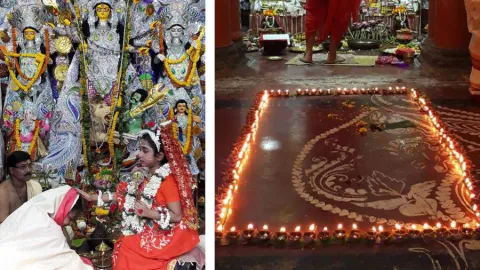
Kumari Puja takes place on Ashtami; the 108 lamps lit during Sandhi Puja are arranged in a rectangular shape (Pictures by the Ranaghat Pal family)
Upload Image
Image
Is Background Visible
Off
Images View Mode
Simple
Text Body
Ashtami features Kumari Puja for one young girl. During Sandhi Puja, the women of the house light 108 earthen lamps arranged in a rectangle on banana leaves. Animal sacrifice is avoided, although sugarcane, white gourd and cucumber are symbolically sacrificed.
On Navami, an elderly woman performs dhuno porano by carrying three flaming earthen containers while wearing a wet sari and a veil covering her face. A hom or yajna follows. Another unusual tradition is Kada Khela, or mud play, involving young members of neighbouring Puja families and dhakis. Participants once rolled in mud; today, the ritual is observed by applying a mud tilak to one another's foreheads.
Dashami brings Darpan Visarjan, Dadhi Karma, Boron and Sindoor Khela. The goddess, once carried manually and immersed from a boat, is now transported by vehicle to the nearby Churni river.
At Pal Bari, the festival commemorates not only the goddess but also Lal Gopal Pal's extraordinary journey and the family traditions preserved by successive generations.
Is Background Visible
Off
Published on
Article Image
Image
Updated On
Read Time
7 min
Article Type
Story
Article Videos
Is Background Visible
Off
Upload Video
Display Type
Long Description
Content Family
General Purpose
Image Gallery
Upload Images
Is Background Visible
Off
Images View Mode
Simple
Video Gallery
Is Background Visible
Off
Upload Video
gallery view mode
horizontal
sub title
Four ancestral family pujas show the many faces of Bengal’s greatest festival
Detail Page Title
Bonedi Durga Pujas from districts of Bengal
action if location
default
Comments