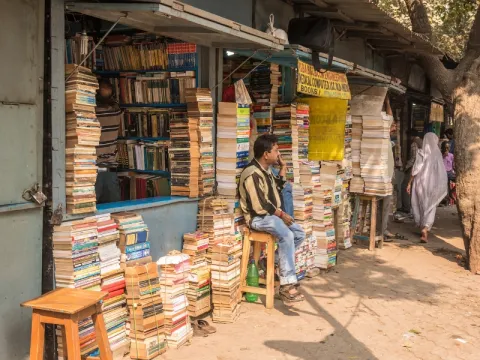
College Street, or Boi Para (“Book Neighbourhood”), is exactly what it appears to be and something far stranger. Its footpaths are paved with books: bestsellers, textbooks, rare colonial-era volumes, pre-Partition Bengali literature, crumbling 1940s medical journals and salvaged pages from books that didn’t survive, all stacked with a logic opaque to outsiders but precise to the vendors. There is no catalogue; walk slowly, browse with no agenda and accept you’ll find several things you didn’t know you needed.
Toward College Square, commerce gives way to institution. Presidency University (founded as Hindu College in 1817, renamed 1855; present building completed 1874) counts among its alumni Subhas Chandra Bose, Tagore (briefly), Bankim Chandra Chattopadhyay, Meghnad Saha, Jibanananda Das, Satyajit Ray and Amartya Sen, plus Jagadish Chandra Bose, who spent thirty years teaching physics there. It’s not routinely open to casual visitors, but the front gate and its dense fringe of photocopy shops and student adda spots reward a look.
A short walk away, Sanskrit College (founded 1824) has a colonnaded inner hall with Ionic pillars and a small museum named for Ishwar Chandra Vidyasagar, its principal from 1851 to 1858. Calcutta University, established in 1857 alongside Bombay and Madras as one of India’s first modern universities, became the Bengal Renaissance’s institutional backbone; its compact College Street campus houses the Darbhanga, Ashutosh, Hardinge and Centenary buildings.
Coffee House, serving since 1942, sits behind a nondescript doorway leading up a dark stairway into a high-ceilinged room thronged for generations by students, poets and revolutionaries; its reputation exceeds its coffee, but deservedly. Nearby, Medical College Kolkata (founded 1835) was the first in Asia to teach Western medicine; Kadambini Ganguly became its first female graduate in 1886, going on to become one of India’s first women licensed to practise it. On College Square’s eastern side sits the Mahabodhi Society, founded in 1891 by Sri Lankan revivalist Anagarika Dharmapala, which campaigned for decades for Buddhist control of Bodh Gaya’s Mahabodhi Temple and remains active in publishing Buddhist literature.
Article Content
Text Body
Is Background Visible
Off
Published on
Article Image
Image
Updated On
Read Time
2
Article Type
Location
Article Videos
Is Background Visible
Off
Upload Video
Content Family
General Purpose
Image Gallery
Upload Images
Is Background Visible
Off
Images View Mode
Simple
Video Gallery
Is Background Visible
Off
Upload Video
gallery view mode
horizontal
action if location
default
Comments