Bengal's terracotta masterpiece
Location Category
Location Circuits
Location Interest
Location How Many Days
Location Group
Location Content
Text Body
Welcome to the terracotta town! Nestled in the Bankura district of West Bengal, Bishnupur is a living, open-air museum of terracotta artistry and medieval Bengali architecture. This small town, once the capital of the powerful Malla dynasty, stands as a testament to centuries of artistic excellence, where every brick seems to tell a story and every temple wall is a canvas of intricate craftsmanship. The Bishnupur Group of Monuments has been on UNESCO’s World Heritage Tentative List since 1998 and the town packs an exceptional concentration of late-medieval and early-modern heritage sites within a walkable area.
Why visit Bishnupur
Bishnupur offers a rare glimpse into Bengal’s glorious past, far from the tourist crowds. The town’s 17th and 18th-century terracotta temples are unmatched in their artistic detail, depicting scenes from The Ramayana and The Mahabharata alongside everyday life in medieval Bengal. Beyond the temples, you’ll discover traditional Baluchuri silk weaving, distinctive pottery and the haunting melodies of classical music that still echo through the town.
History
Bishnupur rose to prominence under the Malla rulers, whose early origin stories blend history with local legend. Traditional accounts describe the dynasty’s founder as a gifted wrestler-king (hence malla, “wrestler”), but the earliest genealogy and dates vary across sources, so it’s best read as part myth, part memory rather than a single settled narrative.
What is clearer is Bishnupur’s later flowering as a capital and cultural powerhouse. Scholarly accounts note that the early Malla capital was at Praddumnapur and that Jagat Malla (often identified as the 19th ruler in the line) shifted the capital to Bishnupur. Over the centuries that followed, especially from the 17th to 18th centuries, the town’s rulers and patrons built the remarkable temples and civic structures that define Bishnupur today.
The monumental Rasmancha (c. 1600 CE) is among the earliest surviving landmarks and many of Bishnupur’s best-known terracotta temples date from roughly the next 150 years, when temple-building and terracotta storytelling reached a peak in this region.
Title
History and Culture
Is Background Visible
Off
Location Information Items
Section Title
Top Sights and Experiences
Text Body
Getting There
By Train: Bishnupur Railway Station is well-connected to Kolkata, Howrah and other major cities. Several express trains (like the Rupashi Bangla Express) connect Howrah (Kolkata) to Bishnupur (VSU) in about 3 to 3.5 hours. All trains are via Kharagpur and Midnapore.
By Road: About 145km from Kolkata (4-5 hours by car depending on route/traffic; popular route via Arambagh-Kotulpur-Joypur). State-run West Bengal Transport Corporation (WBTC) buses and private vehicles operate from Kolkata, Durgapur, Bankura, etc.; frequency and comfort vary. Buses are also available from Tarakeswar, Durgapur, Kharagpur, Bardhaman, Asansol and other nearby cities.
By Air: The closest airport by road is Kazi Nazrul Islam Airport (Andal/Durgapur) but it operates limited flights. The Kolkata (Netaji Subhash Chandra Bose International Airport) is the largest nearby hub with the widest connectivity.
Getting Around
The temples are spread across town but can be covered by cycle-rickshaw, auto-rickshaw, or on foot if you’re up for it. Hiring a local guide (Rs 500-800 for a full day) adds valuable context to your temple visits.
Culture, Etiquette and Practical Tips for Visitors
- Start early to avoid midday heat and have better light for photography.
- Temples are heritage religious sites: dress modestly, remove footwear where required, avoid climbing on structures or touching panels.
- Carry cash; ATMs are limited and many shops do not accept cards.
- Mobile data generally OK in town; can dip on rural side-trips.
- Hire a local guide for deeper insights into the terracotta narratives. Rates negotiable — agree clearly upfront.
- The Archaeological Survey of India maintains several temples; there’s a small composite fee (higher for foreigners).
- Still photography is generally allowed in temple complexes; drones/tripods are often restricted. Check current ASI rules at the gate.
- Mosquito repellant is advisable, especially near the lakes.
What to Buy
Bishnupur offers unique shopping opportunities:
Baluchuri and Swarnachari Saris - Handloom silk saris inspired by terracotta panels, depicting stories from epics and religious texts. Versions with modern motifs are now available.
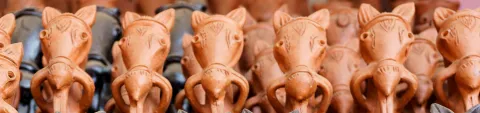
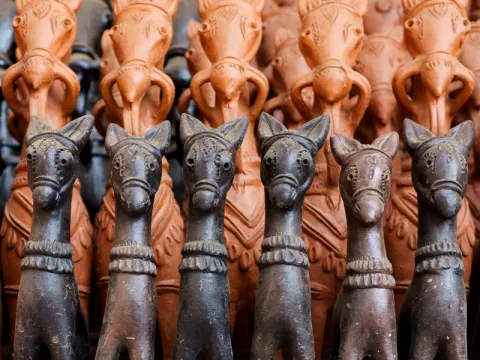
Terracotta Artefacts - The most sought-after items. The popular giraffe-like Bankura horse is available in different sizes.
Various other terracotta items range from large sculptures to jewellery.
Dashavtar Cards - A unique 120-card game with 10 suits representing the 10 avatars of Lord Vishnu, introduced by Bir Hambir. These circular cards (4.5 inches diameter) are works of art made from layers of cloth pasted together, painted with organic colours.
Brass and German Silver Utensils - Famous local products including utensils and decorative artefacts.
Conch Shell Artefacts - Decorated conch shells and items made from them, including bangles (shankha).
Dokra Art - Lost-wax bell-metal casting artwork.
What to eat
Don't come here looking for fine dining; come for authentic Bengali flavours. Simple, local eateries and the tourist lodge's restaurant are your best bets. The region is famous for its preparations using posto (poppy seeds).
Must-try dishes include Bishnupur Motichoor Laddu (traditionally made using piyal seed flour rather than gram flour), Posto Bora (poppy-seed fritters; a Bankura/Bishnupur summer favourite) and Mecha Sandesh (a Bankura-region speciality).
Best Time to Visit
Peak Season (October to March) offers pleasant weather (15-28°C) ideal for exploring temples and outdoor sites.
Monsoon (July-September) brings lush greenery but can make temple exploration uncomfortable.
Summer (April-June) is hot (30-40°C) but sees fewer tourists. Carry sun protection and stay hydrated.
Festival Season (December-January): Bishnupur Mela (late December; dates vary year to year) brings the town alive with crafts, performances and folk culture. Rash/Ras celebrations are typically tied to Kartik Purnima (often Oct–Nov), when the wider region marks the Ras season.
Title
Things to Know
Is Background Visible
Off
Text Body
Dihar (8km): Proto-historic site famous for the Saileswar and Sareswar temples built by King Prithvimalla in 1346. Chalcolithic people had settled here by 1200-1000 BC.
Dharapat (12km): 18th-century Jain-Hindu temple with three excellent stone idols. Features a fascinating statue of Parasnath that was converted into a Vishnu idol by adding two hands, signifying the overpowering Hindu influence after Jainism's decline in the area.
Joypur Forest (15km): Sal forest drives, birds; combine with Bishnupur in a day.
Susunia Hills (60-65km): Rock inscriptions of 4th-century King Chandravarma, ancient fort ruins and moderate trekking opportunities.
Panchmura (25km): Traditional terracotta horse village where the famous Bankura Horses are made. Features Tridhara Milan Mandir (established July 1, 2022).
Mukutmanipur (65-75km): Large reservoir and dam across the Kangsabati River with boating facilities, scenic views and hilly landscape.
Title
Nearby Excursions
Is Background Visible
Off
Location Images
Image
Location Banner Image
Image