The square now called Binoy-Badal-Dinesh Bagh, honouring three freedom fighters who shot dead the British Inspector General of Prisons on the balconies of Writers’ Building on 8 December 1930, was known to the British as Dalhousie Square and served for roughly 150 years as the administrative nerve centre of the most powerful empire on earth. At its centre sits Lal Dighi, a tank excavated in the early 18th century that was the nucleus around which colonial Calcutta grew.
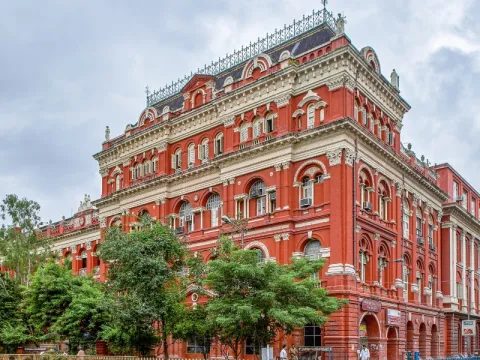
The square is the most institutionally dense in the city: Writers’ Building (the long terracotta-and-white neoclassical block, begun as Company clerks’ barracks in 1776 and given its current arcaded facade in 1882); the General Post Office, with its Corinthian rotunda and 67-metre dome, built on the site of the original Fort William; the High Court (1862), modelled on the Cloth Hall at Ypres; and the Reserve Bank of India and Lok Bhavan (Raj Bhavan). Trading houses and banks, among them Lloyd’s, Credit Lyonnais and Jardine Henderson, ring the outer streets, many since absorbed or overshadowed. The buildings are imperfectly maintained and the tank is murky, but this reflects continued use rather than neglect: these are still working government offices, the machinery of state turning inside its colonial casing.
Inside the GPO, look for the plaque marking the “Black Hole of Calcutta,” where British prisoners were held overnight in 1756 by the forces of Nawab Siraj ud-Daula. Survivor J. Z. Holwell claimed 123 of 146 prisoners died; historians have revised the figure sharply downward and some question the account altogether; yet the British used it to justify the reconquest of Bengal and the destruction of the Nawab’s power at Plassey. The actual Holwell Monument, after decades of relocation, now stands in the churchyard of St. John's Church, a short walk away, alongside the octagonal mausoleum of Job Charnock, the East India Company agent traditionally credited with founding the settlement.
Directly opposite Writers’ Building is St. Andrew’s Kirk (1818), Kolkata’s only Scottish Presbyterian church, its steeple reportedly built a few feet taller than St. John's purely so as not to be outdone. The Town Hall (1813), an undervisited Palladian building that hosted the first European art exhibition in Kolkata and later anti-colonial speeches, rewards a slow look inside. Lok Bhavan (formerly Raj Bhavan, formerly Government House), designed by Charles Wyatt for Lord Wellesley and completed in 1803, is an Indian adaptation of Kedleston Hall in Derbyshire; in a neat historical coincidence, Lord Curzon, whose ancestral seat was Kedleston itself, later occupied it as Viceroy. Nearby, the Great Eastern Hotel (opened 1840, one of India’s first electrically lit hotels, praised by Mark Twain) has reopened as The LaLiT Great Eastern after extensive renovation.
Article Content
Text Body
Is Background Visible
Off
Published on
Article Image
Image
Updated On
Read Time
3
Article Type
Location
Article Videos
Is Background Visible
Off
Upload Video
Content Family
General Purpose
Image Gallery
Upload Images
Is Background Visible
Off
Images View Mode
Simple
Video Gallery
Is Background Visible
Off
Upload Video
gallery view mode
horizontal
action if location
default
Comments