Bengal's land of sacred springs
Location Category
Location Circuits
Location Interest
Location How Many Days
Location Group
Location Content
Text Body
Tucked away in the red-earth landscape of Birbhum district, about 230 km northwest of Kolkata, Bakreswar is one of those rare Indian destinations where geology and mythology fuse into something extraordinary. The town sits on a cluster of geothermal hot springs (some reaching temperatures of 80°C) that bubble up through ancient Precambrian rock, while overhead, the spires of one of India’s 51 Shakti Pithas pierce the Bengal sky. Known locally as the “Gupta Kashi” (Hidden Varanasi) of the Rarh region, Bakreswar offers pilgrims, geology enthusiasts and culture-curious travellers a compelling reason to venture beyond the well-trodden circuit of Kolkata and Santiniketan.
Bakreswar is not a place of luxury or polish. It is a place of substance. Where else in India can you stand on rock that is billions of years old, watch helium gas bubble up from the Earth’s mantle, soak in mineral-rich springs that ancient sages believed could heal the body and pray at a temple whose mythology stretches back to the very creation of the cosmos? For the traveller willing to forgo resort comforts in exchange for something altogether more profound, Bakreswar delivers an experience that lingers long after the steam has cleared.
History & Mythology
The Legend of Ashtavakra
The very name “Bakreswar” tells a story. Derived from the Sanskrit words “Vakra” (bent or curved) and “Ishwar” (lord), it refers to the sage Ashtavakra, a man whose body was twisted at eight points. According to the local temple tradition, during the marriage ceremony of Lakshmi and Narayana in the Satya Yuga, the sage (then known as Subrata Muni) was cruelly mocked by Indra, the king of the gods. So consumed by fury and humiliation was he that eight deformities seized his body. Burning with humiliation, Ashtavakra retreated to this remote corner of Bengal and devoted himself to an extraordinary ten-thousand-year meditation upon Lord Shiva.
Moved by this monumental act of devotion, Shiva not only healed his devotee’s twisted body but declared that any pilgrim who venerated Ashtavakra before worshipping Shiva at this site would receive an abundance of blessings. The divine architect Vishwakarma was then commanded to erect a temple on this sacred spot and so arose Bakreswar.
The Shakti Pitha Connection
Bakreswar’s significance extends beyond the Shaivite tradition. It is revered as one of the 51 Shakti Pithas: sacred sites scattered across the Indian subcontinent where parts of the goddess Sati’s body are said to have fallen when Lord Vishnu used his Sudarshan Chakra to dismember her corpse and halt Shiva’s devastating dance of grief. At Bakreswar, it is believed that Sati's forehead and eyebrows, that portion between the eyes held to be the seat of the mind, landed here, making this a place of exceptional spiritual potency for devotees of both Shiva and Shakti.
Historical Context
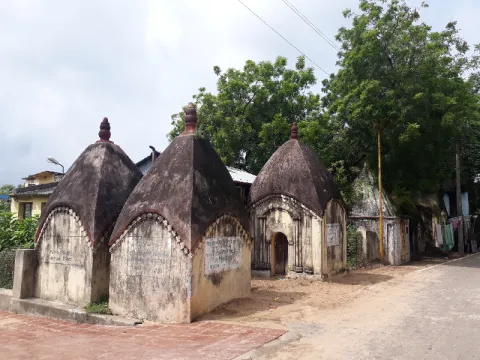
The temple complex has drawn pilgrims for centuries and the architectural style of the main shrine shows clear Odishan (Oriya) influence, a “rekha-deul” form with a curvilinear tower that speaks to the cultural crosscurrents of this border region between Bengal and Odisha. The Bakreswar River flows past the town and the Papahara (also called Phaphra) River (whose name literally means “remover of sins”) runs to the south, where a cremation ground has served as a site for last rites for centuries. This confluence of water, fire (the hot springs) and spirituality has given Bakreswar a reputation as a powerful place for tantric practice, attracting sadhus and Aghori practitioners through the ages.
Title
History and Culture
Is Background Visible
Off
Location Information Items
Section Title
Top Sights & Experiences
Text Body
Getting There
From Kolkata
By Road (230 km, 5-6 hours)
The most flexible option. Take NH 19 (the old Grand Trunk Road) to Panagarh, then the Panagarh–Morgram Expressway towards Siuri. From Siuri, Bakreswar is just 18 km by a well-metalled road. SBSTC government buses run regularly from Dharmatala Bus Stand in Kolkata to Siuri. Private buses and shared vehicles are also available. You can also hire a private car from Kolkata.
By Train (to Siuri or Dubrajpur)
The nearest railway station to Bakreswar is Dubrajpur, on the Andal–Sainthia branch line of the Eastern Railway zone. Sainthia Junction, at the line's far end, connects to the main Sahibganj loop. Alternatively, trains run to Siuri (the district headquarters), which is better connected. The Hool Express connects Howrah directly to Siuri. The Mayurakshi Express, which runs Howrah to Deoghar, stops at both Dubrajpur and Siuri en route; passengers should alight at Dubrajpur for the closest access to Bakreswar. From Siuri station, auto-rickshaws and shared vehicles cover the 18 km to Bakreswar in about 30 minutes.
By Air
The nearest airport is Netaji Subhash Chandra Bose International Airport in Kolkata. From there, take a pre-booked car or connect via train/bus as described above. There is no airport closer to Bakreswar.
Travel Tip: If you are combining Bakreswar with Santiniketan and Tarapith (highly recommended), consider basing yourself in Bolpur/Santiniketan and making day trips. Bakreswar is about 45 km from Bolpur and 60 km from Tarapith, making a circuit of all three very manageable in 2-3 days.
Getting Around
Within and around Bakreswar, auto-rickshaws, shared vans (totos) and cycle-rickshaws are the primary modes of transport. For day trips to nearby attractions, hiring a car through your hotel is the most convenient option. Shared transport between Siuri and Bakreswar runs frequently throughout the day.
What to Eat
Bakreswar’s food scene is modest but deeply satisfying if you appreciate authentic Bengali home-style cooking. Don’t expect fine dining. Several small eateries and food stalls cluster around the temple and hot springs area. These are run by local families and serve homely Bengali thalis (rice, dal, fish or vegetable curries and a sweet). Hotel restaurants offer slightly more variety but the charm lies in eating where the pilgrims eat: on simple benches, under a tin roof, with food that tastes of home.
Khirer Singara: Bakreswar’s signature snack: a crispy samosa filled with a spiced mixture of condensed milk and paneer. Irresistible with a cup of chai.
Rosogolla: No Bengali destination is complete without this iconic spongy sweet. The local versions are made fresh and are worth seeking out.
Maach Bhaat: The Bengali staple of fish and rice. The small eateries near the temple serve simple but flavourful preparations of river fish in mustard or light curry gravies.
Macher Jhol: Light fish curry, comfort food at its best, especially after a morning dip in the hot springs.
Mangsher Singara: For the non-vegetarian: a samosa variant stuffed with spiced keema (minced meat).
Jhal Muri & Gughni Chaat: Spicy puffed rice and chickpea preparations. Perfect for a quick, cheap and tasty street snack.
Best Time to Visit
Oct - Feb (Best): Cool, dry and pleasant. Daytime temperatures of 15-28°C. Clear skies, comfortable for temple visits and spring bathing. Peak pilgrim season around Shivaratri (Feb/Mar).
Mar - May (Hot): Temperatures soar above 40°C with punishing humidity. Only for the truly devoted or those who revel in warmth. Carry ample water and sun protection.
Jun - Sep (Monsoon): Annual rainfall of about 1,400 mm falls mostly in these months. The landscape turns lush green but roads can become muddy. Fewer crowds; atmospheric but unpredictable.
Title
Things to Know
Is Background Visible
Off
Location Images
Image
Location Banner Image
Image
