Step into a world of palaces, temples and trading history
Location Category
Location Circuits
Location Interest
Location How Many Days
Location Group
Location Content
Text Body
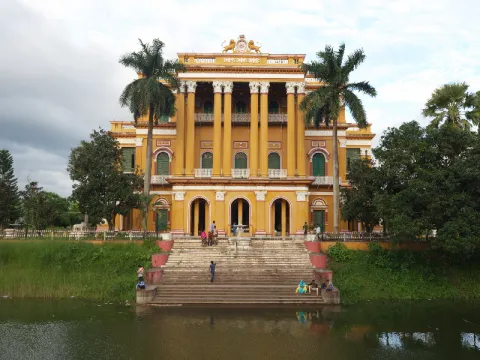
Straddling opposite banks of the Bhagirathi River in Murshidabad district, the twin towns of Azimganj and Jiaganj guard one of India's most remarkable yet overlooked heritage corridors. Just upriver lies Baranagar, Rani Bhabani’s famed temple village, often nicknamed the “Varanasi of Bengal” for its remarkable concentration of shrines, while Azimganj and Jiaganj supplied the mercantile muscle: bankers, silk and river trade. Among Jain pilgrims, this landscape is often spoken of as Shri Murshidabad Tirth: a living triangle of temples and memory, with Azimganj and Jiaganj as its riverbound base and the Nashipur–Mahimapur/Kathgola cluster rising a little farther out like an inland summit. It’s a tirth not because it is museum-quiet, but because worship never quite left.
Today, around fourteen magnificent Jain temples, spread across Azimganj, Jiaganj and the wider Nashipur–Kathgola hinterland, anchor the route, their Indo-Mughal-colonial architecture blending seamlessly with terracotta Hindu temples and crumbling aristocratic mansions. This is rural Bengal at its most atmospheric, a place where mustard fields meet marble shrines, where 18th-century banking empires rose and fell and where time seems to have paused somewhere around 1900.
Historical Context
The Sheherwali Legacy
In the 18th century, Shwetambar Jain businessmen from Rajasthan, known as Sheherwalis (an “urban” mercantile Jain community, whose clan histories and temple-trust networks took shape in and eventually helped shape, some of eastern India’s most cosmopolitan trading towns), migrated to Murshidabad. They built empires in textiles and banking, eventually becoming zamindars (landowners). The Sheherwalis adapted to prevailing cultural influences (Mughal, British, Bengali and European) creating their own unique culture.
At its height, the community ran to around a hundred households, clustered around a handful of prominent trading-and-temple families, with names like the Dugars, Dudhorias, Nahars, Nowlakhas (and others remembered locally) still echoing across the old kothis and temple trusts.
Rise and Fall
At the city’s 18th-century peak, Murshidabad sat startlingly close to the nerve-centre of global commerce, with banking, bullion, silk and textiles moving through a river capital where European companies, Mughal-era grandees and Indian merchant dynasties all kept one eye on the same ledger. Many families stayed on well into the late 1960s and 1970s, before unrest, targeted crime and the long aftershock of Bengal’s radical politics pushed a fresh wave of departures to Kolkata and western India. Today, restoration efforts by families like the Dugars and Nowlakhas through the Murshidabad Heritage Development Society aim to preserve this unique cultural legacy.
Title
History and Culture
Is Background Visible
Off
Location Information Items
Section Title
Top Sights and Experiences
Text Body
Getting There
By Train: Azimganj Junction and Jiaganj railway stations sit on opposite sides of the river, with multiple daily links to Howrah/Kolkata. Options include morning and afternoon expresses and InterCity services via the Malda–Murshidabad corridor. Schedules shift seasonally, so check the current timetable close to your travel date. Depending on the train and your station choice, Kolkata-to-Azimganj/Jiaganj is commonly a five-ish-hour run.
By Air: The nearest airport is Netaji Subhash Chandra Bose International Airport (CCU), Kolkata (195 km away). Arrange a taxi or pre-booked car from the airport.
By Road: Regular state and private buses connect to Berhampore, Lalbagh, Lalgola and Kolkata. Shared taxis (shuttle taxis) are also available from nearby towns.
Getting Around
Totos (electric rickshaws): The primary mode of local transport. Available outside both railway stations. A full-day toto can be hired for temple tours (Rs 400-600).
Ferry Service: Municipal ferries connect Jiaganj and Azimganj across the Bhagirathi, operating throughout the day. A memorable experience.
Walking: The old city areas are compact and best explored on foot.
What to Eat
Sheherwali Cuisine
Sheherwali cuisine is a unique fusion blending Rajasthani vegetarian traditions with Bengali culinary techniques. This 300-year-old food heritage emerged when Rajasthani Jain merchants adapted their cooking to local ingredients.
Must Try:
Kheere ki Kachori: A spicy pastry stuffed with cucumber (a cooling ingredient for the humid Bengal weather).
Saloni Mewa ka Khichdi: A rich, dry fruit-laden rice dish.
Khatte ki Pakauri: Chickpea flour fritters in tamarind water.
Make sure to try Chanabora, a deep-fried cottage cheese sweet that is hard on the outside and juicy inside: a Murshidabad specialty. Rosokodombo is a Malda-born, Murshidabad-loved kadam-flower-shaped sweet, like a dry rasogolla scented with cardamom and finished with a poppy-seed-and-sugar coating, inspired by Mahaprabhu Sri Chaitanya’s rest beneath a Kadam tree.
What to Buy
Murshidabadi Silk
This stretch of Bengal has silk in its bloodstream. Jiaganj and Azimganj are hubs of weaving activity, particularly famous for Murshidabadi silk. The area is especially known for Baluchari Saris. “Baluchari” takes its name from Baluchar in Murshidabad, where the style first flourished, even though much of today’s best-known weaving is associated with Bishnupur. In and around Jiaganj–Azimganj you’ll still find plenty of Murshidabadi silk in shops and markets. Ask for locally woven pieces and don’t be shy about requesting provenance.
Best Time To Visit
Winter (October-March): The weather is pleasant with temperatures between 15°C and 25°C, perfect for temple-hopping and riverside walks. Bengali winters offer crisp mornings ideal for photography and exploration.
Monsoon (June-September): Heavy rains can disrupt ferry services and make temple visits uncomfortable, though the countryside becomes lushly green.
Summer (April-May): Hot and humid, with temperatures exceeding 35°C. Best avoided unless you're accustomed to tropical heat.
Title
Things to Know
Is Background Visible
Off
Location Images
Image
Location Banner Image
Image