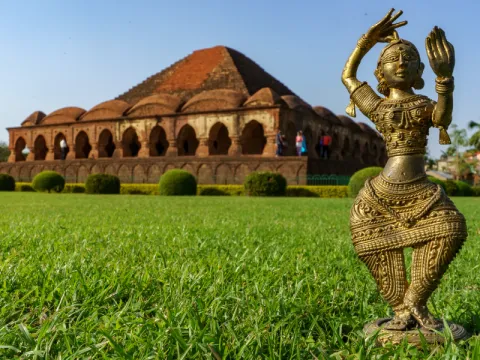
Start at the Rasmancha, the icon of Bishnupur and the gateway to the ASI temple complex (common ticket is issued here). This massive pyramidal structure is architecturally unique. Built by Malla King Bir Hambir, it wasn’t a temple itself, but a grand stage where all the local deities (idols) from various temples were brought in procession and displayed during the annual Ras festival. Its large, arched galleries are built for crowds and the atmosphere, especially at dusk, is unforgettable.
Then walk or cycle to:
- Jorbangla Temple (Kestorai Temple) A masterpiece of the do-chala style, this temple (built in 1655) looks like two traditional Bengali thatched-roof huts have been fused together. The real magic is in the details. The terracotta panels covering its walls and arches are among the most intricate, depicting scenes from the Ramayana, Mahabharata and the playful lilas (divine acts) of Krishna. Panels of ships and boats are particularly notable and a panel depicting Bhishma on his bed of arrows stands out among all.
- Madan Mohan Temple One of the best-preserved temples and a classic example of the ekaratna (single-spired) style. Built in 1694, its carvings are sharp and clear, showcasing the Dashavatara (ten avatars of Vishnu) and other mythological tales. It’s one of the few temples where a deity is still actively worshipped. The temple is enclosed inside a high-walled complex with a do-chala gateway on the western side.
- Shyam Rai Temple A structural marvel, this temple (built in 1643) is the finest example of the pancharatna (five-pinnacled) style. The five towers sit on a square, flat-roofed building and every inch of the temple is covered in terracotta reliefs depicting aspects of Lord Krishna's life.
- Lalji Temple Built by Bir Singha in 1658, this single-pinnacled laterite stone temple is considered the finest of its kind in Bishnupur. The temple follows a similar architectural style to the Radhashyam Temple but was constructed 100 years earlier.
- Radheshyam Temple This ekaratna temple built of laterite stone (1758) contains limestone stucco decoration and is enclosed with high walls. Its entrance consists of a triple-arched Islamic-style gateway, built by Malla King Chaitanya Singha.
Other notable temples:
- Nandalal Temple This south-facing single-pinnacle temple stands on a raised platform with a triple-arched entrance. Built sometime in the 17th century, it features a square plan with very little ornamentation, just shallow relief work. Originally plastered with lime, only traces remain today, giving it a weathered, understated elegance compared to its more ornate neighbors.
- Lal Bandh cluster South of Lal Bandh tank sits a cluster of lesser-visited temples that reward exploration. Kalachand Temple (1656) is Bishnupur's earliest surviving laterite eka-ratna shrine, with arched openings on all sides creating a corridor-like feel. Jor Mandir (1726), despite its name, is actually a trio of temples in striking formation. Radha Govinda (1729) and Radha Madhava (1737) showcase intricate Krishna-lila reliefs; the latter features a rare do-chala bhoga-mandapa (offering hall) nearby, the only structure of its type in Bishnupur. For solitude seekers, Patpur Temple (late 18th century) sits isolated on Krishna-bandh's eastern shore, reached only via precarious tracks through paddy fields.
- Radha Vinod Temple (1659) An at-chala (eight-sloped roof) brick temple with traces of terracotta ornamentation.
- Malleswar Temple (1622) A unique Shiva temple, one of the earliest in Bishnupur, with an unusual octagonal turret.
- Sridhar Temple The only navaratna (nine-pinnacled) temple in Bishnupur with rich terracotta ornamentation.
- Madangopal Temple (1665) A pancharatna (five-pinnacled) laterite stone temple.
- Murali Mohan Temple (1665) An ekaratna laterite stone temple built by Siromani Devi.
Within or near the old fort area stand several dilapidated temples worth noting for architecture enthusiasts: the Mahaprabhu Temple (1734–35), a crumbling Jor-bangla-type shrine with exceptional terracotta work gradually succumbing to the elements and rare North Indian-style deul (sikhara), temples including Krishna–Balarama and Nikunjabihari, architectural oddities in this land of Bengali chala roofs.
Hours: General ASI rule of thumb (India-wide) for protected monuments is 9am to 5.30pm (or sunset, whichever is earlier).
Comments