From Himalayan hills to the world's finest cup
Article Content
Text Body
In India, the day doesn't truly begin until the first sip of tea touches your lips. Here, tea is more than just a beverage; it is a way of life, a symbol of hospitality, warmth and tradition.
Among the vast landscape of Indian teas, from bold Assam brews to fragrant Nilgiri blends, one variety stands apart. Nestled in the misty slopes of the Eastern Himalayas grows our most precious jewel: Darjeeling Tea.
What is it about this particular tea that has captivated connoisseurs across continents?
To truly understand Darjeeling tea, one must travel to where it is born.
Is Background Visible
Off
Upload Images
Image Caption
A sprig of Camellia sinensis — the tea plant at the heart of it all. (Shutterstock)
Upload Image
Image
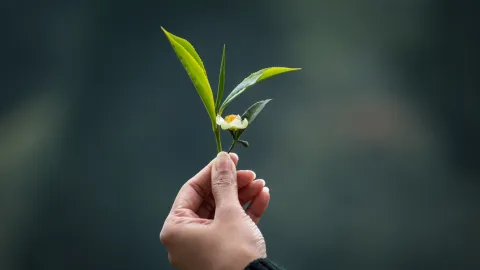
Image Section Title
Understanding the legacy
Is Background Visible
Off
Images View Mode
Simple
Text Body
Before one sets foot in a tea garden, understanding its origins will deepen the experience. In every perfectly brewed cup lies the legacy of one of history’s most successful acts of industrial espionage.
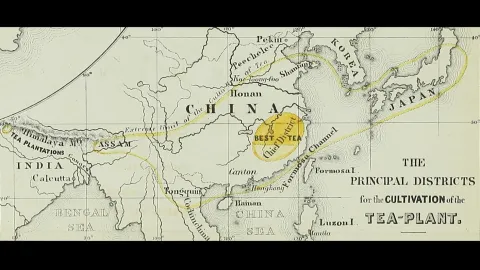
Tea is not native to most of India. Whilst indigenous to Assam, the British were obsessed with the Chinese variety (Camellia sinensis var. sinensis). For generations, China alone possessed the knowledge to grow and process tea properly and was not willing to share these closely guarded secrets.
In the 18th and early 19th centuries, the British spent tonnes of silver buying Chinese tea whilst China showed little interest in purchasing British goods. The resulting trade imbalance proved to be both expensive and humiliating for the empire.
Is Background Visible
Off
Upload Images
Image Caption
A traditional Chinese tea ceremony. (Shutterstock)
Upload Image
Image

Is Background Visible
Off
Images View Mode
Simple
Text Body
The solution? Scottish botanist Robert Fortune. In the 1840s, he went on an undercover mission to China. He disguised himself, learned Mandarin and smuggled out tea plants and seeds, including crucial tea workers who knew the processing secrets. He snuck thousands of plants out of China and brought them to India.
Meanwhile, the British East India Company began searching for regions within its empire where tea could be grown. Assam, where a wild tea plant already existed, became one answer. Darjeeling, cool, misty and recently annexed from Sikkim, became another. It was chosen because it resembled the Chinese highlands and because the British were already turning it into a hill station for rest, recovery and governance.
In the 1840s, Dr Archibald Campbell planted the first seeds in his garden in Darjeeling as an experiment. It thrived in the high altitude and by 1852, the first gardens producing tea commercially were Tukvar, Steinthal and Aloobari.
Is Background Visible
Off
Upload Images
Image Caption
Title page of the map constructed by German cartographer August Heinrich Petermann to document Robert Fortune's covert expeditions to the tea districts of China and India, published in Fortune's Two Visits to the Tea Countries of China (John Murray, 1853). (Wikimedia Commons)
Upload Image
Image
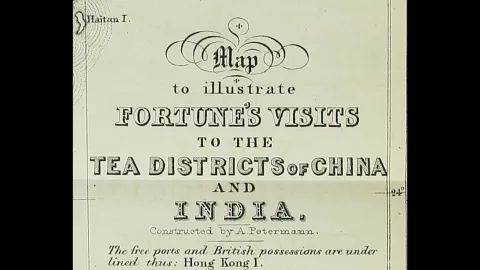
Image Caption
The inset map from Robert Fortune's Two Visits to the Tea Countries of China and the British Tea Plantations in the Himalaya (John Murray, 1853). It charts the principal tea-growing districts across Asia, marking China's interior as the "Best Tea" region, while already noting "Tea Plantations" along the Himalayan foothills of Assam and Bengal. (Wikimedia Commons)
Upload Image
Image
Is Background Visible
Off
Images View Mode
Simple
Text Body
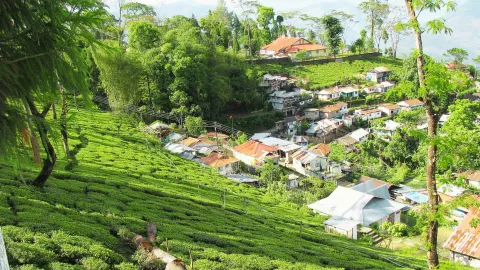
Today, these sprawling tea gardens carpet the slopes of Darjeeling and Kalimpong, thriving at altitudes between 2,000 and 7,000 feet above sea level.
Many estates welcome travellers for guided walks through the gardens, factory tours that follow the journey from leaf to cup and tastings that highlight the nuances of first and second flush. Depending on the estate, visitors can choose between intimate village homestays or restored colonial bungalows, with experiences ranging from biodynamic garden tours and tea pairings to riverside picnics and mountain treks.
Is Background Visible
Off
Upload Images
Image Caption
One of Darjeeling's original three commercial gardens, Tukvar's motto says it all: "None Before Us." (Picture by flowcomm, Wikimedia Commons)
Upload Image
Image

Image Caption
Workers' quarters nestle among the tea bushes at Tukvar estate. (Picture by shankar S., Wikimedia Commons)
Upload Image
Image
Is Background Visible
Off
Images View Mode
Simple
Text Body
Did you know? According to legend, Britain's love of tea began with a Portuguese princess. When Catherine of Braganza married King Charles II in 1662, her dowry included chests of dried tea leaves. As queen consort, she made tea central to courtly life, transforming it from exotic novelty to fashionable aristocratic drink. By drinking tea publicly, she shifted its image from medicinal tonic to coveted status symbol. Without her influence, the demand that birthed Darjeeling's gardens might never have existed.
Is Background Visible
Off
Upload Images
Image Caption
Women pluckers carrying wicker dokos (baskets) on their backs. (Picture by Benoy, Wikimedia Commons)
Upload Image
Image
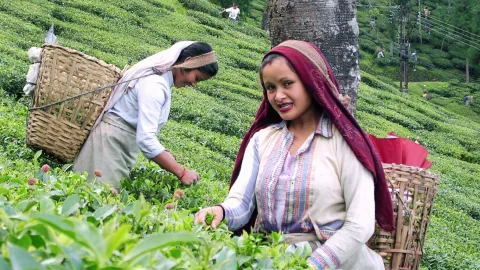
Image Section Title
Meeting the people
Is Background Visible
Off
Images View Mode
Simple
Text Body
As visitors approach a tea garden in Darjeeling, they often notice that most pluckers are women, moving swiftly up steep slopes with wicker baskets known as “dokos” strapped to their backs.
When the British began transforming Darjeeling into a tea-producing region in the mid-19th century, they faced a problem: the area was sparsely populated and local Lepcha and Bhutia communities were neither numerous nor easily absorbed into plantation labour. Tea cultivation demanded permanent, disciplined, hill-adapted workers. The British found their answer across the border, in Nepal.
The groundwork for this choice had been laid decades earlier. During the Anglo-Nepalese War (1814-1816), British officers were struck by the fighting ability, discipline and endurance of Nepali soldiers. This admiration birthed two enduring legacies: the recruitment of Gorkhas into the British Army and the idea of Gorkhas as a "martial race", hardy hill people who were naturally loyal and physically resilient. By the 1860s, when tea plantations were rapidly expanding in Darjeeling, that old memory of war made Nepali migrants seem like the obvious choice for labour.
Thousands of Nepalis poured into Darjeeling, drawn by promises of water, free medical treatment and housing. By 1900, 100 tea gardens employed 64,000 workers who communicated in Nepali and whose customs forged a distinctive identity: the Indian Gorkha. Today, gardens employ roughly 50,000 permanent workers. Darjeeling tea's identity is now inseparable from Gorkha culture.
Is Background Visible
Off
Upload Images
Image Caption
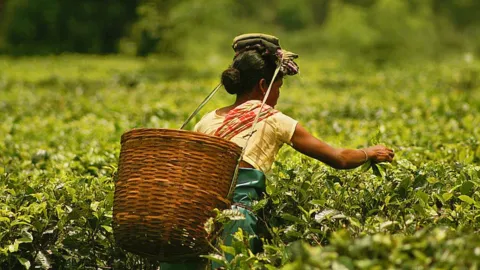
A plucker demonstrating the "two leaves and a bud" technique, the precise, generational skill at the heart of Darjeeling tea's delicate character. (Picture by Akarsh Simha, Wikimedia Commons)
Upload Image
Image
Is Background Visible
Off
Images View Mode
Simple
Text Body
The Art of Plucking
The best time to visit a tea garden is early morning, when pluckers begin their work. Using the “two leaves and a bud” technique, they select only the youngest shoots. This method, passed down through generations, gives Darjeeling tea its delicate character.
Experienced pluckers can gather 30 to 35 kilograms of fresh leaves in a day, which produces about 7 to 8 kilograms of finished tea. A single kilogram of fine Darjeeling requires thousands of carefully chosen leaves.
Many estates invite visitors to try plucking with a traditional basket, a task that appears simple until you attempt the precision required for a world class flush. Gardens often arrange interactions during tea tastings, where guests can interact with pluckers, factory supervisors, or estate managers, many of whom are from third or fourth generation tea families. Some estates also offer homestays in workers’ villages, allowing travellers to experience Gorkha hospitality, cuisine and daily life firsthand.
Is Background Visible
Off
Upload Images
Image Caption
A panoramic view of the Darjeeling hills carpeted in tea, with mist rolling through the valleys — the landscape that captivated British planners and travellers for generations. (Shutterstock)
Upload Image
Image
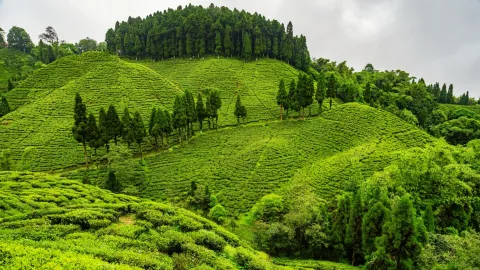
Image Section Title
Walking through landscape
Is Background Visible
Off
Images View Mode
Simple
Text Body
In most parts of the world, large-scale agriculture is called a "farm" or a "plantation". In Darjeeling, however, tea estates are almost always called "gardens" (bagan in Bengali), a word that evokes care and leisure. This is because British planters imagined themselves as curators of landscape, not just industrialists. They also avoided the term "plantation" because of its associations with slavery and brutal labour.
The word "garden" also reflects Darjeeling’s geography. Unlike vast, flat monocultures of wheat or corn, tea here grows along the steep slopes of the Himalayas. Bushes are pruned and shaped by hand, planted in careful rows that follow the natural curves of the hills. Over time, "garden" came to signify patience, attentiveness and refinement, qualities that remain central to Darjeeling tea's identity.
Whether you're staying at an estate bungalow or taking a day tour, pause to take in the landscape. Many gardens provide guided nature walks that explain the ecosystem beyond just tea cultivation. Walking through a tea estate feels less like visiting an industrial farm and more like strolling through a curated ornamental garden, rows of vibrant green bushes following the contours of the mountains, shaded by silver oaks and interspersed with natural forest. On clear days, Kanchenjunga dominates the northern horizon, the world's third-highest peak turning golden at sunrise and sunset.
Is Background Visible
Off
Upload Images
Image Caption
The Darjeeling Caddy Logo — the GI-protection mark featuring a woman plucking tea — guarantees that the product inside is 100% authentic Darjeeling tea.
Upload Image
Image

Image Section Title
Tasting the terroir
Is Background Visible
Off
Images View Mode
Simple
Text Body
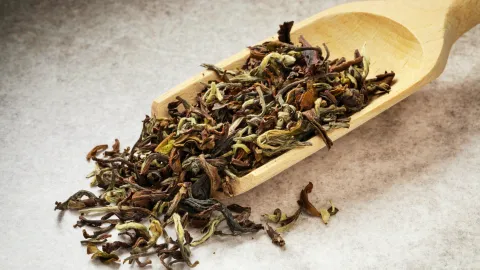
Darjeeling tea is often called the “Champagne of Teas” because of its distinctive character, shaped by a unique combination of plant genetics, soil chemistry, high altitude, temperature, rainfall and the misty Himalayan climate. Together, these conditions produce a flavour profile, most notably the prized muscatel or grape-like notes, that cannot be replicated anywhere else in the world.
In 2004, Darjeeling Tea became the first Indian product to receive Geographical Indication (GI) protection, joining the ranks of Champagne, Roquefort cheese and Scotch whisky. This means that only tea grown, produced and processed in the defined hilly areas of the Darjeeling district can legally be marketed as “Darjeeling Tea”.
Is Background Visible
Off
Upload Images
Image Caption
A close-up of loose leaf Darjeeling tea. (Shutterstock)
Upload Image
Image
Is Background Visible
Off
Images View Mode
Simple
Text Body
Geographical Indications act as legal proof of origin and authenticity, much like a birth certificate. They are a form of intellectual property that identify goods as originating from a specific region and possessing qualities, reputation or characteristics intrinsic to that place.
The GI protects both the tea's reputation and workers' livelihoods. This protection matters because the name is far more famous than the supply. While global markets sell millions of kilograms labelled "Darjeeling," less than one per cent of the world's tea actually qualifies as such. GI status prevents this misrepresentation. Just as Champagne must come from France's Champagne region, Darjeeling tea must come from these specific hills.
Did you know? West Bengal is home to several other GI-protected products that celebrate the state's rich cultural and culinary heritage such as Gobindobhog Rice, Banglar Rasogolla, Baluchari Sari and even Santiniketan Leather Goods.
Is Background Visible
Off
Upload Images
Image Caption
Factory workers sort and grade dried tea leaves by hand. (Shutterstock)
Upload Image
Image
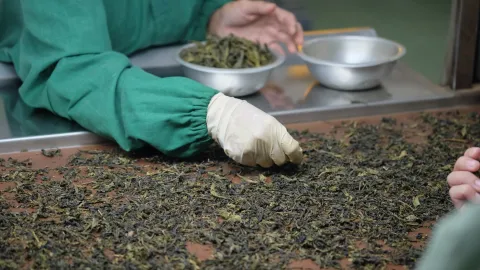
Image Section Title
Choosing your garden
Is Background Visible
Off
Images View Mode
Simple
Text Body
Today, 87 tea gardens across the Darjeeling and Kalimpong districts are officially registered under Geographical Indication (GI) protection. Each garden has its own distinctive character and many have earned international reputations in their own right.
Estates such as Makaibari, Castleton, Margaret's Hope and Glenburn are legendary among tea connoisseurs, regularly commanding premium prices at global auctions. In 2014, a rare lot from Makaibari sold for approximately $1,850 per kg, placing it amongst the most expensive teas in the world.
In recent years, many gardens have embraced organic and biodynamic cultivation in response to growing global demand for sustainably produced teas. Today, over 60% of Darjeeling's tea estates are either fully organic or in the process of conversion. Whilst this shift often results in lower yields, it produces finer-quality leaves and stronger demand in European and Japanese markets.
Visitors can ask guides about organic practices, as they are usually proud to explain the shift and its challenges. For those interested in sustainability, gardens often display their organic certificates proudly and can explain their chemical-free practices and certification status.
Is Background Visible
Off
Upload Images
Image Caption
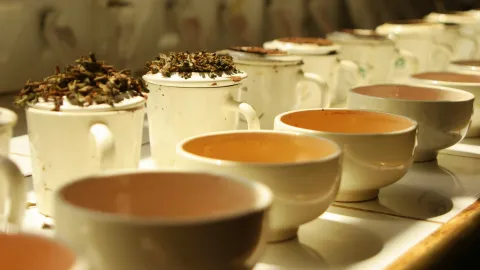
A cupping session at a Darjeeling estate. (Shutterstock)
Upload Image
Image
Is Background Visible
Off
Images View Mode
Simple
Text Body
What makes Darjeeling tea irreplaceable
Darjeeling produces around 7 million kilograms of tea annually, less than 1% of India's total output. Yet it remains the country's most globally recognised and celebrated tea brand.
To taste it at source is to taste something truly local and fleeting.
Most gardens offer tasting sessions where estate managers guide visitors through cupping sessions, slurping tea from wide bowls to aerate it across the palate. Guests compare first flush (light, almost champagne-like) with second flush (full-bodied, muscatel character) and autumn flush (mellow and mature).
The same estate produces completely different teas depending on season, slope and even time of day the leaves were picked. Tasting guides explain how altitude affects flavour, as gardens at different elevations produce distinctly different teas even in the same flush.
Is Background Visible
Off
Upload Images
Image Caption
Freshly plucked leaves spread across withering troughs in a Darjeeling factory — the first step in processing, where moisture is slowly drawn out before rolling and oxidation begin. (Shutterstock)
Upload Image
Image
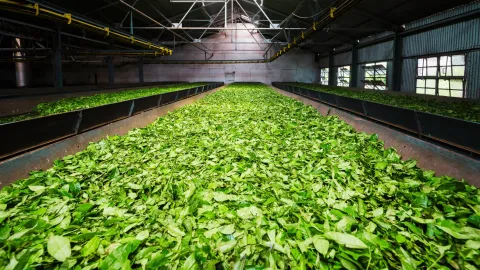
Image Section Title
Practical visitor information
Is Background Visible
Off
Images View Mode
Simple
Text Body
Best Time to Visit: The ideal months are March to May and October to November, when skies are clearer and the gardens are at their most vibrant.
Getting There
- By air: Fly to Bagdogra Airport and drive three to four hours to Darjeeling.
- By train: Take the Darjeeling Himalayan Railway from New Jalpaiguri, a UNESCO World Heritage experience.
- By road: Well connected to Siliguri, Kalimpong and Gangtok.
Darjeeling town serves as the base, with tea gardens located 5 to 30 kilometres away. Kurseong, often quieter than Darjeeling, is known for its intimate estates and slower pace.
Travel Tips
- When planning a visit, the season plays a crucial role. It is advisable to research the different flush periods in advance and contact estates directly to ensure availability and to select a time that best matches one’s preferred tea profile.
- Buy Local: Always look for the Darjeeling Caddy Logo (a woman plucking tea) to ensure you are buying 100% authentic, GI-protected tea. Consider purchasing directly from estate shops, more money reaches the workers this way.
- Pair tea experiences with the Darjeeling Himalayan Railway, monastery visits and mountain viewpoints
- Responsible Tourism: Tea pluckers are skilled artisans, not performers. If you wish to photograph them, always ask permission first.
Is Background Visible
Off
Published on
Article Image
Image
Updated On
Read Time
7-min read
Article Type
Experience
Story
Article Videos
Is Background Visible
Off
Upload Video
Display Type
Long Description
Content Family
General Purpose
Image Gallery
Upload Images
Is Background Visible
Off
Images View Mode
Simple
Video Gallery
Is Background Visible
Off
Upload Video
gallery view mode
horizontal
sub title
From Himalayan hills to the world's finest cup
action if location
default
Comments