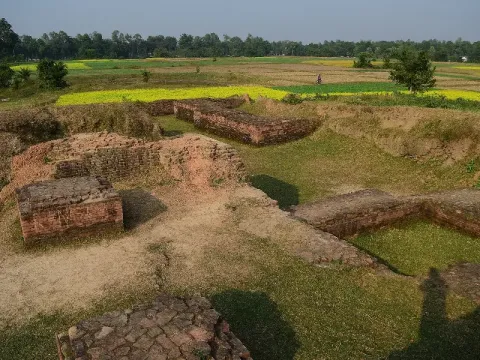
The Sena dynasty’s patronage of Bangarh continued into the 12th century until the fateful campaigns of Muhammad Bakhtiyar Khalji, who conquered Bengal in 1204 CE and established his capital at Devkot (Bangarh). Bakhtiyar Khalji died at Devkot (Bangarh), on the eastern bank of the Punarbhaba, in 1205–06. His grave was subsequently established on the western bank of the river, where it can still be visited today. Historical accounts strongly suggest he was murdered, with his own governor, Ali Mardan Khalji, believed to be the perpetrator. His grave still stands on the riverbank, one of the most evocative and overlooked historic sites in West Bengal. The city under Muslim rule was known as Damdama, and Devikot was recorded in the Ain-i-Akbari as a mahal in the sarkar of Lakhnauti, assessed at 31,624 dams in revenue.
The brick tomb of Molla Ataruddin (also known as Shah Ata), built as early as the 14th century, stands today as a rare surviving example of early sultanate architecture in the region: a square, roofless mausoleum with a stone lower portion and brick upper section. The continued administrative importance of Devkot is further demonstrated by a substantial infrastructure project undertaken by Ali Mardan's successor, Iwaz Khalji (Ghiyas-ud-din Iwaz Khalji): a wide, high-embanked road connecting Devkot to Lakhnor in the Birbhum district, with ferries provided to cross the major rivers, including the Ganges on the Lakhnor side and the Mahananda and Punarbhaba on the other.
Comments