Labhpur sits at the crossroads of two distinctly Bengali obsessions: the sacred and the literary. It is home to Fullaratala, one of the most atmospheric of Birbhum's Shakti Peethas and is also the birthplace of Tarasankar Bandyopadhyay, the Jnanpith-winning novelist whose prose mapped the soul of rural Bengal like no one before or since. On a well-organised day, you can stand inside a 1,000-year-old sacred grove and, hours later, sit in the room where one of Bengal's greatest writers was born.
The Fullara Shakti Peetha (Fullaratala)
Of the two Birbhum Shakti Peethas in the heritage belt, Fullara is the more dramatically situated, surrounded by dense foliage, its octagonal-roofed temple rising from a clearing beside a large sacred pond, with the Kanuri River winding through green fields and red soil nearby. The place has a mysterious, sheltered quality that pilgrims and casual visitors alike find deeply compelling.
Mythology & Significance
According to the Pitha Nirnay Tantra, the lower lip (attahasa, or 'great laughter') of Goddess Sati fell here at what was called Fullara Mahapith. The word attahasa (meaning laughter) suggests a particular quality attributed to this site: a kind of fierce, liberated joy associated with the Goddess. The presiding deity is Devi Fullara (or Phullara, meaning "Blooming"), worshipped here alongside the Bhairava Vishwesh. No conventional figurative idol is installed in the sanctum; instead, a large stone approximately 15-18 feet wide, representing the lower lip of Sati, is smeared with vermilion and kumkuma as the focus of veneration. Here, as at Kankalitala, there is no conventional figurative idol, only the stone, adorned and honoured.
Tradition holds that the first priest here was Attahasa himself and that his successor Bhabadev Bhatta entrusted the care of the temple to Maithili Brahmins, a lineage of priests whose origins lie in the learned Brahmin communities of what is now Bihar. A small temple of the Pitha Bhairav (Vishweshwara) stands nearby and the Panchamundi asana (the five-skulled seat used in Tantric practice) and the Shivabhog place are also visible in the complex.
The Temple & Complex
Hours: 6:00 AM – 10:00 PM (closed 12 noon – 1 PM for bhog)
Entry: No entry fee; prasad service (afternoon) requires advance booking
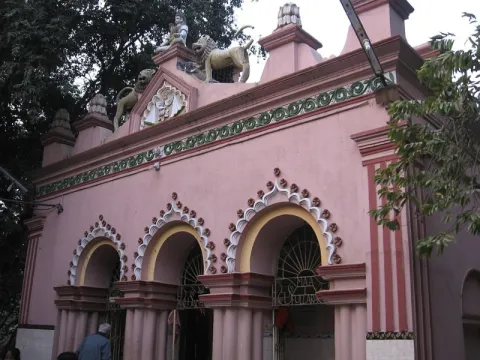
The present temple structure was installed by the local zamindar Yadavlal Bandopadhyay in 1902 and restored since; its octagonal roof covers a substantial sacred area. The Goddess is worshipped here with great ceremony and the rituals observe an ancient pattern: the temple closes from 12 noon to 1 pm for the bhog (sacred food offering) and a paid prasad service is available in the afternoon (advance booking recommended for large groups). Dress requirements are strict: women are expected to wear a clean sari; men should wear dhoti or pyjama with kurta.
The Sacred Pond (Daldali)
Beside the temple lies the Daldali: a large, lotus-bearing pond around which pilgrims circumambulate. Local mythology connects this pond to the Ramayana: it is said that the sage Hanuman collected 108 blue lotuses from these waters for Sri Ramachandra's worship of Goddess Durga. According to the Siyan Eulogy, a golden pot was once installed at the apex of the original temple, testimony to the grandeur once accorded to this site by local rulers.
Article Content
Text Body
Is Background Visible
Off
Published on
Article Image
Image
Updated On
Read Time
5
Article Type
Location
Article Videos
Is Background Visible
Off
Upload Video
Content Family
General Purpose
Image Gallery
Upload Images
Is Background Visible
Off
Images View Mode
Simple
Video Gallery
Is Background Visible
Off
Upload Video
gallery view mode
horizontal
action if location
default
Comments