Step into the maze of potters’ alleys, where Durga Puja idols are born
Article Content
Text Body
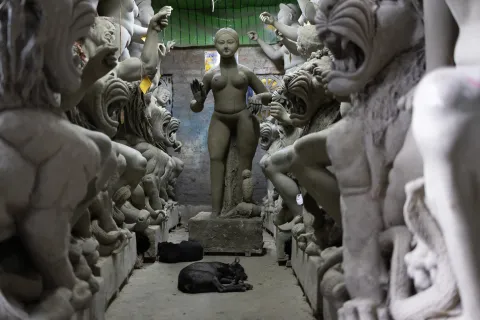
Tucked away in the narrow alleys of North Kolkata lies a neighbourhood that is a living museum of Bengal’s cultural soul — Kumartuli. A centuries-old potters’ quarter, this maze of lanes and humble ateliers has long been the cradle of Bengal’s artistry, where clay is not just shaped but infused with life, devotion and heritage.
To step into Kumartuli is to enter a world where art and spirituality become inseparable, where the essence of Bengal finds its most eloquent expression.
Getting to Kumartuli is part of the charm. From Howrah Station, it’s a 25-minute drive across the river; from the airport, about 15 to 20 minutes by cab. For those in central Kolkata, Sovabazar Metro Station is the closest stop — a short walk through winding lanes leads straight into Kumartuli’s heart.
Many also arrive by boat, crossing the Hooghly from Baghbazar or Ahiritola ghats, watching the skyline open up before stepping into the labyrinth of clay and colour. Once here, the neighbourhood offers more than its ateliers: the aristocratic Sovabazar Rajbari with its echoes of 18th-century grandeur, the ghats where the river glows at sunset and Chitpur Road with its jumble of shops, sweetmeat stalls and century-old houses.
Is Background Visible
Off
Upload Images
Image Caption
Though Durga Puja dominates, Kumartuli’s craft is not confined to a single festival. (Picture by Subham Behera)
Upload Image
Image
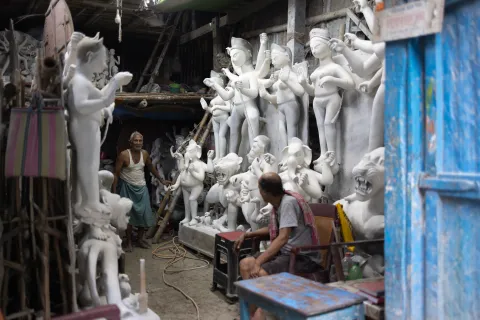
Image Section Title
The epicentre of Durga Puja
Is Background Visible
Off
Text Body
The story of Kumartuli begins in the 18th century, when the British East India Company allotted plots here to kumors (potters) who had migrated from Nadia and Krishnanagar. Over time, the locality evolved into a specialised hub for idol-making, catering to wealthy zamindars who celebrated Durga Puja with grandeur in their sprawling mansions.
What started as a community of artisans and mritshilpis (clay sculptors) serving religious needs eventually grew into one of Kolkata’s most iconic cultural landmarks. Today, Kumartuli is not only the epicentre of Durga Puja preparations but also an internationally recognised centre for clay artistry, sending idols to Bengali communities across the globe.
The first thing that strikes the senses here is the fragrance of damp earth, freshly dug from the banks of the Ganga, carrying with it a rush of nostalgia. As one wanders deeper into the alleys, the soundscape unfolds: the rasp of chisels against bamboo, the slap of straw being tied into shape, the brushstrokes of paint and devotional songs drifting softly from radios. The visuals are just as captivating. Row after row of half-finished idols stand tall in the workshops — some skeletal with bamboo frames, others fleshed out with straw and clay and still others dazzling in paint, awaiting their final touches of ornamentation.
Though Durga Puja dominates, Kumartuli’s craft is not confined to a single festival. Artisans here create idols for Kali Puja, Saraswati Puja, Lakshmi Puja and even nativity scenes for Christmas or Ganesh idols for celebrations outside Bengal. This adaptability speaks volumes about the inclusivity of Bengal’s cultural spirit, where tradition constantly converses with modernity and where artisans respond to a changing world while keeping the heart of their craft intact.
Is Background Visible
Off
Upload Images
Image Caption
Younger artisans are experimenting with eco-friendly materials, adapting designs for audiences far beyond Bengal. (Picture by Subham Behera)
Upload Image
Image
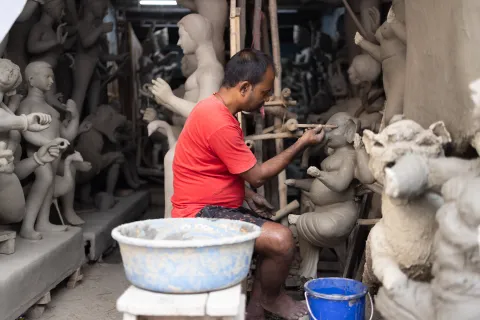
Image Section Title
Making idols come alive
Is Background Visible
Off
Text Body
Mintu Ghosh, 62, who has been at work in Kumartuli for more than four decades, explains: “For the structure of a traditional ek chala pratima (an idol of Goddess Durga and her four children built under one roof), it takes about 10 to 12 days to create the bamboo frame, which is filled with khar (hay) for volume, followed by a layer of thick sticky clay to give it shape. Once it dries, another layer is applied to carve the body. Then the figures are coated with white chalk paint and tamarind seed gum, which binds the many colours they are painted in.”
Every corner offers its own revelations. Photographers from across the world gather here in the weeks leading up to Durga Puja, capturing the neighbourhood’s magical transformation. Workshops now open their doors to visitors who wish to see the process more closely, interact with the artists and even take home a small clay figurine or mask. The ornamentations themselves are a universe of artistry.
As sculptor Swapan Pal, 48, explains: “There are three forms of traditional decorations — daak-er-shaaj, which uses golden zari work and takes its name from the postal office that once supplied the raw materials; shola-r-shaaj, crafted from strips of sholapith (a plant); and perhaps the oldest, maati-r-shaaj, made of clay embellishments including drapes and cascading hair.”
Kumartuli is not simply about the past; it is about continuity into the future. “In recent years, challenges such as rising costs, competition from cheaper synthetic idols and limited space have threatened livelihoods,” says sculptor Buddhadeb Pal, who has worked here for 27 years. Yet younger artisans are experimenting with eco-friendly materials, adapting designs for audiences far beyond Bengal and using digital platforms to showcase their craft to the world.
Kumartuli is not just a place — it is an emotion. Its lanes echo with history yet pulse with resilience and artistry. To walk here is to witness Bengal’s enduring spirit: creative, devotional and timeless.
Is Background Visible
Off
Published on
Article Image
Image
Updated On
Read Time
5-min read
Article Type
Experience
Article Image Mobile
Image
Article Image Caption
Kumartuli is a labyrinth of clay and colour in the bylanes of North Kolkata (Picture by Subham Behera)
Display Type
Short Description
Content Family
General Purpose
Image Gallery
Upload Images
Is Background Visible
Off
Video Gallery
Is Background Visible
Off
Upload Video
gallery view mode
horizontal
sub title
Step into North Kolkata’s maze of potters’ alleys, the place where Durga Puja idols are born
Comments