Kolkata's National Library is now home to Shabdalok
Article Content
Text Body
Before there were alphabets, there was sound. Before sound, silence. That is the premise on which India's first Museum of Word, Shabdalok, has been built — a nearly 50,000-square-foot institution, spread over three floors, dedicated entirely to the journey of human communication. From the earliest vibrations of language to the scripts, songs, gestures and stories that carried it across the subcontinent, the museum sets out to show that communication is at the core of civilisation and that a word is never just a word.
Is Background Visible
Off
Upload Images
Image Caption
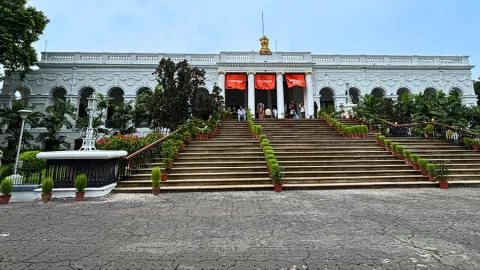
The first-of-its-kind museum was inaugurated by Hon. Home Minister, Amit Shah.
Upload Image
Image
Is Background Visible
Off
Images View Mode
Simple
Text Body
Announced by Prime Minister Narendra Modi on 11 January 2020, work on the museum's first phase began in 2021 at a cost of more than Rs 16 crore. Additional phases took the overall project cost to an estimated Rs 41.26 crore. The museum — which depicts civilisation as an entity shaped by sound, emotion, memory, art and culture — is expected to open to visitors on 15 August, with an entry fee of Rs 75. It will remain open Tuesday to Sunday.
Where Language Begins
The visitor's journey opens with a question: where did words come from? The museum's answer — from silence. Drawing on the ancient Indian concept of Shabda Brahman, it explores the idea of primordial sound — the transition from nothingness to vibration, and from vibration to language.
From there, the narrative moves into the science of sound, taking in the symbolism of Shiva's damru and the Shiva Sutras, before arriving at the work of Panini, whose fourth-century BCE text Ashtadhyayi laid down a remarkably sophisticated system of grammar.
Is Background Visible
Off
Upload Images
Image Caption
Depictions of rock paintings and other primitive means of communication are on display.
Upload Image
Image
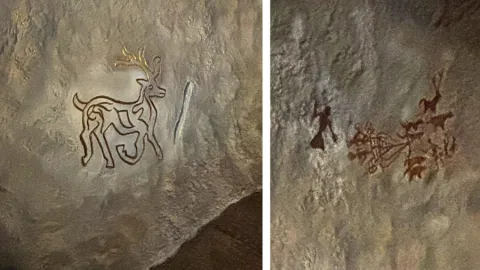
Image Section Title
From Sound to Script
Is Background Visible
Off
Images View Mode
Simple
Text Body
One gallery explores the linguistic heritage of the Indus-Saraswati civilisation, alongside ancient inscriptions, rock art and petroglyphs — early attempts to record thought beyond the spoken word. The story of decipherment also finds space here, including the contribution of James Prinsep, whose work helped unlock the secrets of the Brahmi script.
Is Background Visible
Off
Upload Images
Image Caption
Digital and holographic displays are designed to provide an immersive experience.
Upload Image
Image
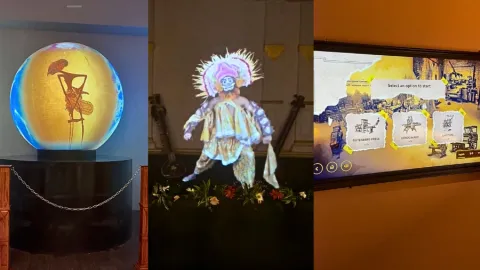
Image Section Title
Keeping Languages Alive
Is Background Visible
Off
Images View Mode
Simple
Text Body
The museum is not simply about alphabets, manuscripts and inscriptions — it is also about the people who kept languages alive. It brings together linguistic and cultural traditions associated with communities and languages including Gondi, Khasi, Tamil and Kabui, highlighting how stories, folklore and knowledge travelled orally from one generation to the next.
Is Background Visible
Off
Upload Images
Image Caption
The museum currently has 39 bays depicting different aspects of language: from ancient scriptures in many languages to historic typewriters and printing presses.
Upload Image
Image
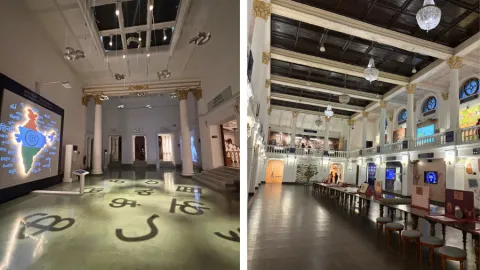
Image Section Title
A Multisensory Journey
Is Background Visible
Off
Images View Mode
Simple
Text Body
The experience is deliberately multisensory. One section examines the relationship between language and the senses, letting visitors encounter textures including silk, cotton, wood, grass and sandpaper — a reminder that people understand the world through more than words alone.
India's linguistic diversity comes alive through lullabies in 21 constitutional languages, letting visitors hear the intimate sounds of different mother tongues. The museum also explores scripts associated with languages including Devanagari, Bengali and Assamese, alongside traditions such as Sanskrit, Braj, Rajasthani and Konkani — part of the larger story of languages that have evolved, borrowed from one another and crossed geographical boundaries.
Literature becomes a journey of its own: The Ramayana is presented through versions in 11 languages, showing how a common epic acquires different voices and meanings as it travels from one region to another. The museum also celebrates oral traditions — stories, songs and folklore passed from grandparents to children and from storytellers to audiences, surviving without ever being written down.
Is Background Visible
Off
Upload Images
Image Caption
A wall of masks and other artefacts prove that communication is never limited only to the written word.
Upload Image
Image
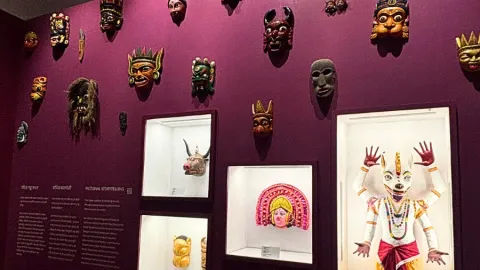
Image Section Title
Beyond Words
Is Background Visible
Off
Images View Mode
Simple
Text Body
The journey then moves from words to movement. Drawing on the ideas of Bharata Muni and the Natyashastra, the museum explores the Navarasas, or nine fundamental emotional states, showing how emotion communicates across linguistic boundaries. India's classical dance traditions, along with Chhau, show how stories can be told through gesture and movement alone, while visual traditions such as alpana and rangoli add a further dimension — patterns and symbols as their own form of communication.
What's Next
The museum's development is being carried out in phases. The second phase includes a cafeteria; the third, a light-and-sound show with 3D projection on the museum's facade, estimated at Rs 7.82 crore, its theme not yet revealed. The fourth phase, covering the ground floor and part of the second floor, carries an estimated cost of Rs 18.71 crore.
For now, take a walk around the Museum of Word to discover that the simple act of communicating can feel a little less ordinary with the right knowledge. A lullaby hummed in a mother tongue, a story never written down but still remembered, a gesture that says what no word could — each is a thread in a fabric thousands of years in the making. Because a script is not merely a collection of symbols and communication goes beyond language, this museum simply asks visitors to listen a little closer and discover its depth.
Fact Check
Where: National Library's Belvedere Estate (Alipore)
When: Tuesday to Sunday (10am to 6pm);
Monday closed
Tickets: Rs 75 (after 15 August)
Is Background Visible
Off
Published on
Article Image
Image
Updated On
Read Time
3 mins
Article Type
Experience
Story
Article Image Caption
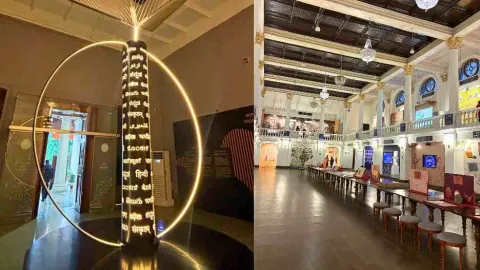
The interiors of the museum hold interesting installations and historic artefacts.
Article Videos
Is Background Visible
Off
Upload Video
Content Family
General Purpose
Image Gallery
Upload Images
Is Background Visible
Off
Images View Mode
Simple
Video Gallery
Is Background Visible
Off
Upload Video
gallery view mode
horizontal
sub title
From rock art to lullabies in 21 languages, this new museum tells the story of how humans learned to communicate.
Detail Page Title
Where words come alive: Inside India's first Museum of Word
action if location
default
Comments