Read about musical instruments native to the state
Article Content
Text Body
Bengal's cultural identity runs deepest in its music. It carries the legacy of stalwarts like Rabindranath Tagore and Kazi Nazrul Islam, the classical rigour of the Senia and Bishnupur gharanas, and the living folk traditions of Kirtan, Baul, Bhawaiya and Bhatiali. Behind each of these genres sits a set of instruments that are not mere accompaniment — they are signatures of the music itself, shaping its identity as much as any voice does.
Bengal is home to a striking number of such instruments, each rooted in a particular region or community. Here is a guide to the ones truly born of the Bengal soil.
Strings
Is Background Visible
Off
Upload Images
Image Caption
An ektara on display (Picture by Salim Khandoker); a baul performs with an ektara in hand (Picture by Contact Base WB)
Upload Image
Image
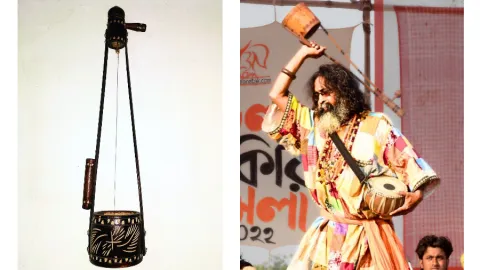
Image Section Title
Ektara
Is Background Visible
Off
Images View Mode
Simple
Text Body
A single-stringed drone instrument, indigenous to the Bauls and Fakirs of Shantiniketan. The resonator is a dried gourd or pumpkin, over which a split bamboo neck is fixed. A string runs from a piece of leather at the base of the resonator, up through the split bamboo, to a tuning peg at the top. Squeezing the two halves of the neck together loosens the string and bends its pitch — the source of the ektara's distinctive wavering drone. It remains one of the most recognisable sounds of Baul music and is still handcrafted in Shantiniketan. The ektara has received the geographical indication (GI) tag this year.
Is Background Visible
Off
Upload Images
Image Caption
An anandalahari on display (Picture from Metropolitan Museum of Art), Purna Das Baul performs with a khamak (Picture by Boragoridev, Wikimedia Commons)
Upload Image
Image

Image Section Title
Khamak, Dugdugi (Anandalahari)
Is Background Visible
Off
Images View Mode
Simple
Text Body
A two-stringed percussive instrument, also central to Baul and Fakir music. Alongside the ektara, it is made in Shantiniketan and Bolpur, with Nadia district home to a further cluster of makers.
Is Background Visible
Off
Upload Images
Image Caption
Banam (Picture by Bodi Baski), a kendri being played (Picture by Contact Base WB), sarinda (Picture by Wmpearl)
Upload Image
Image
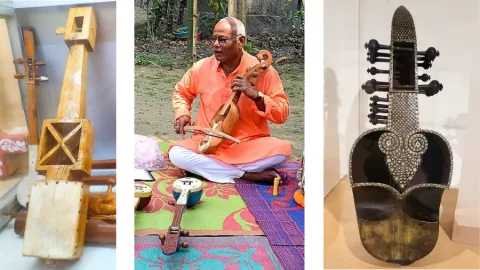
Image Section Title
Banam, Kendri, Sarinda
Is Background Visible
Off
Images View Mode
Simple
Text Body
Three tribal string instruments with distinct roles: the Banam accompanies Chadar Badar, the tribal puppetry tradition; the Kendri is played with tribal and jhumur songs; and the Sarinda of North Bengal is the melodic backbone of Bhawaiya music. All three, like the ektara and khamak, are crafted around Shantiniketan and Bolpur.
Is Background Visible
Off
Upload Images
Image Caption
A dotara on display (Picture by Aniruddha Buragohain); a dotara being made at a workshop (Picture by Contact Base WB).
Upload Image
Image
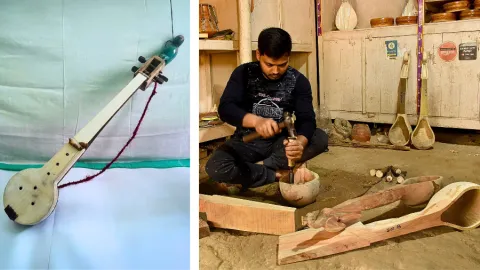
Image Section Title
Dotara
Is Background Visible
Off
Images View Mode
Simple
Text Body
A four-stringed lute that accompanies Bauls and Fakirs as well as Bhatiali and Bhawaiya songs. It is carved from teak, neem or jackfruit tree wood, with a soundboard of goat skin, a finger board of steel or brass, and strings of steel or nylon, played with a wooden plectrum. Dotara makers work out of Ranaghat and Panikhali in Nadia, Dhupguri in Jalpaiguri, and Shantiniketan.
Wind
Is Background Visible
Off
Upload Images
Upload Image
Image

Image Section Title
Bamboo flute
Is Background Visible
Off
Images View Mode
Simple
Text Body
While the flute can be called pan Indian, its journey from village pastures to the concert stage is a distinctly Bengali one. It was Pandit Pannalal Ghosh — born in Barisal, undivided Bengal, in 1911 — who took the banshi, Bengal's folk flute and elevated it to a lead instrument in Hindustani classical music. He redesigned the length of bamboo with seven finger holes, closed with a blow hole at one end. Bamboo flute makers still work out of Maynaguri in Jalpaiguri and Agarpara in Kolkata, and travelling banshiwalas — flute-sellers carrying wicker baskets of bamboo flutes and playing a tune to draw a crowd — continue to be a familiar sight at Bengal's fairs.
Khal
A bamboo flute associated with the Rabha community of North Bengal, distinct from the classical bansuri in both build and repertoire.
Singa (Shinga)
A horn-style trumpet made of brass or animal horn, played among Bengal's tribal communities. It is crafted in Bankura, Nadia and Purulia.
Percussion
Is Background Visible
Off
Upload Images
Image Caption
A traditional Dhaak; a Dhaaki playing at an event (Picture by Ramjit Tudu).
Upload Image
Image
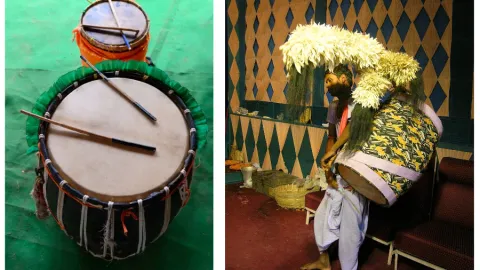
Image Section Title
Dhaak
Is Background Visible
Off
Images View Mode
Simple
Text Body
The instrument most closely associated with Bengal, the Dhaak is a barrel drum of mango wood with animal-hide heads on both sides, its tension adjusted through interwoven ropes and metal rings, and played with cane or bamboo sticks for a loud, carrying beat. It sounds through Durga Puja and folk performances like Chhau and Natua dance alike. Dhaak makers work across Bankura, Purulia, Hooghly and Murshidabad — and the dhaakis who play it were among the artisan communities specifically honoured by India's Ministry of Culture when UNESCO inscribed Kolkata's Durga Puja on its Representative List of Intangible Cultural Heritage of Humanity in 2021.
Is Background Visible
Off
Upload Images
Image Caption
(Picture by Bodi Baski)
Upload Image
Image
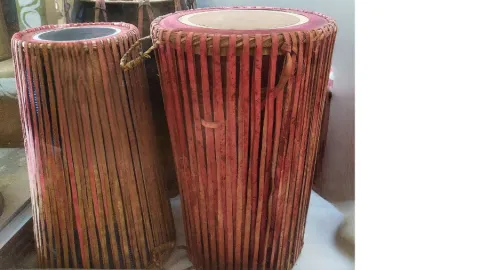
Image Section Title
Madol
Is Background Visible
Off
Images View Mode
Simple
Text Body
This drum is made of burnt clay or wood with animal hide coverings on both ends tuned with a paste at the centre called gab. Central to tribal and folk dances across Bengal, the instrument is played with both hands. It is made in areas of Purulia such as Hatakol and Sindri.
Is Background Visible
Off
Upload Images
Image Caption
(Picture by Ramjit Tudu)
Upload Image
Image
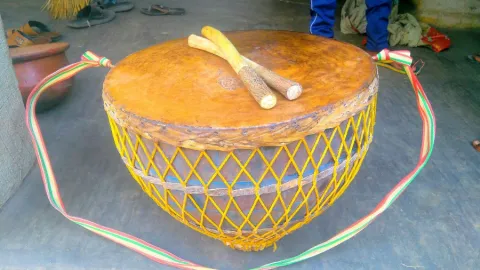
Image Section Title
Dhamsa
Is Background Visible
Off
Images View Mode
Simple
Text Body
A large, bowl-shaped drum with buffalo-hide heads, played with wooden sticks to produce a deep bass. The Dhamsa drives Jhumur songs, Chau dance and Santhal music, and is made in Paradda village, Purulia.
Is Background Visible
Off
Upload Images
Image Caption
(Picture by Shohrab Hossain Titu)
Upload Image
Image
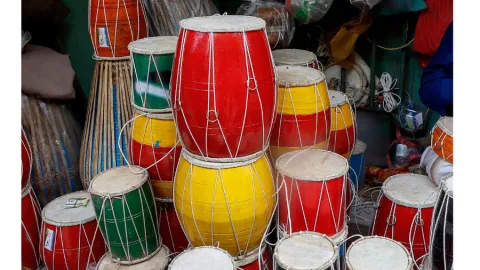
Image Section Title
Bengal Dhol
Is Background Visible
Off
Images View Mode
Simple
Text Body
A smaller relative of the dhaak, the Bengal Dhol is played differently and pitched differently — one side gives a bass tone, played by palm, the other a treble tone, played with sticks or palm. It provides rhythm across Bengal's folk dances and is made in parts of Nadia, Purulia and Bankura.
Is Background Visible
Off
Upload Images
Image Caption
(Picture by Catrin)
Upload Image
Image

Image Section Title
Khol
Is Background Visible
Off
Images View Mode
Simple
Text Body
A clay-bodied, double-headed barrel drum, Khol is the very soul of Kirtan, and also accompanies Kirtan-based Rabindrasangeet. Its two leather-covered faces are asymmetrical — a larger bass face on the left, a smaller treble face on the right. The Khol is tuned with the same gab paste used on the madol. Nabadwip in Nadia district and Murshidabad are its main centres of production.
Is Background Visible
Off
Upload Images
Image Caption
(Picture by Contact Base WB)
Upload Image
Image
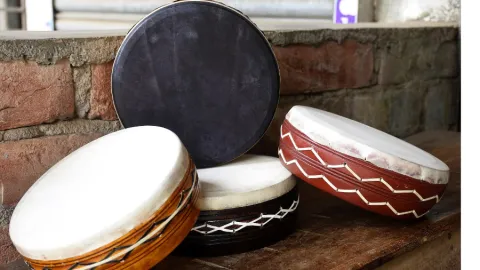
Image Section Title
Dubki
Is Background Visible
Off
Images View Mode
Simple
Text Body
A frame drum used typically with Baul songs. It has a skin stretched over a circular wooden frame and is played with the right hand while the left holds the frame. Its pitch is adjusted by wetting the skin. It is made in Bolpur (Shantiniketan), Ranaghat (Nadia) and Malda. A similar version almost like dubki is found in the hills among the Tamang community. It is called Damphu.
Idiophones
Is Background Visible
Off
Upload Images
Upload Image
Image
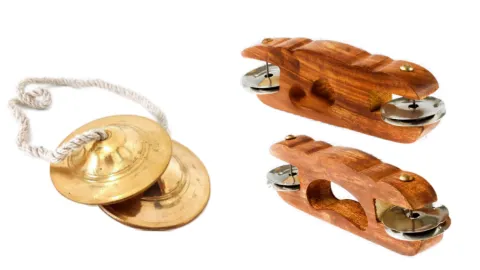
Image Section Title
Manjira and Kartal
Is Background Visible
Off
Images View Mode
Simple
Text Body
Manjiras are small, hand-held brass clash cymbals, joined by a cord, used in Kirtan and community singing. Pitch varies with size.
Kartals are wooden hand cymbals, typically of sheesham, fitted with brass jingles that clap together to keep rhythm in community singing. They are crafted chiefly in Mayapur and Nabadwip, in Nadia district.
Khanjanis are yet another variant.
None of Bengal's music exists in isolation — North Bengal hills also bring a different musical inheritance. Generations of Gorkha, Lepcha and Tamang communities have made instruments from the wider Himalayan belt, as much a part of Bengal's musical landscape as the dhaak or the dotara. It is in the drone, strum or beats of all these instruments that Bengal's musical identity is heard most clearly — carried, quite literally, on instruments still handmade in the same villages where they have always been made.
Is Background Visible
Off
Published on
Article Image
Image
Updated On
Read Time
7-min
Article Type
Story
Article Image Caption
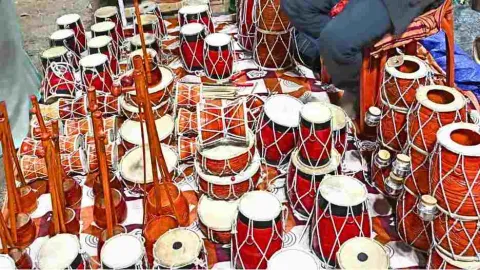
Ektara, dugdugi, dhol and other musical instruments on display. (All pictures sourced from Wikimedia Commons)
Article Videos
Is Background Visible
Off
Upload Video
Display Type
Short Description
Content Family
General Purpose
Image Gallery
Upload Images
Is Background Visible
Off
Images View Mode
Simple
Video Gallery
Is Background Visible
Off
Upload Video
gallery view mode
horizontal
sub title
From the Baul's ektara to the Puja dhaak, a guide to the instruments that carry Bengal's own sound
Detail Page Title
Sounds of the soil: Musical instruments native to Bengal
action if location
default
Comments