West Bengal's doll-making traditions tell the story of its people
Article Content
Text Body
West Bengal's doll-making heritage is one of the most diverse and spectacular in India. Fashioned from clay, terracotta, shellac, jute, bamboo and palm leaf, these figures are far more than just playthings. They embody local deities, mark the turning of seasons and carry within them centuries of communal memory. Each district has developed its own distinct style, its own materials, motifs and methods and together they form a living map of Bengali culture. Many of these traditions now survive by the hands of a single family, or even a solitary craftsperson.
Is Background Visible
Off
Upload Images
Image Caption
The Natungram owl
Upload Image
Image
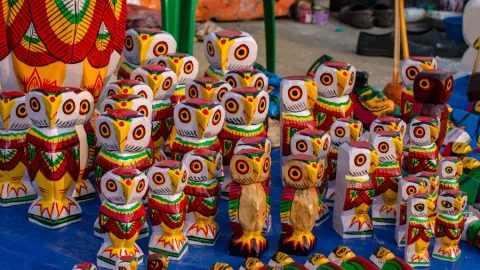
Image Section Title
Natungram (Burdwan)
Is Background Visible
Off
Images View Mode
Simple
Text Body
The wooden doll tradition of Bengal was once spread across Medinipur, Howrah, Bankura, Purulia, Nabadwip and Kalighat, but today it is concentrated largely in Natungram. The dolls are carved from white teak and painted, formerly with herbal colours, now with chemical dyes. The celebrated Natungram owl is the most iconic of these forms, alongside figures of kings and queens and Radha-Krishna.
Sunderbans
Is Background Visible
Off
Text Body
The clay dolls of Majilpur, in the Sundarban region, are among Bengal's most vivid. This primitive art form is distinguished by its bold use of colour, heightened further with a coat of Garjan oil. Figures of Bonbibi, the presiding deity of the forest, sit alongside a girl carrying a pitcher and devotional subjects such as Radha-Krishna, Kaliadomon and Jagadhatri. Today, the tradition rests almost entirely with Sambhu Das, grandson of the great Manmath Das, a recipient of the President's Award in 1986, who strives single-handedly to keep the craft alive.
Purba (East) Medinipur
Is Background Visible
Off
Text Body
The distinctive dolls of East Medinipur, also known as Galar Putul, are made from soil sourced from white ant-hills, hand-pressed into shape, sun-dried, then finished with shellac colours and a glaze of oil. Brindaban Chanda of Patashpur village is the last living master of this technique.
The district is also home to the beni (braided) dolls of Padmatali which are articulated puppets of bamboo and palm seed, crafted to move in time with song. Today the head is typically made from clay with wooden limbs and attached bells; Ramapada Ghoroui is amongst the foremost artists continuing this form.
Is Background Visible
Off
Upload Images
Image Caption
The Taalpatar Shepai (Picture by Salil Kumar Mukherjee, Wikimedia Commons)
Upload Image
Image
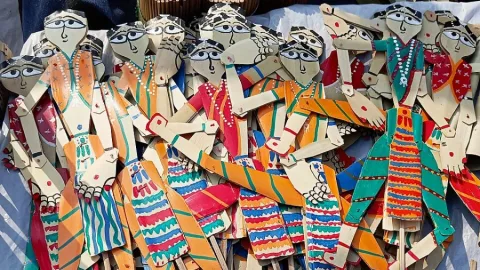
Image Section Title
Birbhum
Is Background Visible
Off
Images View Mode
Simple
Text Body
The Taalpatar Shepai, soldiers of the palm leaf, are found mainly in Birbhum and Guskara. Made from dried palm leaves and attached to bamboo sticks, the figures of soldiers, cats, tigers and dancers jerk into life when their strings are pulled. The tradition dates to 1857, when the puppets were conceived as a satirical comment on British soldiers and the name has stuck ever since. Madan Mohan Dutta, son of the craftsman Dolgobindo Dutta who revived the form with its historical context, keeps the legacy alive through performance and storytelling.
Is Background Visible
Off
Upload Images
Image Caption
The Diwali putul
Upload Image
Image
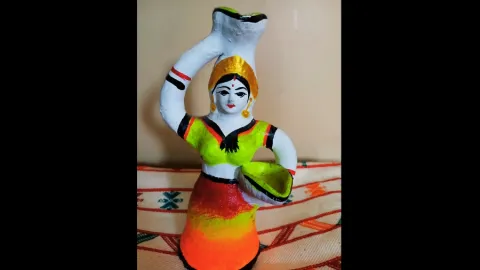
Image Section Title
Bankura
Is Background Visible
Off
Images View Mode
Simple
Text Body
Bankura is home to several distinct traditions. The Heemputul, also known as Hingul dolls, are made by women of Bishnupur, clay figures sun-dried and coloured in bright hues, notably with a vivid red mineral pigment of mercury sulphide. These are a folk version of the traditional sasthi dolls. Their attire, with frocks and hats, shows the curious influence of western-style dolls and have a resemblance to the tepa putul.
The Tusu dolls, designed in the form of brides in colourful paper, are worshipped as the goddess throughout the month of Poush and immersed at Poush Sankranti. The Diwali putul, which are dolls with diyas in their hands, features a clay lower body, wheel-thrown and ghagra-skirted, with moulded upper portion and limbs arranged in a round girdle to hold festival lamps. Another form of Diwali dolls with intricate colourful floral patterns are found in the Mirzabazar fair of Malik Chowk area in Midnapore.
North Dinajpur
Is Background Visible
Off
Text Body
The Sasthi dolls of North Dinajpur are hand-pressed terracotta figures, typically depicting a mother and child. The mother is shown carrying a basket on her head, her son in her lap or on her back, an image drawn directly from the lives of women working in the tea gardens of the region.
Is Background Visible
Off
Upload Images
Image Caption
Dolls made of dyed jute.
Upload Image
Image
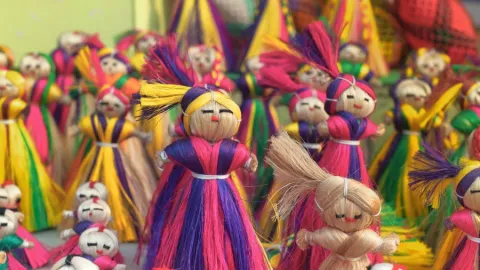
Image Caption
The kanthalia doll of Murshidabad
Upload Image
Image
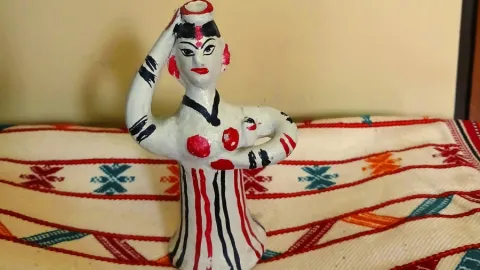
Image Section Title
Murshidabad
Is Background Visible
Off
Images View Mode
Simple
Text Body
The kanthalia dolls of Murshidabad are celebrated for their depictions of everyday domestic life: a woman braiding her companion's hair, a milkmaid, a mother oiling her baby. Each figure is modelled by hand, fired, then coated with mica and chalk dust before being painted in red and black, often in characteristic striped patterns. More recently, artisans of the district have taken to creating dolls from dyed jute — braided figures, birds and animals that speak to an inventive adaptation of local materials.
Is Background Visible
Off
Upload Images
Image Caption
The tepa putul of Howrah (Shutterstock)
Upload Image
Image
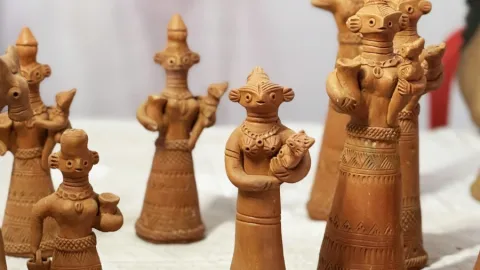
Image Section Title
Howrah
Is Background Visible
Off
Images View Mode
Simple
Text Body
The tepa putul of Howrah or the “pressed dolls” named for the hand-pressure technique used to make them, are the work of women from the Kumbhakar families of Narendrapur. Sun-dried and then baked, they typically appear in bridal pairs: the bridegroom with his conical face, the bride with her bun, tilak and eyes pierced with a thin stick. Horse figures are also made. These quiet, pale forms carry an understated elegance.
Is Background Visible
Off
Upload Images
Image Caption
Clay dolls of Krishnanagar (Shutterstock)
Upload Image
Image
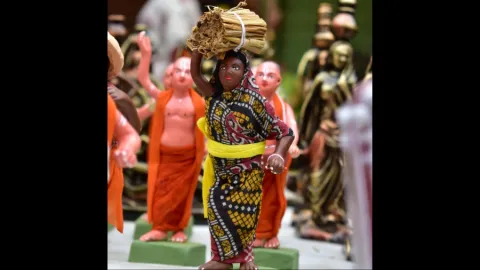
Image Section Title
Krishnanagar (Nadia)
Is Background Visible
Off
Images View Mode
Simple
Text Body
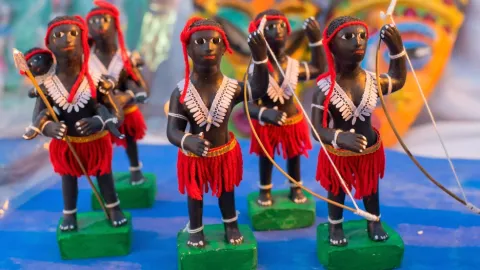
No account of Bengal's dolls would be complete without Krishnanagar, specifically the hamlet of Ghurni, whose clay figures are renowned across India for their extraordinary realism, expressive faces and radiant colour. The tradition flourished under the patronage of Raja Krishnachandra and has since grown into a living industry. Alluvial clay (etel maati) is kneaded, hand-modelled, sun-dried, coloured and dressed with cloth and ornament. The dolls are available in varying sizes, from miniature to large and the kumbhakar community is usually engaged in this art. The subjects range from mythological figures and historical leaders to rural workers in the fields — a gallery of Bengal rendered in clay.
Where to buy: District melas, Biswa Bangla stores, select online platforms
Is Background Visible
Off
Published on
Article Image
Image
Updated On
Read Time
5-min read
Article Type
Experience
Story
Article Videos
Is Background Visible
Off
Upload Video
Display Type
Long Description
Content Family
General Purpose
Image Gallery
Upload Images
Is Background Visible
Off
Images View Mode
Simple
Video Gallery
Is Background Visible
Off
Upload Video
gallery view mode
horizontal
sub title
From the mangrove fringes of the Sunderbans to the alluvial plains of Nadia, West Bengal's doll-making traditions tell the story of its people
action if location
default
Comments