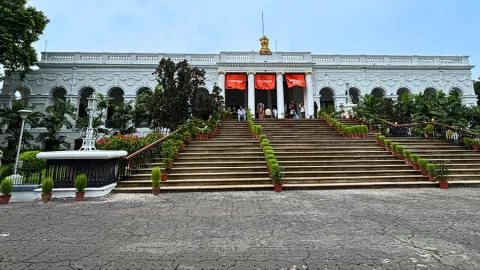
Tucked among paddy fields and mango groves in Murshidabad district, Kiriteswari is one of West Bengal's most quietly remarkable destinations. Just 18km from the historic city of Murshidabad, on the banks of the sacred Bhagirathi, this unassuming village carries a weight that belies its size. In September 2023, the Union Ministry of Tourism crowned it India's Best Tourism Village, recognising its unbroken tradition of faith, communal harmony, ecological stewardship and a folk culture that has never stopped breathing.
At its spiritual core is the Shaktipeeth Shri Kiriteswari Temple, believed to be over 1,000 years old and counted among India's 51 Shaktipeethas, the shrines marking the spots where the body parts or ornaments of the Goddess Sati fell to earth. Here, it is the divine crown (kirit) of Sati that is said to have landed, giving the village and its presiding goddess their name: Kirit-Eswari, the Crowned Goddess.
But Kiriteswari is not just a pilgrimage town. It is a place where a medieval barter economy still breathes through the annual Poush Mela, where tribal Baha and Lagre dances are performed under winter skies, where Muslim villagers sit on the temple committee and have donated land for the temple's reconstruction and where 19 government-approved homestays let curious travellers sleep inside the rhythms of authentic Bengali rural life. Come here when you are tired of the scripted and the sanitised, and want to feel something real.
The Legend of the Crowned Goddess
The mythological foundation of Kiriteswari is rooted in one of Hinduism's most poignant cosmic narratives. Sati, the consort of Lord Shiva, was the daughter of the celestial patriarch Daksha. When Daksha organised a grand yajna (fire sacrifice) and deliberately excluded Shiva from the invitation, the humiliated Sati immolated herself in grief. Overcome by sorrow and rage, Shiva lifted Sati's body and wandered the universe in inconsolable mourning. To release him from this grief and restore cosmic balance, Lord Vishnu used his Sudarshana Chakra (divine discus) to dismember Sati's body as Shiva carried it. The 51 places where the pieces of her body, and in some traditions, her ornaments, fell to earth became the Shaktipeethas, each consecrated as a seat of the Divine Feminine.
At Kiriteswari, it is specifically Sati's crown (kirit or mukut) that is believed to have landed, making this an Upapeeth, a site where not a body part but a sacred ornament fell. The presiding goddess here is known as Devi Vimala (the Pure), while Lord Shiva's presence is represented as Samvarta (or Sangbarta). Locals also call the goddess Mukuteshwari (Goddess of the Crown) and Mahishamardini (Slayer of the Buffalo Demon).
A Thousand-Year History
The temple's origins are lost in the mists of pre-medieval Bengal, with the original structure believed to date back over 1,000 years. According to local chronicles, the original temple was destroyed in 1405 AD, likely during a period of regional conflict. The present-day structure was rebuilt in the 19th century by King Darpanarayan Roy (also spelled Darpanarayana Roy), the Raja of Lalgola, and was later renovated by his descendant Yogendranarayan Roy, the late king of Lalgola.
The temple's spiritual pedigree is formidable. It is mentioned in the Vabisyapurana and is referenced in the teachings of Adi Shankaracharya. In its golden era, when Murshidabad was the capital of the Nawabs of Bengal, the temple served as the presiding deity of the ruling house of Murshidabad. Even the infamous Nawab Mir Jafar is said to have requested the temple's charanamrito (holy water) from his deathbed as he suffered from leprosy, a telling indication of the temple's reach across religious lines in this deeply syncretic region. The celebrated Rani Bhabani, the great philanthropist zamindar of Rajshahi (now in Bangladesh), contributed to the temple's preservation and is associated with the Guptamath, a sacred chamber on the opposite side of the road from the temple where the original kirit or crown of the goddess is preserved.
Communal Harmony: A Living Tradition
Perhaps the most moving thing about Kiriteswari is not its antiquity but its present-day reality. The temple management committee includes Muslim villagers, who actively participate in the upkeep of the temple, in festival preparations, and in rituals. In a singular gesture of communal solidarity, Muslim residents of the village donated land for the reconstruction of the Hindu temple that had been destroyed centuries ago. At the annual Poush Mela and Baisakh pilgrimages, Islamic families routinely participate alongside Hindu worshippers, a living enactment of Bengal's long tradition of syncretic coexistence.